Past Seminar Talks
Below is a collection of past Everytopic Seminar talks and talks from its two predecessor seminars that I have gathered from available records. Click a semester to see its talks, then click Abstract to read an abstract.
416 historical listings: 220 Everytopic and 196 predecessor talks. Semesters appear from newest to oldest, with talks in chronological order within each semester. Some records are incomplete. Original abstracts are included where recovered. Updated September 6, 2026.
Spring 2025
5 talks
Abstract
Abstract. Residually finite groups can be approximated arbitrarily well by their finite quotients. Classical work of Mal’cev in 1958 established residual finiteness as a criterion for linearity. We will discuss both the importance of residual finiteness in topology for promoting immersions to virtual embeddings with connection to the resolution of the virtual Haken conjecture for hyperbolic 3-manifolds, and also the challenges involved in constructing residually finite groups.
Room 117.
Department seminar announcement — February 7, 2025
Abstract
Abstract. In the 1970s, Coxeter and Conway introduced infinite arrays of positive integers called frieze patterns. In the 2000s, it was discovered that these friezes could be extended to general Dynkin types with deep connections to representation theory. Most types of positive integral friezes have been completely enumerated using methods from discrete geometry, algebraic combinatorics, and cluster algebras. We describe how to view these enumeration problems as a question of bounding the number of positive integral points on certain n-dimensional affine varieties associated to Cartan matrices.
12:15–13:15 (local time) · Goldsmith 117.
Department seminar announcement — February 20, 2025 · Public source
Abstract
Abstract. This is a story about “pictures”. For any group \(G\) given by generators and relations, the elements of the third homology of \(G\) can be represented by planar diagrams called “pictures”. When the group is the Steinberg group \(St(R)\) we know that \(H_3St(R)\cong K_3(R)\), the third algebraic K-theory group of the ring \(R\).
In my paper “Generalized Grassmann invariant-redrawn” (arXiv:2502.19147), I decided to redraw the pictures from my old paper so that they match the “stability diagrams” for representations of quivers which are a popular concept in representation theory. But, the diagrams don't quite match. One piece of the picture (one root of the associated Lie algebra) is missing. Using a modified version of Bridgeland stability, I will bring back the missing root as a “ghost module”. But two ghosts appear! I will keep the exposition simple, drawing lots of pictures. I will show you how to look for “ghosts” with possible applications to algebraic K-theory.
12:15–13:15 (local time) · Goldsmith 117.
Department seminar announcement — March 7, 2025
Abstract
Abstract. The study of lattice models, a visualization tool for molecular chemistry, began with the desire to understand how local energy states of one molecule could coalesce to create global phenomena like temperature or potential energy of a material. Shockingly, these same constructions allow us to study mathematical functions showing up in the representation theory of groups like the general linear group, giving us new tools that provide elegant proofs of symmetry-type identities and reveal additional information about these mathematical objects. In this talk, we will start with one popular case (Schur polynomials), which show up all over combinatorics, group theory, and representation theory, before diving into the flexibility of these chemistry-inspired models and the surprising algebraic information they encode.
12:15–13:15 (local time) · Goldsmith 117.
Department seminar announcement — March 23, 2025
Abstract
Abstract. Given any holomorphic dynamical system with a marked periodic cycle, we may track the changes in the marked cycle under perturbations of the system in some ambient parameter family. This gives rise to a marked cycle curve, which is a branched covering over the parameter family. In this talk, we discuss marked cycle curves of fixed period over two families: quadratic polynomials, and quadratic rational maps with a critical 2-cycle. The topology of these curves is highly related to the topology of the Mandelbrot set. In particular, we shall give cell-decompositions for these curves based on the combinatorics of special parameters in the Mandelbrot set. This is joint work with Caroline Davis, Daniel Stoll and Giulio Tiozzo.
12:15–13:15 (local time) · Goldsmith 117.
Department seminar announcement — April 5, 2025 · Public source
Fall 2024
5 talks
Abstract
Abstract. A translation surface is a polygon in the plane with an even number of sides, where we identify sides by translation (side come in pairs where each side in the pair has the same length). Some translation surfaces have large groups of affine diffeomorphisms which are diffeomorphisms mapping the surface to itself. On the polygonal representation of the translation surface, these affine diffeomorphisms look like linear maps applied to the polygon (where we cut and re-glue the transformed polygon back to the original). Lattice surfaces, whose collection of derivatives of these affine maps comprise a lattice in \(\mathrm{SL}_2(\mathbb{R})\), are surfaces with large groups of affine diffeomorphisms. In this talk, we will discuss ongoing work that shows that the affine diffeomorphisms of lattice surface have Diophantine-like properties. This is ongoing work with Chris Judge.
12:15–13:15 (local time) · Goldsmith 300.
Department seminar announcement — October 3, 2024 · Public source
Abstract
Abstract. Graphene is an exciting new two-dimensional material. Though it was considered theoretical for a long time, it was isolated about 20 years ago. Since then, it has drawn much attention due to its numerous exciting properties. More recently, it was discovered that when twisting two layers of graphene with respect to each other, at certain angles called “magic angles”, exotic transport properties emerge. The primary tool for studying this thus far is the famous Bistritzer-MacDonald model, which relies on several approximations.
This work aims to build the first steps in studying magic angles without using this model. Thus, we study a model for TBG without the approximations mentioned above in the continuum setting, using two copies of potential with the symmetries of graphene, sharing a common origin and twisted with respect to each other (so-called TBG in AA stacking). We describe the angles for which the two twisted lattices are commensurate and prove the existence of Dirac cones for such angles. Furthermore, we show that for small potentials, the slope of the Dirac cones is small for commensurate angles that are close to incommensurate angles. This work is the first in a series of works to build a more fundamental understanding of the phenomenon of magic angles.
In this talk, I will introduce the main phenomena of twisted bilayer graphene and state our main results.
12:15–13:15 (local time) · Goldsmith 300.
Department seminar announcement — October 21, 2024
Abstract
Abstract. I will give a gentle introduction to the first algebraic K-theory group \(K_1(R)\) of a ring \(R\) from a geometric perspective and explain its relation to Smale’s proof of the topological Poincaré conjecture in high dimension.
12:15–13:15 (local time) · Goldsmith 300.
Department seminar announcement — October 27, 2024
Abstract
Abstract. Geometry has been a tool in the study of groups for as far back as the work of Max Dehn on fundamental groups of surfaces in the early 20th century. In this introductory talk, I will discuss what is meant when we speak of "nonpositively curved groups" in the broad sense. I will start by introducing group presentations and van Kampen's Lemma, which provides us with a combinatorial geometric way of understanding groups. I will then give some historical background, discussing Dehn's work exploiting hyperbolic geometry to solve algorithmic questions for surface groups. Finally, I will discuss more recent developments in this line of thinking, which has emerged as a major subfield of geometric group theory.
12:15–13:15 (local time) · Goldsmith 300.
Department seminar announcement — November 25, 2024 · Public source
Abstract
Abstract. Bridgeland stability conditions, defined by Bridgeland, is a stability condition defined on an arbitrary triangulated category. In this talk, I will give a brief introduction to Bridgeland stability conditions on the derived category of coherent sheaves on smooth varieties, focusing on the cases of curve and surface. I will also discuss results on Bridgeland stable objects on some surfaces. This is a joint work with Tristan Collins, Jason Lo, and Shing-Tung Yau.
12:15–13:15 (local time) · Goldsmith 300.
Department seminar announcement — December 8, 2024
Spring 2024
4 talks · 2 cancellations
Source. No speaker or talk title was announced.
Abstract
Abstract. Intransitivity is an inherent facet of nature, being part of evolutionary equilibrium, of election prediction, sports leagues, interactions between medications, among many others. In mathematics, it produces rather interesting phenomena already from basic objects, for instance when playing dice. It is rather simple to produce three dice A, B and C with four faces each which are intransitive, in the sense that A is a better die to play with than B, B is better than C, and C is better than A. What about producing intransitive dice with larger numbers of faces? And what about producing four or more intransitive dice? In our talk, we will explain how combinatorics of words and a certain Central Limit Theorem for correlated random variables helped us answer these questions recently.
The talk is based on joint work with Luis G. Coelho, Tertuliano Franco, Lael V. Lima, João P. C. de Paula, João V. A. Pimenta and Daniel Ungaretti, which was carried out as part of an REU-like program in Brazil.
12:15–13:15 (local time) · Goldsmith 300.
Department seminar announcement — February 11, 2024 · Public source
Cancelled; a replacement date was not confirmed.
Abstract
Abstract. The concept of "quasi-periodic" sets, functions, and measures is prevalent in diverse mathematical fields such as Mathematical Physics, Fourier Analysis, and Number Theory. The Poisson summation formula provides a “Fourier characterization” for periodicity of discrete sets, and a Fourier Quasicrystals (FQ) generalizes this notion of periodicity: a counting measure of a discrete set is called a Fourier quasicrystal (FQ) if its Fourier transform is also a discrete atomic measure, together with some growth condition.
Recently Kurasov and Sarnak provided a method for constructing one-dimensional FQs as the intersections of an irrational line in the torus with the zero set of a multivariate Lee-Yang polynomial. In this talk, I will show that the Kurasov-Sarnak construction generates all one-dimensional FQs.
I will also discuss the distribution of gaps between atoms in such FQs, showing that the countably many gaps equidistribute on an interval, with a distribution given explicitly in terms of ergodic dynamical systems on tori.
In the last part, I will present a generalization of the Kurasov-Sarnak construction to any dimension, by introducing Lee-Yang varieties.
Department seminar announcement — March 11, 2024 · Public source
Abstract
Abstract. A pair of tensors (g,B) form the induced metric and shape operator of an immersion into hyperbolic space if and only if they solve the Gauss-Codazzi equations. Therefore, these equations can be seen as a kind of integrability condition for isometric immersions. Under certain curvature restrictions, the pair (g,B) induces a pair (g',B')---related to the ideal boundary at infinity of hyperbolic space---that solve a dual set of equations tied to the conformal geometry of g'. Moreover, any solution (g',B') produces a solution (g,B) to the Gauss-Codazzi equations, and hence produces an immersion into hyperbolic space. We review this construction (of (g',B') to immersion), survey some of its recent uses, and describe our work generalizing these ideas to higher dimensions.
12:15–13:15 (local time) · Goldsmith 300.
Department seminar announcement — March 24, 2024 · Public source
Abstract
Abstract. The right-angled Artin group (RAAG) associated to a graph is the group generated by the vertices and in which two generators commute when they are connected by an edge. There is a beautiful interplay between the combinatorial properties of the graph and the algebraic properties of the associated RAAG. This has made RAAGs very popular over the years, so it is not surprising that many other groups try really hard to look like RAAGs. We will discuss the problem of recognizing RAAGs among groups that look like RAAGs. While this problem is in general undecidable, we will describe a strategy that works Bestvina-Brady groups. The method is based on a combinatorial analysis of certain spaces of characters. This is based on joint work with Y.-C. Chang.
13:15 (local time) · Goldsmith 226.
Department seminar announcement — April 15, 2024 · Public source
Abstract
Abstract. The celebrated pseudo-homomorphic curve theory stands as a cornerstone in symplectic geometry. Yet, its intricate nature often demands a thorough exploration of the moduli space of solutions to certain nonlinear Cauchy-Riemann equations, a task fraught with difficulty. Conversely, a relatively softer approach, the microlocal theory of sheaves pioneered by Kashiwara-Schapira in the 1990s, has emerged as an alternative technical avenue within symplectic geometry, offering insights across various facets of the field.
In this talk, I will elucidate the fundamental concepts of the microlocal theory of sheaves and illustrate its utility in unraveling the mysteries of symplectic geometry. To enhance accessibility, my focus will primarily rest on concrete examples rather than delving into deep theorems.
13:15 (local time) · Goldsmith 300.
Department seminar announcement — May 6, 2024 · Public source
Fall 2023
3 talks
Abstract
Abstract. Liouville Conformal field theory (LCFT) is an integral component of noncritical Bosonic string theory. Conformal blocks of 2D LCFT are fundamental objects in showing the conformal bootstrap program and are closely related to four dimensional supersymmetric gauge theory. Recently, there have been major breakthroughs in constructing LCFT using probabilistic ideas and proving conformal bootstrap programs. In this talk, we discuss how to construct conformal blocks using probabilistic ideas and mention many of its properties and interesting connections. This talk will be based on two separate works with Guillaume Remy, Xin Sun and Yi Sun.
12:15–13:15 (local time) · Goldsmith 300.
Department seminar announcement — October 19, 2023 · Public source
Abstract
Abstract. In 1922, Mordell proved that the set of rational points of an elliptic curve defined over the rational numbers is a finitely generated abelian group. This implies that it has finite rank, known as the Mordell-Weil rank.
Obtaining lower bounds for the Mordell-Weil rank of an elliptic curve defined over Q is a relevant problem in number theory. For example, the question of whether the ranks of elliptic curves over Q are uniformly bounded or not remains open due to the lack of sharp bounds.
In this talk, I will present two distinct methods for finding lower bounds. The first method is based on a result by Silverman concerning families of elliptic curves. The second method is based on results of Gao, Ge & Kühne about subvarieties of abelian varieties. These are joint works with N. Garcia-Fritz and H. Pasten.
12:15–13:15 (local time) · Goldsmith 300.
Department seminar announcement — October 31, 2023 · Public source · Additional source
Abstract
Abstract. Central pattern generators (CPGs) are neural networks that are intrinsically capable of producing rhythmic patterns of neural activity and are adaptable to sensory feedback to produce robust motor behaviors such as breathing and swallowing. In this talk, I will discuss mathematical tools we developed for understanding complex bursting dynamics in CPG neurons as well as robust responses of motor systems to external perturbations, across multiple scales. Applications to biological problems and novel mathematical concepts inspired by these applications will be highlighted.
12:15–13:15 (local time) · Goldsmith 300.
Department seminar announcement — November 20, 2023 · Public source
Fall 2022
3 talks
Abstract
Abstract. It is well-known that every closed, oriented 3-manifold can be obtained by Dehn surgeries on links in the 3-sphere. Links also show up in 4-manifolds, as the singularity links of algebraic curves in the complex plane or the singularity links of topological spines in 4-manifolds. I will talk about the low-dimensional topology questions relating to links and use the modern tool called link Floer homology to study such topological questions.
13:30–14:30 (local time) · Mandel G12.
Department seminar announcement — October 18, 2022 · Public source
Abstract
Abstract. Zonotopal algebras arose in various situations in 1990s and 2000s, they are defined for arbitrary zonotopes. There are three main types of these algebras: external, central, and internal. These algebras have a number of interesting properties. Their Hilbert series are specializations of the corresponding Tutte polynomial. In the case of unimodular zonotopes: the total dimensions are the number of lattice points, the volume, and the number of interior lattice points resp. I will mostly focus on external case, where it is possible to classify all external algebras up to isomorphism in terms of zonotopes.
12:10–13:15 (local time) · Goldsmith 226.
Department seminar announcement — November 4, 2022 · Public source
Abstract
Abstract. This expository expo expounds my experiments in explicitly expanding exponents. Experiencing expanded expressions explain expansive examples, and explosive exploration of exp. Explicitly, exponentiation exports algebras to groups and exposes exploitable expressways to solving ODE and PDEs. Before expiring, expect explicit yet expedited explanations of experimental exploits of extra functional expressions.
12:10–13:15 (local time) · Goldsmith 226.
Department seminar announcement — December 1, 2022 · Public source
Fall 2020
1 talk
Abstract
Abstract. No original abstract recovered.
Spring 2020
6 talks
Abstract
Abstract. Naively, one might guess that a cobordism between two smooth varieties is defined by another smooth variety (of one dimension higher) admitting a projective morphism to P^1. This is almost correct, save for some serious transversality issues. In this talk, we will give a survey of the theory of algebraic cobordism (due to Voevodsky Levine-Morel, and Levine-Pandharipande), give some examples and say what the the theory is good for. We will then give some recent progress on how to solve transversality issues using derived algebraic geometry. Part of this is joint work with Bachmann, Hoyois, Sosnilo and Yakerson.
17:00–17:50 (local time) · Goldsmith 300.
Abstract
Abstract. The aim of this talk is to provide some background for two recent breakthroughs in arithmetic intersection theory, namely the proof of the Arithmetic Fundamental Lemma (AFL) by Wei Zhang and the proof of the Kudla-Rapoport (KR) Conjecture by Chao Li and Wei Zhang. Both results concern intersection numbers on moduli spaces of p-divisible groups.
We will begin by defining p-divisible groups and by explaining how they come up in arithmetic geometry. We will then define their moduli spaces and illustrate some of their geometric properties. We end with a brief discussion of the two aforementioned results.
17:00–17:50 (local time) · Goldsmith 300.
Abstract
Abstract. We will discuss a certain class of manifolds introduced by string theorists C. Hull and A. Strominger. These spaces are non-Kahler Calabi-Yau threefolds. We propose to study this geometry by using the Anomaly flow, which is a nonlinear flow of non-Kahler metrics. This talk will contain joint work with T. Fei, D.H. Phong, and X.-W. Zhang.
17:00–17:50 (local time) · Goldsmith 300.
Advance announcement; whether the talk took place is unconfirmed.
Abstract
Abstract. No original abstract recovered.
17:00–17:50 (local time) · Goldsmith 300.
Advance announcement; whether the talk took place is unconfirmed.
Abstract
Abstract. No original abstract recovered.
Goldsmith 300.
Advance announcement; whether the talk took place is unconfirmed.
Abstract
Abstract. No original abstract recovered.
17:00–17:50 (local time) · Goldsmith 300.
Fall 2019
7 talks
Abstract
Abstract. Recently there has been a flurry of activity around the global Gan-Gross-Prasad conjecture and its relatives. In this talk I will try to explain some of the motivation behind these conjectures, which relate central values of certain \(L\)-functions to period integrals of automorphic forms. I will also survey some of the recent progress on these conjectures. This talk will involve an overly-speedy review of some of the basic objects involved in these statements, and should be largely accessible to graduate students.
11:00–12:00 (local time) · Goldsmith 300.
Abstract
Abstract. A 2-ton interactive sculpture came to life at Burning Man 2018, the world’s most influential large-scale sculpture showcase. Rising 12 feet tall with an 18-foot wingspan in the Nevada desert, the unfolding dodecahedron was illuminated by 16,000 LEDs, requiring 6500 person hours and $50,000 in funds. Its interior, large enough to hold 15 people, was fully lined with massive mirrors, alluding to a possible shape of our universe.
The heart of this artwork can be traced back 500 years to Albrecht Durer, and the tantalizing open problem of discovering a geometric unfolding for every convex polyhedron. We develop a combinatorial algorithm and show that *every* unfolding of an n-cube is valid, with elegant relationships to integer partitions and chord diagrams. Numerous unsolved questions remain, with connections to group theory, topology, and computational geometry.
11:00–12:00 (local time) · Goldsmith 300.
Abstract
Abstract. We consider large Hermitian matrices whose entries are defined by evaluating the exponential function along orbits of the skew-shift \(\binom{j}{2}\omega+j\cdot y+x \mod 1\) for irrational frequency \(\omega\). We prove that the global eigenvalue distribution of these matrices converges to the corresponding distributions from random matrix theory, namely, the Wigner semicircle law for square matrices and the Marchenko-Pastur law for rectangular matrices. The result evidences the quasi-random nature of the skew-shift dynamics. This is joint work with Arka Adhikari and Horng-Tzer Yau.
11:00–12:00 (local time) · Goldsmith 300.
Abstract
Abstract. In 2013, Manolescu showed that for all n greater than or equal to 5, there exist topological manifolds of dimension n that cannot be triangulated. We'll talk about a constellation of topics related to this result, including smooth 4-manifolds, the homology cobordism group, and Floer homology, as well as giving a brief rendition of Manolescu's proof. Then we'll give a sketch of how Heegaard Floer homology works, and finally, a sketch of how Heegaard Floer homology does not work.
11:00–12:00 (local time) · Goldsmith 300.
Abstract
Abstract. Take a lattice in SL(2,R) and let it act linearly on the plane. Its orbits will be either discrete or dense. If we take a discrete lattice orbit; how are its points distributed in the plane? We will see examples, illustrate what makes this question challenging, and what can be said using some ideas from number theory. The latter bit is based on recent work with Amos Nevo, Rene Rühr, and Barak Weiss.
11:00–12:00 (local time) · Goldsmith 300.
Abstract
Abstract. There is a rich interplay between the fields of knot theory and 3- and 4-manifold topology. In this talk, I will describe knot concordance (a weak notion of equivalence for knots) and highlight some historical and recent connections between knot concordance and the study of 4-manifolds, with a particular emphasis on applications of knot concordance to the construction and detection of small 4-manifolds which admit multiple smooth structures.
11:00–12:00 (local time) · Goldsmith 300.
Abstract
Abstract. The interplay between growth processes and spatial patterns has intrigued researchers in many areas, such as directional quenching in alloy melts, growing organisms in biological systems, moving masks in ion milling, eutectic lamellar crystal growth, and traveling reaction fronts, where such processes have been shown to select and control spatially periodic patterns, while mediating defects. Mathematically, they can be encoded in a step-like parameter dependence that allows patterns in a subset of the spatial domain, and suppresses them in the complement, while the boundary of the pattern-forming region propagates with fixed normal velocity.
In this talk, I will show how techniques from dynamical systems, functional analysis, and numerical continuation, can be used to study the effect of these traveling heterogeneities on patterns left in the wake. I will also show how periodic wrinkles can form on top of pure stripes, with frequency behavior similar to that of a saddle-node on a limit cycle. I will explain this approach in the context of the Swift-Hohenberg PDE, a prototypical model for many pattern forming systems, posed in one and two spatial dimensions. I will also discuss recent work which uses techniques from matrix Ricatti equations and modulational theory to study the stability and dynamics of these structures.
11:00–12:00 (local time) · Goldsmith 300.
Spring 2019
5 talks
Abstract
Abstract. Dynamical system models with delayed negative feedback arise in a wide variety of applications in science and engineering, ranging from models of neuronal networks to Internet rate control models. In some applications, synchronous stable periodic oscillatory behavior can be critical to the well functioning of a system; and in other applications, it can represent systemic failure. In the first part of this talk we consider a prototypical one-dimensional delay differential equation (DDE) with a negative feedback condition and we review prior work on existence, uniqueness, and stability of periodic oscillatory solutions of this DDE. In the second part of the talk we discuss synchronous periodic oscillatory solutions of a system of coupled DDEs. Interestingly, we show that under conditions where the one-dimensional system exhibits stable periodic oscillatory behavior, the stability of the synchronous periodic solution depends on the spectrum of the coupling matrix.
12:00–13:00 (local time) · Goldsmith 300.
Abstract
Abstract. Lagrangian (resp. Legendrian) submanifolds of symplectic (resp. contact) manifolds exhibit rigidity phenomena arising from the presence of subtle pseudo-holomorphic curve invariants. When the symplectic (resp. contact) manifold is a cotangent bundle (resp. 1-jet space) many of these rigidity phenomena can be recovered from the viewpoint of parametrized (finite dimensional) Morse theory. Indeed, the generating function construction produces an immersed Lagrangian (resp. embedded Legendrian) submanifold out of any family of functions parametrized by the base of the cotangent bundle (resp. 1-jet space). In this talk we will explain the generating function construction and give a sampling of its implications, including some hopes and dreams.
12:00–13:00 (local time) · Goldsmith 300.
Abstract
Abstract. Located mainly in the tropics, Savannas cover around 20% of the Earths landmass and their interaction with another ecologically vital biome, tropical forest, is the subject of significant interest from the point of view of conservation. The Staver-Levin mean-field model is a widely studied and phenomenologically rich system of ODEs describing the interactions of savanna, grasslands and tropical forest. I will discuss ongoing work in which we derive appropriate spatial extensions of this important model from probabilistic foundations and analyze the behavior of the resulting spatial models. In particular, we show that Turing-type pattern formation is not possible unless resource constraints are present and that a linear rainfall gradient across the spatial domain can induce novel behaviors which merit further study (on both practical and theoretical grounds).
This is joint work with Jonathan Touboul, Carla Staver (Yale) and Simon Levin (Princeton).
12:00–13:00 (local time) · Goldsmith 300.
Abstract
Abstract. Often in mathematics, we study an object by breaking it down into easier-to-understand pieces. A combination theorem is a result which says if we know something about the pieces and how they fit together, we can say something about the bigger object. I will discuss a combination theorem for one-ended CAT(0) groups and their boundaries, and will do so through a number of examples.
12:00–13:00 (local time) · Goldsmith 300.
Abstract
Abstract. In this talk, I will first try to indicate why some people care about cluster algebras and cluster categories. Then I will focus on a specific cluster category, namely the cluster category coming from a Dynkin graph of type A. Although the formal definition for a cluster category can look a bit intimidating, we will see that the category has a nice Auslander-Reiten quiver — pictorial description of the category — (at least for type A) and so can be easily understood. Hopefully there will be time to give the definition of a partial cluster-tilted algebra, give an idea of how I’ve been trying to study them.
12:00–13:00 (local time) · Goldsmith 300.
Fall 2018
10 talks
Abstract
Abstract. The higher R-torsion is a cohomology invariant which detects exotic smooth structures on compact smooth manifold bundle. There are three different definitions of this invariant (IK, BL, DWW). These have been shown to be equivalent. This talk is about ``Igusa-Klein’’ higher torsion. I will concentrate on the motivating example which is called ``Hatcher’s construction’' This is an elementary construction of an exotic smooth structure on the trivial disk bundle over a 4k-sphere. One of the keys to showing equivalence of IK,BL,DWW-torsion is to compute all of them on this basic example. I will also report on recent progress made jointly with Tom Goodwillie and Chris Ohrt including a better description of basic properties of IK-torsion.
12:00–13:00 (local time) · Goldsmith 300.
Abstract
Abstract. Within number theory, the field of arithmetic statistics is primarily concerned with seemingly elementary counting questions. How many finite extensions of the rationals are there of a given flavor? How many solutions are there typically to a polynomial equation of a given type? Despite the simplicity of these questions, answers are embarrassingly few and far between. In this talk, the speaker will survey known results on these problems, primarily focusing on work of Bhargava and collaborators but also touching on some work of himself. Given time, he will also draw parallels between these two problems, indicating how results from one can be used to inform progress toward the other.
12:00–13:00 (local time) · Goldsmith 300.
Abstract
Abstract. Any smooth manifold X has a Riemannian metric, in fact many. The topology of X can impose restrictions on the curvature, so for instance a 2-sphere cannot have a metric of strictly negative curvature and a surface of genus at least one cannot have a metric of positive curvature. I will talk a bit about the least restrictive curvature condition, having a metric of positive scalar curvature. There are obstructions in all dimensions; I will discuss some new obstructions for 4-dimensional manifolds.
12:00–13:00 (local time) · Goldsmith 300.
Abstract
Abstract. We will review results on local eigenvalue universality in random matrix theory. We begin by introducing Wigner matrices and the semicircle law. We will then explain the notion of local statistics in the bulk and at the edge. We will also discuss Dyson Brownian motion, a stochastic eigenvalue dynamics that has played a key role in recent developments on eigenvalue universality.
12:00–13:00 (local time) · Goldsmith 300.
Abstract
Abstract. Formal languages are a tool used by linguist as models of natural languages. Given a group G with a finite generating set S one can associate the word problem i.e. {w is a word in S | w is trivial in G}. One can then study what formal language classes this falls into. We will look at the cases where the word problem is a regular language, a context-free language and perhaps, time permitting, a multiple context free language. I will define the various type of formal languages and show how these constrain groups with a word problem in that class.
12:00–13:00 (local time) · Goldsmith 300.
Abstract
Abstract. Many integral sequences of interest in number theory, group and representation theory, and combinatorics happen to be the list of coefficients of a modular form. After explainng/recalling what a modular form is, and illustrating the preceding sentence with examples, I will discuss two general recent results, one by me, Ben Green and Kannan Soundararajan, and one by me alone, about the divisibility properties of the coefficients of a modular form.
12:00–13:00 (local time) · Goldsmith 300.
Abstract
Abstract. The algorithmic problem of deciding whether two graphs are isomorphic has been notorious in the theory of computing for its unresolved complexity status. We will give a crash course on the problem, including the Weisfeiler-Leman hierarchy of refinement algorithms, the significance of primitive coherent configurations as combinatorial obstacles, Luks' group-theoretic algorithm, and barriers to future progress.
12:00–13:00 (local time) · Goldsmith 300.
Abstract
Abstract. The Tutte poynomial is a well-studied invariant of undirected graphs. This invariant has many great properties and captures quite a lot of enumerative information about the graph such as its number of spanning trees, acyclic orientations, tottally cyclic orientations etc.
In this talk we will present an invariant for directed graphs, which is a legitimate generalization of the Tutte polynomial, in the sense that it is equivalent to the Tutte polynomial for any directed graph which corresponds to an undirected graph. This invariant fills a void in the literature by providing a common generalization of several known invariants, and it has many interesting specializations.
This is joint work with Jordan Awan.
12:00–13:00 (local time) · Goldsmith 300.
Abstract
Abstract. The immersed boundary method is a general purpose numerical method for simulating the motion of elastic bodies in fluid. It has been used to simulate diverse phenomena in biology including insect flight, blood flow, and swimming. In this talk, I will introduce the immersed boundary method and demonstrate its application to the motion of red blood cells in capillaries, a problem that connects to the differential geometry of surfaces in three dimensions, image processing, and the theory of random graphs. I will discuss extensions of this method to growing membranes and multiphase fluids, highlighting several unresolved questions along the way.
12:00–13:00 (local time) · Goldsmith 300.
Abstract
Abstract. Harry Furstenberg married dynamics and combinatorics in his ergodic-theoretic proof of Szemerédi’s theorem on arithmetic progressions: subsets of the natural numbers with positive upper density contain arbitrarily long arithmetic progressions. That was 41 years ago, but the language and tools of topological and measurable dynamics continues to have a strong influence in Ramsey theory today. We will look at Szemerédi’s theorem through a “static” lens by considering how arbitrary sets in a probability space intersect, and we’ll talk about some recent applications of relatives of Szemerédi’s theorem in division rings and finite fields. The plan is ultimately to arrive at several open problems and indicate some current directions of research.
12:00–13:00 (local time) · Goldsmith 300.
Spring 2018
12 talks
Abstract
Abstract. Lattice point counting in Euclidean space has a long history and deep connections to number theory and geometry. The set of all Euclidean lattices of a given co-volume forms a homogeneous probability space and classical results of Siegel and Rogers tell us about the moments of the lattice point counting function on this space. In this talk we will first introduce these concepts, the formulas and their applications; then we will discuss new Rogers type formulas due to the author and Jayadev Athreya for the space of symplectic lattices. The symplectic setting reveals a subtle interplay between arithmetic and geometry of the lattice point count that does not have an analogue in the classical formulas. Finally we will discuss some applications to the discrepancy of random symplectic lattices.
12:00–13:00 (local time) · Goldsmith 300.
Abstract
Abstract. People often say we live in a time when privacy is dead. But what exactly is privacy? We cannot hope to protect it until we have settled on a definition. In this talk I will discuss some famous instances of "privacy violations," give two proposed formal definitions of privacy, and discuss their respective pros and cons. We will then talk about mechanisms for achieving these proposed definitions in data releases, something which has been an extremely active topic recently in Computer Science.
This work is motivated by a research agreement with the Census Bureau, although the information will be general. No background in CS, or in Math beyond basic Probability, will be assumed.
12:00–13:00 (local time) · Goldsmith 300.
Abstract
Abstract. Gelfand pairs have applications in many different areas of mathematics such as combinatorics and harmonic analysis. I will recall the tools developed by Gelfand to study pairs (G,K) where K is a compact subgroup and if time permits some extensions that address the non-compact case.
12:00–13:00 (local time) · Goldsmith 300.
Abstract
Abstract. Neurons communicate information through the emission of stereotyped impulses, called spikes, which are emitted in response to increases of the electrical voltage of the cell. Integrate-and-fire models, a central class of models of neurons, decompose nerve cells activity into an integration phase and the spike emission with an instantaneous reset. They thus form a class of hybrid dynamical systems that combine a nonlinear differential equation and a discrete dynamical systems associated to spikes. I will present the analysis of the dynamics of these models of neurons. I will start by focusing on the geometry of the continuous (subthreshold) dynamics, a key to understand the way neurons respond to an input. I will next show that sequences of spikes can be described as iterates of a discrete map, called the firing map, which is a continuous unimodal map when the subthreshold dynamics has no fixed points, and which may be discontinuous with infinite left- and right- derivatives at the discontinuity points otherwise. I will show the relationship between fixed points, periodic and chaotic orbits of the firing map and regular spiking, bursting and chaotic spiking of the neuron model. Furthermore, I will exhibit the purely geometric hybrid mechanism supporting the emergence of MMOs in these systems (in the absence of explicit slow-fast structure) or a period-adding bifurcation structure and chaos.
12:00–13:00 (local time) · Goldsmith 300.
Abstract
Abstract. This is a warm-up exposition in anticipation of the colloquium talk to be given by our visitor from Moscow, Nikolay Moschevitin (Moscow State University) the next day. He will talk about Diophantine approximation and Diophantine exponents. I will define diophantine exponents in the simplest possible set-up of one-dimensional approximation. Then I will explain how to interpret them via two different dynamical systems: the Gauss map of the unit interval and the geodesic flow of the unit tangent bundle to the modular surface. The connection between the latter system and Diophantine apporximation generalizes to the higher-dimensional set-up. If time allows, I will explain why the multi-dimensional theory is more complicated, which problems are interesting, and how one can approach them.
12:00–13:00 (local time) · Goldsmith 300.
Abstract
Abstract. Braid groups are omnipresent both in topology and in representation theory. In the last decades it was realized that rich structures arising in the latter give many new construction of knot invariants. All these construction involve some form of categorification, i.e. extracting numerical information from higher level structures in the categories of representations of quantum groups, Soergel bimodules, matrix factorizations and many other settings. We will try to elucidate a small part of this vast program. Work of Bezrukavnikov on local geometric Langlands correspondence and works of Gorsky, Neguţ, Rasmussen and Oblomkov, Rozansky on knot homology and matrix factorizations suggest that there should be a categorical version of a certain natural homomorphism from an affine Hecke algebra to a finite Hecke algebra in type A, sending basis lattice elements on the affine side to Jucys-Murphy elements on the finite side. I will try to explain some of the structures involved and will talk about recent progress towards a construction of such a categorification in the setting of Hecke categories.
12:00–13:00 (local time) · Goldsmith 300.
Abstract
Abstract. Whether differential equations mod p have algebraic solutions or not is controlled by an invariant of the differential equation, called the p-curvature. Grothendieck and Katz conjectured that differential equations in characteristic zero have solutions if and only if almost all pcurvatures vanish. In this talk, we will indicate why the p-curvature conjecture is true in certain easy cases. If time permits, we will also relate the p-curvature to analytic solutions of p-adic differential equations.
12:00–13:00 (local time) · Goldsmith 300.
Abstract
Abstract. A long-standing question in studying the topology of algebraic varieties is the question of what groups can occur as the fundamental group of a smooth projective variety. One approximation of this question in the case of fibered varieties is to ask what groups can occur as the monodromy group of such a fibration. We use Hodge theory to investigate this question in the case of fibered algebraic surfaces, called Kodaira fibrations, whose fibers are all smooth and draw connections with questions about Shimura varieties and the moduli space of smooth algebraic curves.
12:00–13:00 (local time) · Goldsmith 300.
Abstract
Abstract. The talk is motivated by a statistical problem, but the content will be purely mathematical, and I will explain all of the necessary statistics for it. Nonparametric density estimation is a challenging problem in theoretical statistics—in general the maximum likelihood estimate (MLE) may not even exist. Introducing shape constraints allows a path forward. This talk offers an invitation to non-parametric density estimation under total positivity and log-concavity. Totally positive random variables are ubiquitous in real world data and possess appealing mathematical properties. Given i.i.d. samples from such a distribution, we prove that the maximum likelihood estimator under these shape constraints exists with probability one. We characterize the domain of the MLE and show that it is in general larger than the convex hull of the observations. If the observations are 2-dimensional or binary, we show that the logarithm of the MLE is a tent function (i.e. a piecewise linear function) with "poles" at the observations, and we show that a certain convex program can find it. In the general case the MLE is more complicated. We give necessary and sufficient conditions for a tent function to be concave and supermodular, which characterizes all the possible candidates for the MLE in the general case.
12:00–13:00 (local time) · Goldsmith 300.
Abstract
Abstract. I shall use examples to explain a program to relate the arithmetic of Calabi-Yau hypersurfaces in toric varieties or flag varieties, to their period integrals at the so-called large complex structure limit in mirror symmetry. In particular, this leads to a proof of a recent conjecture of Vlasenko regarding higher Hasse-Witt matrices. It is a joint work with Bong Lian, Shing-Tung Yau and Cheng-long Yu.
12:00–13:00 (local time) · Goldsmith 300.
Abstract
Abstract. I plan to give an elementary introduction to the theory of residues and periods, especially some of the more recent progress (which some consider breakthroughs) on this topics. Roughly, residues are multidimensional (think C^n vs. C) generalizations of what we all learn as an undergraduates in one-complex variables, and periods are global versions of residues (think algebraic manifolds vs. the projective line). We all know that Cauchy's residue formula is an effective way to compute contour integrals. There is multidimensional version of this, but it is no longer effective. In fact, it is usually very difficult to compute residues. Thanks to the theory of D-modules and Hodge theory, much progress has been made in recent years to this end. Even though we are still no simple algorithm to compute them, there are now many ways -- algebraic, topological, physical, arithmetic -- to characterize or compute them. I will attempt to explain some of the joint work with A. Huang, C.-L. Yu, and S.-T. Yau.
12:00–13:00 (local time) · Goldsmith 300.
Abstract
Abstract. Cluster morphism categories are used to describe the representation theory of hereditary algebras. Cube complexes, on the other hand, are metric spaces formed by pasting together Euclidean cubes of various dimensions. It turns out, when certain finiteness conditions are met, there is a surprising relationship between these two seemingly unrelated objects. In this talk, we will present a recent generalization of cluster morphism categories to the non-hereditary case and our current work to view these generalized categories as NPC cube complexes. This is joint work with Kiyoshi Igusa. No prior knowledge of representation theory or geometric group theory will be assumed.
12:00–13:00 (local time) · Goldsmith 300.
Fall 2017
10 talks
Abstract
Abstract. Brustle-Dupont-Perotin proved that tame quivers admit finitely many maximal green sequences. We have shown that this result can be generalized to m-maximal green sequences. Furthermore we have defined the concepts of green sequence finiteness and almost morphism finiteness and have shown that quivers of finite and tame types have these properties. I'm going to start from some combinatorics to introduce all the concepts so that they are accessible.
14:00–15:00 (local time) · Goldsmith 317.
Abstract
Abstract. The theory of dynamical systems studies points moving along complicated trajectories. Very important classes of such systems come from actions of algebraic groups. I will talk about general theorems for such actions and discuss various connections to number theory. This can be viewed as an introduction to the next week's talk (Brandeis Thursday October 3) by Nattalie Tamam, Tel Aviv University.
14:00–15:00 (local time) · Goldsmith 317.
Abstract
Abstract. In the theory of Diophantine approximations, singular points are ones for which Dirichlet’s theorem can be infinitely improved. It is easy to see that all rational points are singular. In the special case of dimension one, the only singular points are the rational ones. In higher dimensions, points lying on a rational hyperplane are also obviously singular. However, in this case there are additional singular points. In the dynamical setting the singular points are related to divergent trajectories. In the talk I will define obvious divergent trajectories and explain the relation to rational points. In addition, I will present the more general setting involving Q-algebraic groups. Lastly I will discuss results concerning classification of divergent trajectories in Q-algebraic groups.
14:00–15:00 (local time) · Goldsmith 317.
Abstract
Abstract. Given a "good" homogeneous polynomial P with integral coefficients, its zeros define a complex submanifold X in the projective space. A conjecture of Weil (now proven by Deligne) is that the Betti numbers of X, the Poincaré duality of the cohomology groups, etc., can be inferred from counting the number of solutions of P over a finite field. More precisely, Weil defined a formal power series as the generating function of the number of solutions of the P in \(F_{p^{n}}\), and it turns out the (archimedean) absolute values of the "roots" and "poles" of this formal power series will reveal the topological information of X. I will talk about this circle of ideas, and also discuss some phenomena when we look at the p-adic (nonarchimedean) absolute values of these roots and poles.
14:00–15:00 (local time) · Goldsmith 317.
Abstract
Abstract. I will discuss random lozenge tilings of polygons and other domains --- one of the most well-studied models of statistical mechanics. Due to free fermion structure, random lozenge tilings can be analyzed asymptotically in multiple different regimes with the help of exact formulas. I will describe existing results about random tilings, and point out new developments towards universality of these results.
14:00–15:00 (local time) · Goldsmith 317.
Abstract
Abstract. Counting paths in a given region with a specified set of steps is one of the fundamental problems of enumerative combinatorics. I will discuss some of the fundamental methods and results in this area.
14:00–15:00 (local time) · Goldsmith 317.
Abstract
Abstract. Culler-Vogtmann's outer space parametrizes the set of marked, rank-n, metric graphs. It comes equipped with an action of \(\operatorname{Out}(F_n)\), the outer automorphism group of a rank-n free group, and can therefore be seen as a free group analog of Teichmuller space. In the first half, we will provide an introduction to Outer space and the moduli space of rank n graphs. In the second half, we will define the period mapping, which is a continuous map from outer space to the space of positive definite quadratic forms. For each n>1, we explicitly describe the homotopy type of the fibers of this map.
14:00–15:00 (local time) · Goldsmith 317.
Abstract
Abstract. While groups are defined as algebraic objects, they can also be viewed as symmetries of geometric objects. This viewpoint gives rise to powerful tools for studying infinite groups. The work of Max Dehn in the early 20th century on groups acting on the hyperbolic plane was an early indication of this phenomenon. In the 1980’s, Dehn’s ideas were vastly generalized by Mikhail Gromov to a large class of groups, now known as hyperbolic groups. In recent years there has been an effort to push these ideas even further. If a group fails to be hyperbolic, might it still display some hyperbolic behavior? Might some of the techniques used in hyperbolic geometry still apply? The talk will begin with an introduction to some basic ideas in geometric group theory and Gromov’s notion of hyperbolicity, and conclude with a discussion of recent work on finding and encoding hyperbolic behavior in more general groups.
14:00–15:00 (local time) · Goldsmith 317.
Abstract
Abstract. Abelian covers of finite volume hyperbolic manifolds are ubiquitous. We will discuss ergodic properties of the geodesic flow/ frame flow on such spaces. In particular, we will discuss the local mixing property of the geodesic flow/ frame flow, which we introduce to substitute the well-known strong mixing property in infinite volume setting. We will also discuss applications to measure classification problems and to counting and equidistribution problems. Part of the talk is based on the joint work with Hee Oh.
14:00–15:00 (local time) · Goldsmith 317.
Abstract
Abstract. In this talk we study the set of points in a homogeneous space whose orbit escapes the complement of a fixed compact subset. We find an upper bound for the Hausdorff dimension of this set. This extends the work of Kadyrov, where he found an upper bound for the Hausdorff dimension of the set of points whose orbit misses a fixed ball of sufficiently small radius in a compact homogeneous space. We can also use our main result to produce new applications to Diophantine approximation. This is joint work with Dmitry Kleinbock.
14:00–15:00 (local time) · Goldsmith 317.
Spring 2016
1 talk
Abstract
Abstract. No original abstract recovered.
Fall 2015
11 talks
Abstract
Abstract. Configurations of lines in the plane have been studied since antiquity. In recent years, combinatorial methods have been used to decide if a specified incidence relation between certain objects ("lines") and other objects ("points") can be realized by actual points and lines in a projective plane over a field. For the real and complex fields, one can weaken the condition to look for topologically embedded lines (circles in the real case, spheres in the complex case) that meet according to a specified incidence relation.
I will explain some joint work with Laura Starkston (Stanford) giving new topological restrictions on the realization of configurations of spheres in the complex projective plane.
14:15–15:05 (local time) · Goldsmith 300.
Abstract
Abstract. I will discuss a general convexity principle for minimax problems, and relate it to classical results from the theory of zero-sum games. I will then describe some recent applications of this principle in differential geometry: to metrics with maximal first eigenvalue (due to Nadirashvili); to metrics with maximal first Steklov eigenvalue (due to Fraser and Schoen); and to conformal classes realizing the Yamabe invariant (due to myself).
14:15–15:05 (local time) · Goldsmith 300.
Abstract
Abstract. Hurwitz numbers are the "Q(i)-analogue" of Bernoulli numbers; they show a remarkable number of patterns and properties, and deserve to be better-known than they are. I'll discuss some old results on these numbers due to Hurwitz and Katz, and some newer results obtained by four Columbia undergraduates during an REU this past summer. No background knowledge will be assumed.
14:15–15:05 (local time) · Goldsmith 300.
Abstract
Abstract. In this lecture I will talk about many topics, with main emphasis on the connections between these topics. I will lightly (sometimes only with examples) introduce: quiver representations, their relation to root systems, Auslander-Reiten quivers, derived categories of the representation category, cluster category, cluster tilting objects, semi-invariants, domains of semi-invariats, c-vectors from cluster theory, mutations, green mutations as mutations in the direction of non-negative c-vectors, sequences of green mutations (the last notions are related to some of the notions in BPS states in physics).
I will state two conjectures that we proved using semi-invariant pictures and indicate how the semi-invariant pictures were used.
Below is the semi-invariant picture for the following quiver of type \(A_3\):
\[Q = (1 \leftarrow 2 \leftarrow 3).\]
Each part of the picture (vertex, line segment, triangle, circle, semi-circle) has several interpretations, and I will be adding the following information on the picture: roots of Lie algebra, indecomposable quiver representations, cluster objects, cluster tilting objects, domains of semi-invariants, c-vectors, mutations, green mutations, etc.
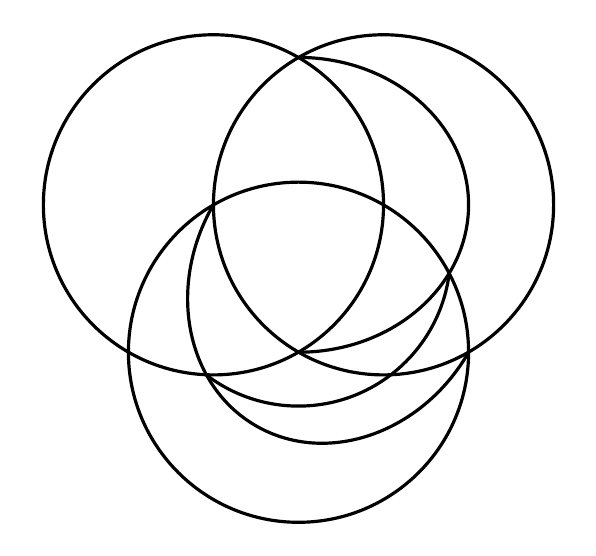
References: There are very many references here, however we are including only the latest one (which contains many of the other references).
Semi-invariant pictures and two conjectures about maximal green sequences. arXiv:1503.07945 (Thomas Brustle, Stephen Hermes, Kiyoshi Igusa, GT)
14:15–15:05 (local time) · Goldsmith 300.
Abstract
Abstract. The Gaussian Unitary Ensemble (GUE) consists of matrices with independent complex Gaussian entries, constrained by Hermitian symmetry. It is usually studied with respect to the statistics of its eigenvalues, but several seemingly unrelated properties of the GUE gain simultaneous explanations from the fact that the singular values of the ensemble can be decomposed as the union of two independent sets of singular values of ensembles of Laguerre type. These constituent matrices have nominal half-integer size, but can also have concrete sparse models, through which we can observe facts about the determinant of the GUE. In this talk, I will describe the decomposition, discuss some of the properties the decomposition explains, and outline how the decomposition is related to a combinatorial identity involving the enumeration of orientable maps.
14:15–15:05 (local time) · Goldsmith 300.
Abstract
Abstract. The oriented exchange graph of a quiver (i.e. a directed graph) describes sequences of local transformations of quiver. The maximal directed paths in an oriented exchange graph of finite length are in bijection with maximal green sequences, which are of interest to representation theorists and string theorists. In addition, the class of oriented exchange graphs contains interesting families of partially ordered sets including the Tamari lattices. We model oriented exchange graphs combinatorially, using what we call an oriented flip graph, where quivers correspond to collections of noncrossing arcs in a disk and mutation corresponds to moving between such noncrossing collections. We show that oriented flip graphs are semidistributive, congruence uniform, and polygonal lattices. No background on quivers will be assumed. This is joint work with Thomas McConville.
14:15–15:05 (local time) · Goldsmith 300.
Abstract
Abstract. My intention is to talk about a very broad and active research area through a particular example: genus one curves with n marked points. I will show, through this example, how very classical algebraic geometry often manifests itself in the modern study of moduli spaces. Shiny new results will be discussed, but old gems will also appear, so this talk will be accessible to many. Many of the results are joint with Dawei Chen.
14:15–15:05 (local time) · Goldsmith 300.
Abstract
Abstract. There are several questions about the zero set of Laplace eigenfunctions that have proved to be extremely hard to deal with and remain unsolved. Among these are the study of the size of the zero set, the study of the number of connected components, and the study of the topology of such components. A natural approach is to randomize the problem and ask the same questions for the zero sets of random linear combinations of eigenfunctions. In this talk I will present some recent results in this direction.
14:15–15:05 (local time) · Goldsmith 300.
Abstract
Abstract. One often hears that there is a relationship between the locations of the zeros of the Riemann zeta function and the distribution of the prime numbers among the natural numbers. Indeed, the Riemann Hypothesis predicts the location of the zeros of zeta, which has implications for the distribution of the prime numbers. The main goal of this talk is to show that this relationship may be made quite explicit through what is known as an "explicit formula." This will be done using basic tools of complex analysis. With what time remains, we will indicate how to generalize this setup to arithmetic objects other than the prime numbers.
14:15–15:05 (local time) · Goldsmith 300.
Abstract
Abstract. I will explain the concept of vanishing cycles. Using the l-adic Fourier transformation, I illustrate how to calculate the monodromy of vanishing cycles for some isolated singularities.
14:15–15:05 (local time) · Goldsmith 317.
Abstract
Abstract. The geodesic flow of a compact hyperbolic Riemannian manifold is a classical object of study, and arguably an origin story for the study of ergodic theory and chaotic dynamical systems. Geodesic flows arising from natural generalizations of the notions of compact, Riemannian, and hyperbolic have entertained dynamicists since the 1930s, and research around the study of geodesic flows remains active today.
In this talk, I will introduce the audience to the world of Hilbert geometries, which can be thought of as a generalization of Riemannian geometries. In particular, compact, nonstrictly convex Hilbert geometries in three dimensions have a fascinating geometric irregularity which creates major barriers for the study of geodesic flows. Many classical techniques are no longer applicable, such as those used for nonuniformly hyperbolic systems, rank one manifolds, and CAT(0) spaces. Nonetheless, by pushing the limits of the geometry, we are able to prove many hyperbolic dynamical results. These results culminate in the construction of a measure of maximal entropy which is ergodic for the geodesic flow.
14:15–15:05 (local time) · Goldsmith 300.
Spring 2015
9 talks
Abstract
Abstract. Homological mirror symmetry conjecture asserts an equivalence between the category of Lagrangian submanifolds and the category of coherent sheaves of the mirror. The conjecture has been verified in several interesting cases by computing generators and relations of the categories. However such a computational approach hardly explains why homological mirror symmetry exists in general. In this talk I will introduce a mirror construction which always comes with a functor between the two categories. It produces mirrors which are not reachable by the SYZ construction, and is naturally connected with non-commutative geometry.
15:30–16:50 (local time) · Goldsmith 226.
Abstract
Abstract. Quantum groups, quantum cluster algebras, and their categorifications Abstract: At the heart of the definition of a quantum cluster algebra is a deep conjecture that the recursively, combinatorially defined cluster monomials of a conjectural quantum cluster algebra structure are elements of the (dual) canonical basis of a quantum group. In this talk I will describe a proof of this “dual canonical basis conjecture" in the special case of acyclic, skew-symmetric quantum cluster algebras by relating the categorifications on either side of this picture. 
15:30–16:50 (local time) · Goldsmith 226.
Abstract
Abstract. Consider the set of knots in the 3-sphere. There are a number of four-dimensional equivalence relations on knots, which have interesting implications towards the study of 4-manifolds. The most well-studied of these is the relation called concordance, under which knots form an abelian group; knots concordant to the trivial knot are said to be slice. We study a generalization of concordance, called shake concordance; in this realm, the analogue for slice knots are called shake slice knots. Any slice knot is shake slice, but the converse is unknown. We construct infinite families of knots that are pairwise shake concordant but not concordant. We also give a complete characterization of shake concordant and shake slice knots in terms of concordance, which allows us to construct new infinite families of shake slice knots. (This is a joint project with Tim Cochran.)
15:30–16:50 (local time) · Goldsmith 226.
Abstract
Abstract. For each odd prime p, there is a formal Hecke operator Tp: Z/2[[x]] -> Z/2[[x]]. The mod 2 reductions of modular forms give rise to certain Tp stable subspsaces of Z/2[[x]]. Nicolas and Serre have analyzed the action of the Tp on a space attached to level 1 forms. Their space is spanned by the odd powers of x+x^9+x^25+x^49+... . They show that the Hecke algebra arising is a power series ring in T3 and T5.
I'll sketch an alternative proof and present related results on some spaces attached to level 3 forms. One of the Hecke algebras I get is a power series ring in T7 and T13 with an element of square 0 adjoined. My arguments are not technical, and the talk should be accessible.
15:30–16:50 (local time) · Goldsmith 226.
Abstract
Abstract. A recursion operator on a polynomial algebra over a field is a linear operator T: F[y] -> F[y] so that the images of powers of y satisfy a linear recurrence over F[y]. Suppose every polynomial f in F[y] is killed by some power of T, and write N(f) for the least such power. We will analyze the growth of this nilpotence index N(y^n) in the case that F has characteristic p, and describe applications to determining the structure of Hecke algebras acting on modular forms modulo p. The main result uses elementary methods only, and the talk should be accessible to a wide audience.
15:30–16:50 (local time) · Goldsmith 226.
Abstract
Abstract. This talk will be about random lozenge tilings of a class of planar domains which I like to call ``sawtooth domains.'' The basic question is: what does a random lozenge tiling of a large sawtooth domain look like? At the first order of randomness, a remarkable form of the law of large numbers emerges: the tiling separates into "frozen" and "liquid" phases separated by an "arctic curve." I will discuss the next order of randomness, in which one wants to analyze fluctuations of tiles near a turning point of the arctic curve. Quite remarkably, this analytic problem can be solved in an essentially combinatorial way, using a desymmetrized version of the double Hurwitz numbers from enumerative algebraic geometry.
15:30–16:50 (local time) · Goldsmith 226.
Abstract
Abstract. I will discuss joint work with Lionel Levine and Wesley Pegden. The Abelian sandpile is a model for "self-organized criticality" that generates approximations of striking fractal images on periodic graphs. Our work explains the appearance of these images: the scaling limit of the sandpile is a nonlinear partial differential equation with unexpected algebraic structure. I will discuss some older work on the square lattice as well as recent work on more general graphs.
15:30–16:50 (local time) · Goldsmith 226.
Abstract
Abstract. Certain knot invariants coming from the Seifert matrix and Alexander polynomial of a knot have interesting number-theoretic structure. I'll explain how a classical construction of knot invariants that are ideal classes of rings fits into the context of Bhargava and Gross's arithmetic invariant theory.
I'll then discuss the following related asymptotic counting question: on the set of knots with squarefree Alexander polynomial of fixed degree and bounded height, our ideal class invariant can take on only finitely many values -- how many? This is a quantitative version of the question "how much additional information is contained in the Seifert matrix that is not captured by the Alexander polynomial?" It also has consequences in higher-dimensional knot theory, where Kearton, Levine, and Trotter identified an important class of knots, the "simple knots", which are entirely classified by higher-dimensional analogues of our invariants.
15:30–16:50 (local time) · Goldsmith 226.
Abstract
Abstract. Methods of equivariant topology have been successfully applied in recent years to a variety of problems in geometric combinatorics, particularly to those concerning measure equipartitions (generalizations of the ham sandwich Theorem: any d masses in Rd can be bisected by a single hyperplane) and point partitions of a Tverberg-type (generalizations of Radon’s theorem: any d + 2 points in Rd can be partitioned into two sets with overlapping convex hulls). Reformulating these problems and their topological reductions in terms of harmonic analysis on finite groups, we will show how a variety of new partition theorems can be obtained as the annihilation of prescribed Fourier transforms.
15:30–16:50 (local time) · Goldsmith 226.
Fall 2014
9 talks
Abstract
Abstract. Let \(G=SL(2,\mathbb{R})\ltimes R^2\) and \(\Gamma=SL(2,Z)\ltimes Z^2\). Building on recent work of Strombergsson we prove a rate of equidistribution for the orbits of a certain 1-dimensional unipotent flow of \(\Gamma\backslash G\), which projects to a closed horocycle in the unit tangent bundle to the modular surface. We use this to answer a question of Elkies and McMullen by making effective the convergence of the gap distribution of sqrt n mod 1.
14:00–15:20 (local time) · Goldsmith 226.
Abstract
Abstract. According to F. Klein's Erlanger program geometry is the study of those properties of a space M, which are invariant under the action of a group G. When M is a smooth manifold and G is a Lie group which acts transitively on M, then M can be identified with the quotient space G/H, where H is the isotropy subgroup of a fixed point p of M. In this case, and under some assumptions, the geometry of the space M (e.g. curvature or geodesics) reduces to the study of the pair (g, h), where g, h are the Lie algebras of G and H respectively. In the first part of the talk I will give some details on the theory of homogeneous spaces and Lie groups and then I will discuss some recent results on homogeneous Einstein metrics on two important class of homogeneous spaces, namely flag manifolds and Stiefel manifolds.
14:00–15:20 (local time) · Goldsmith 226.
Abstract
Abstract. Quiver mutation is a combinatorial process with several striking connections to diverse areas of mathematics including (among others) representation theory, mathematical physics, and geometry. Maximal green sequences are particular sequences of quiver mutations originally introduced by Keller in order to give a combinatorial description of the (refined) DT-invariants of 3-Calabi-Yau categories. Little is known about the enumeration of maximal green sequences in general. In particular, it is unknown if any quiver admits only finitely many maximal green sequences. This talk is a report on work in progress with Brüstle, Igusa, and Todorov to interpret maximal green sequences in terms of the invariant theory of quiver varieties using ``semi-invariant pictures.'' Using the geometry of these pictures we give an alternative proof of a theorem of Brüstle-Dupont-Pérotin stating that so-called ``tame'' quivers admit only finitely many maximal green sequences.
14:00–15:20 (local time) · Goldsmith 226.
Abstract
Abstract. Mahler numbers originate in works of Kurt Mahler on transcendence. Their Diophantine properties have a surprising link with theoretical computer science. We will discuss the state of the art as well as the recent advancements in this area.
14:00–15:20 (local time) · Goldsmith 226.
Abstract
Abstract. What is the canonical way to choose a random, discrete, two-dimensional manifold which is homeomorphic to the sphere? One procedure for doing so is to choose uniformly among the set of surfaces which can be generated by gluing together \(n\) Euclidean squares along their boundary segments. This is an example of what is called a random planar map and is a model of what is known as pure discrete quantum gravity. Another canonical way to choose a random, two-dimensional manifold is what is known as Liouville quantum gravity (LQG), which corresponds to the random surface whose metric when parameterized in isothermal coordinates is formally described by \(e^{\gamma h}(dx^2+dy^2)\) where \(h\) is an instance of the Gaussian free field.
In this talk, I will describe various relationships between these discrete and continuum models for random surfaces (some conjectural, some now proved) as well as a related and new universal family of growth processes called quantum Loewner evolution (QLE). I will also explain how QLE is related to DLA, the dielectric breakdown model, and the Schramm-Loewner evolution.
Based on joint works with Scott Sheffield.
14:00–15:20 (local time) · Goldsmith 226.
Abstract
Abstract. Let \(M_g\) be the moduli space of connected smooth genus g curves, a fundamental object in both algebraic geometry and topology. I will discuss what is known about its cohomology ring \(H^*(M_g)\), focusing on a subring \(RH^*(M_g)\) (known as the tautological ring) defined by Mumford in analogy with the cohomology of Grassmannians. There are two competing conjectural descriptions of the structure of this subring. I will also describe the analogous situation when \(M_g\) is replaced by its compactification, the moduli space of Deligne-Mumford stable curves.
14:00–15:20 (local time) · Goldsmith 226.
Abstract
Abstract. Lian and Yau developed a global Poincare residue formula to study period integrals of families of complex manifolds, and used it to construct canonical PDE systems for period integrals. The notion of a CY bundle is a crucial ingredient in their construction. The idea is to lift line bundles from a manifold X to some larger space (a CY bundle) over X. A question was therefore raised as to whether there exists such a bundle that supports the lifting of all line bundles from X simultaneously. We give partial solutions to this problem. We also discuss the classification of CY bundles. This is a joint work with Bong H. Lian.
14:00–15:20 (local time) · Goldsmith 226.
Abstract
Abstract. The study of unitary representations is an important and active area in representation theory. We will discuss a related object, that of signature characters. We will see what information these invariants encode, as well as how they relate to unitarity. As an explicit example, we will consider the quantum group of type \(A\), for \(|q|=1\). We will discuss a technique for computing signature characters of highest weight representations, which relies on the combinatorics of the Gelfand-Tsetlin bases. As an application, we recover some known results in the classical limit \(q=1\) that were obtained by different means. We also obtain some information about unitarity for arbitrary \(q\). We will also briefly discuss other situations in which one may compute signature characters by harnessing combinatorial structures of representations. We will define all the necessary terms, and provide enough background to be accessible to a general audience.
14:00–15:20 (local time) · Goldsmith 226.
Abstract
Abstract. We consider an analytic curve \(\varphi: I \rightarrow \mathbb{M}(n\times m, \mathbb{R}) \hookrightarrow \mathrm{SL}(n+m, \mathbb{R})\), embed it into some homogeneous space \(G/\Gamma\), and translate it via some diagonal flow \(\{a(t): t > 0 \} < \mathrm{SL}(n+m,\mathbb{R})\). Under some geometric conditions on \(\varphi\), we prove the equidistribution of the evolution of the translated curves \(a(t)\varphi(I)\) in \(G/\Gamma\), and as a result, we prove that for almost all points on the curve, the Dirichlet's theorem can not be improved. This is a joint work with Nimish Shah.
14:00–15:20 (local time) · Goldsmith 226.
Spring 2014
7 talks
Abstract
Abstract. The main purpose of this project to explain my work to people at Brandeis University by removing the representations of quivers from the definitions. Many of the theorems that I and co-authors have proven for any Dynkin quiver (or more generally for finite convex subsets of the preprojective or preinjective partition of the Auslander-Reiten quiver of any modulated quiver without oriented cycles) can, in the special case of \(A_n\) with straight orientation, be presented purely combinatorially.
I will define the category NP(n) with noncrossing partitions as objects and binary forests (unions of binary trees) as morphisms. I will use CAT(0) spaces to show that the classifying space of this category is a \(K(\pi,1)\): It is a finite cubical complex where the link of every vertex is a flag complex. I will explain using examples what this means.
The fundamental group of BNP(n) is very easy to describe. The explicit construction of its classifying space allows for the computation of the cohomology of the group. It is free abelian in every degree with rank given by the ballot numbers.
This is based on 2 joint works. One with Kent Orr, Jerzy Weyman and Gordana Todorov, another with Gordana Todorov.
14:00–15:20 (local time) · Goldsmith 226.
Abstract
Abstract. The talk is about 2D probabilistic systems which can be analyzed by algebraic methods. Known examples of such systems include random stepped surfaces, six-vertex model ("square ice"), spectra of random matrices, interacting particle systems (e.g.TASEP), and directed polymers in 2d random media.
Modern results make us believe that all these systems have similar asymptotic behavior which can be described via new (as compared to the classical 1d case) limit objects. These objects are the Gaussian Free Field and Tracy-Widom distributions.
Although we are far from checking the universality of such behavior, for a certain class of distributions it can be proved. Many rigorous mathematical results in this direction are based on the relations to the symmetric functions of representation-theoretic origins and, more generally, to representations of infinite-dimensional groups.
14:00–15:20 (local time) · Goldsmith 226.
Abstract
Abstract. The first part of the talk will explain how problems linear algebra can often naturally be interpreted in the language of representation theory. The simplest classical example is the correspondence between linear operators and K[x]-modules, where K is a field and x a variable. We will also examine some related geometric constructions such as representation spaces of algebras.
In the second part we will focus on various notions of "finiteness" for classification problems in linear algebra, now using the language of representation theory.
14:00–15:20 (local time) · Goldsmith 226.
Abstract
Abstract. The classical reduction theory of integral quadratic forms was developed by Hermite, Minkowski, Siegel and many others. It is known that a non-degenerate integral quadratic form in n variables is integrally equivalent to a form whose height (the maximum value of the coefficients) is less than its determinant (up to a multiplicative constant), and whose value at (1, 0,...0) is less than the n-th root of its determinant. However, for indefinite forms in at least 3 variables it turns out that neither of the estimates is optimal. In this talk we will discuss some classical results and recent effort in improving these estimates. This is a joint work with Prof. Margulis.
14:00–15:20 (local time) · Goldsmith 226.
Abstract
Abstract. Given a sequence of topological spaces Xn we associate a sequence of rational vector spaces Hi(Xn;Q): the ith rational cohomology group of Xn. We will discuss how these spaces change as the parameter n grows.
In the first part of this talk we will consider the configuration space of n ordered and unordered points in the plane to illustrate two possible stability situations. Other examples such as the moduli space of Riemann surfaces and the pure mapping class group will also be discussed. In the second part of the talk, I will introduce the notion of a finitely generated FI-module and show how it explains the behavior of the examples considered before.
14:00–15:20 (local time) · Goldsmith 226.
Abstract
Abstract. I'll describe in this talk some motivation for a recent construction of bordered monopole Floer homology (joint work with Jon Bloom). I'll start with a discussion of the classical Jones polynomial of a knot in the 3-sphere. I'll then introduce Khovanov homology, a more sophisticated homological knot invariant which encodes the Jones polynomial but is a stronger invariant in general. In particular, Khovanov homology detects the unknot, whereas the analogous question for the Jones polynomial remains open. This fact was proven using a relationship between Khovanov homology and an even more sophisticated invariant of knots called instanton Floer homology. I'll survey the known relationships between the Khovanov homology of knots and the Floer homology of knots and 3-manifolds. I'll then describe how these sorts of relationships, combined with work of Khovanov on tangle invariants, has motivated a recent construction of bordered monopole Floer homology, which provides invariants of 3-manifolds with parametrized boundary and a pairing formula for computing the monopole Floer homology of a closed 3-manifold from the invariants associated to its pieces.
14:00–15:20 (local time) · Goldsmith 226.
Abstract
Abstract. The local Langlands correspondence for GL(n) gives a direct relationship between certain representations of the group \(GL_n(K)\) on p-adic vectors spaces, where K is a non-Archimedean local field of residue characteristic different from p, and n-dimensional p-adic representations of the Galois group Gal(K-bar/K). The proof given by Harris and Taylor illuminates one beautiful aspects of the story: the local correspondence can be realized in the cohomology of certain algebraic varieties.
When K itself is a p-adic field, however, the GL(n)-side of the correspondence is much too coarse to capture some of the intricate behavior on the Galois side. The enriching of the GL(n)-side forms the emerging p-adic Langlands program. The necessary modifications were worked out for n = 2, and K the p-adic number themselves, by Breuil, Colmez, Emerton, Paskunas and many more. The correspondence can be realized inside Emerton's p-adically completed cohomology.
In this talk I will report progress towards conjectures of Christophe Breuil and Florian Herzig (2012) which give a precise prediction on GL(n)-representations appearing inside the cohomology of certain towers of arithmetic manifolds. This represents (very) partial progress towards a formulation of a p-adic local Langlands correspondence beyond the case of GL(2) over the p-adic numbers. Some of our progress was independently by Breuil and Herzig.
This is all joint with Przemyslaw Chojecki.
14:00–15:20 (local time) · Goldsmith 226.
Fall 2013
7 talks
Abstract
Abstract. The sandpile group \(Pic^0(G)\) of a finite graph G is a discrete analogue of the Jacobian of a Riemann surface which was rediscovered several times in the contexts of arithmetic geometry, self-organized criticality, random walks, and algorithms. The order of \(Pic^0(G)\) is equal to the number of spanning trees of G, and so one might ask whether there’s any natural way to define a free, transitive action of \(Pic^0(G)\) on the set of spanning trees.
Holroyd et al. give one possible way to answer this question: given a ribbon graph G, they use the ”rotor-routing” model to define a free and transitive action of \(Pic^0(G)\) on the set of spanning trees of G. However, a priori their construction depends on a choice of basepoint vertex. We prove that the action of \(Pic^0(G)\) is independent of the basepoint if and only if G is a planar ribbon graph, answering a question of Ellenberg. In this talk, I will start by giving an overview of abelian sandpiles, ribbon graphs and the rotor-routing action, and then move on to discuss our main result. This is joint work with Tom Church and Josh Grochow.
14:00–15:20 (local time) · Goldsmith 226.
Abstract
Abstract. In the first half of the talk, I aim to convince you that invariant theory is a beautiful field. This area dates back over 100 years to the work of Hilbert, Klein, Gauss, and many others. It is a very active area of research today, particularly from the viewpoint of algebraic geometry and combinatorics. It also has far reaching applications in representation theory, coding theory, mathematical modeling, and even air target recognition. (I just happened to run across this last application on google; it will *not* be explained.)
In the remainder of this talk, I hope to illustrate the wonders of a new and fast-paced field: noncommutative invariant theory. All basic notions will defined. To say, I will explain the noncommutative analogues of each of the following terms: ”groups”, ”acting on”, and ”polynomial rings”. I will provide an overview of recent work pertaining to Hopf algebra actions on (noncommutative) regular algebras, if time permits. The results discussed here are from joint works with Kenneth Chan, Pavel Etingof, Ellen Kirkman, Yanhua Wang, and James Zhang: see papers arXiv:math/1210.6432, 1211.6513, 1301.4161, 1303.7203.
14:00–15:20 (local time) · Goldsmith 226.
Abstract
Abstract. In this talk, we will discuss some properties of Hodge metric completion of the Teichmuller space of Calabi-Yau manifolds. We will prove that the Hodge metric completion of the Teichmuller space of polarized and marked Calabi-Yau manifolds is a complex affine manifold. We also show that the extended period map from the completion space is injective into the period domain, and that the completion space is a domain of holomorphy and admits a complete Kahler-Einstein metric. This is a joint work with Professor Kefeng Liu and Feng Guan from UCLA.
14:00–15:20 (local time) · Goldsmith 226.
Sources disagree on the date.
Abstract
Abstract. The problem of enumerating discrete orientable surfaces has been introduced by Tutte in the 60s, in his famous ”Census” paper. Although Tutte restricted to specific models of planar maps made of polygons, his techniques can be generalized to obtain functional relations between generating series of maps in all topologies, and also for maps carrying a configuration of standard statistical physics model (Ising, self-avoiding loops, Potts,...).
Solving explicitly those equations is in general very hard for planar maps (i.e. genus 0) with 1 boundary (disks) and 2 boundaries (cylinders). But, once those generating series are known, one can obtain the generating series for all other topologies by a recursion on the Euler characteristics. This recursion takes a universal form, called ”topological recursion”, and is relevant to solve other problems, involving enumerative geometry (I will say a word on ”counting continuous surfaces”) or not (like asymptotic questions in random matrix theory).
A key step to arrive to the solution of Tutte’s equation by the topological recursion is the study of the analytic properties of the generating series of maps, and especially of planar maps with 1 boundary. This also allows a discussion about the way to extract the number of large maps from the solution of the counting problem, via singularity theory. The slogan of this talk will be that the hard part in many ”higher genus” questions actually lies in the ”genus 0” aspects.
14:00–15:20 (local time) · Goldsmith 226.
Abstract
Abstract. We will begin by introducing what is meant by a family or moduli space of representations of a group or algebra, and then exploring these families. Examples will include representations of finite groups and quivers. Along the way, we will observe how homological data/group cohomology control the geometry of the moduli space. We will also explain how such spaces are useful in number theory.
We will then introduce the notion of a pseudorepresentation, and explain how a representation induces a pseudorepresentation, resulting in a map from the moduli space of representations to the moduli space of pseudorepresentations. The rest of the talk will explore the properties of this map. In particular, we will give a theorem describing this map in comparison with geometric invariant theory, and then illustrate this theorem with pictures of fibers of this map. Homological inputs will control these pictures as well!
This talk will also serve as an advertisement for Topics in Algebra (Math 201a), which I will teach in Spring 2014.
14:00–15:20 (local time) · Goldsmith 226.
Abstract
Abstract. In the first part of this talk, we will provide an introduction to symmetric function theory. In particular, we will introduce Macdonald polynomials and discuss some of the famous subfamilies one obtains as limiting cases. We will then provide some well-known examples of “branching rules”, emphasizing the connection between representation theory and combinatorics.
In the second part of the talk, we will discuss some \((q,t)\)-generalizations of branching rules for Schur functions which were proved by Rains and Vazirani using Hecke algebra techniques. Their approach does not work directly at \(q=0\) (the Hall-Littlewood level). We discuss a technique that is more combinatorial in nature, and leads to various generalizations at \(q=0\) as well as a finite-dimensional analog of a recent summation formula of Warnaar. We will explain how this method can be adapted to give an explicit construction of Hall-Littlewood polynomials of type BC. We will also briefly explain how some of these results may be interpreted (and proved) using p-adic representation theory.
14:00–15:20 (local time) · Goldsmith 226.
Abstract
Abstract. I will give an introduction to vertex algebras and show how they arise naturally in the representation theory of infinite-dimensional Lie algebras. Given a simple, strongly finitely generated (SFG) vertex algebra A and a reductive group G of automorphisms of A, the Hilbert problem asks whether the invariant subalgebra \(A^G\) is also SFG. This is a subtle phenomenon that depends sensitively on the nonassociativity of vertex algebras. I will sketch my recent proof of this fact for any G when A is a free field algebra or an affine vertex algebra at generic level.
14:00–15:20 (local time) · Goldsmith 226.
Spring 2013
8 talks
Abstract
Abstract. The Sato-Tate conjecture is concerned with the statistical distribution of the number of points on the reduction modulo primes of a fixed elliptic curve defined over the rational numbers. It predicts that this distribution can be explained in terms of a random matrix model, using the Haar measure on the special unitary group \(\mathrm{SU}(2)\). Thanks to recent work by Richard Taylor and others, this conjecture is now a theorem.
The Sato-Tate conjecture generalizes naturally to abelian varieties of dimension g, where it associates to each such abelian variety a compact subgroup of the unitary symplectic group \(\mathrm{USp}(2g)\), the Sato-Tate group, whose Haar measure governs the distribution of certain arithmetic data attached to the abelian variety. While the Sato-Tate conjecture remains open for all \(g>1\), I will present recent work that has culminated in a complete classification of the Sato-Tate groups that can arise when \(g=2\). I will also describe extensive numerical computations that support the conjecture, along with animated visualizations of this data.
This is joint work with Francesc Fité, Victor Rotger, and Kiran S. Kedlaya.
14:00–15:20 (local time) · Goldsmith 226.
Abstract
Abstract. The study and construction of p-adic families of modular forms goes back to observations and work of Dwork, Katz and Serre in the 1970s. These families (rather, their later incarnations due to Hida and Coleman-Mazur) have either directly, or indirectly, been responsible for amazing progress in algebraic number theory during the last half of the 20th century and the first decade of the 21st. In the first half of the talk I want to give an overview on how one constructs such families beginning from congruences between modular forms. In the second half, I hope to indicate how the geometry of such families can detect subtle arithmetic information about modular forms. No general background will be assumed and we will keep running examples of the basic phenomena we encounter throughout the talk.
14:00–15:20 (local time) · Goldsmith 226.
Abstract
Abstract. We extend the theory of simultaneous Diophantine approximation to infinite dimensions. Moreover, we discuss Dirichlet-type theorems in a very general framework and define what it means for such a theorem to be optimal. Optimality is implied by but does not imply the existence of badly approximable points.
16:30 (local time) · Goldsmith 317.
Abstract
Abstract. Wigner stated the general hypothesis that the distribution of eigenvalue spacings of large complicated quantum systems is universal in the sense that it depends only on the symmetry class of the physical system but not on other detailed structures. The simplest case for this hypothesis concerns large but finite dimensional matrices. Spectacular progress was done in the past two decades to prove universality of random matrices presenting an orthogonal, unitary or symplectic invariance. These models correspond to log-gases with respective inverse temperature 1, 2 or 4.
I will review some historical aspects of this problem and report on a joint work with L. Erdős and H.-T. Yau, which yields universality for log-gases at arbitrary temperature at the microscopic scale.
14:00–15:20 (local time) · Goldsmith 226.
Abstract
Abstract. Let A be an abelian variety of dimension g defined over a number field F. For a prime \(\ell\) we can consider the field \(F(A[\ell^\infty])\), which is an extension of F generated by coordinates of \(\ell\)-powered torsion points of A. While the structure of this field is of interest in its own right, such fields also may help illuminate part of the structure of the absolute Galois group of F. Of particular interest are cases when \(F(A[\ell^\infty])\) is a pro-\(\ell\) extension of \(F(\mu_\ell)\) and A has good reduction away from \(\ell\).
Unfortunately, abelian varieties satisfying both requirements are relatively rare. In 2008, Rasmussen and Tamagawa conjectured that for a fixed F and g such examples will exist for only a finite number of primes \(\ell\). While the finiteness has since been resolved, if we restrict to the case where A is an elliptic curve with complex multiplication we can in fact show that the bound is uniform over all number fields of degree n.
14:00–15:20 (local time) · Goldsmith 226.
Abstract
Abstract. The set \(Bad(i,j)\) of badly approximable vectors with weight \(0\le i,j\le 1,\ i+j=1\) is a measure zero set. Motivated by Jinpeng An’s recent proof of the fact that \(Bad(i,j)\) is a winning set in the sense of Schmidt’s game, we describe a variant of Schmidt’s game and show that \(Bad(i,j)\) is actually winning for the new game. This enables us to generalize results about the intersection of \(Bad(i,j)\) with fractals and \(C^1\)-incompressibility.
14:00–15:20 (local time) · Goldsmith 226.
Abstract
Abstract. An old question of Serre (which also appeared in Deligne’s Weil II) asks whether the \(\ell\)-adic Betti number in the odd degree of any proper smooth variety over a field is necessarily even. I’ll explain the origin of the question, give an answer in the affirmative, and then discuss a more refined question subsequently raised by Serre and Katz.
14:00–15:20 (local time) · Goldsmith 226.
Abstract
Abstract. The well-known Chebotarev’s density theorem (1922), a far-reaching generalization of Dirichlet’s theorem on primes in arithmetic sequences and the most beautiful present ever given to algebraic number theory by its analytic sister, states that the proportion of prime numbers, up to a real number x, which decomposes in a certain way in a fixed finite Galois extension L of \(\mathbb{Q}\) of Galois group G, is asymptotically equal, when x becomes large, to the quotient \(|D|/|G|\), when D is a certain subset of G invariant by conjugation which depends of the type of decomposition envisaged. Under the generalized Riemann hypothesis (GRH) this theorem has both a simple and natural proof, very close in spirit to Dirichlet’s original proof of his theorem, and an elegant effective version, with an explicit error term depending on a quantity, that I’ll call the Littlewood complexity of D and denote by \(\lambda(D)\), which measures how hard it is to describe D spectrally, that is in terms of of the complex representations of G.
In the first part of the talk, I will recall the precise statement and the proof of that effective version of Chebotarev’s density theorem. I will assume no prior knowledge of the density theorem nor of analytic number theory. In the second part, I will study the properties of the Littlewood complexity \(\lambda(D)\), and give many applications (to the theory of primes in arithmetic sequence, to the Lang-Trotter’s conjecture and its generalizations, etc), some old ones due to Serre and Murty and Murty revisited with that new point of view, and some new ones. If time allows, I will discuss in a short third part the question of whether one can go beyond GRH and formulate an even stronger, yet still plausible, effective form of the density theorem.
14:00–15:20 (local time) · Goldsmith 226.
Fall 2012
9 talks
Abstract
Abstract. Remember how you studied series in calculus and decided which series converge and which diverge? Even though this is classical math known to people for centuries, some new stuff can be done here! In this talk we analyze several classical tests for convergence/divergence of number series and relax the monotonicity assumption for the sequence of terms of the series. We check the sharpness of the obtained results on corresponding classes of sequences and functions.
Joint work with S. Tikhonov and M. Zeltser. The talk is suitable for undergraduates, no prerequisites beyond calculus are needed.
14:00–15:20 (local time) · Goldsmith 226.
Abstract
Abstract. This is a survey talk about my results (joint work with Gordana Todorov). First, I will go over the known general facts and partial definitions for cluster categories of acyclic type. These come from representations of quivers over a field K. I explain briefly the cluster categories coming from surfaces. Our approach requires \(\operatorname{char}K\) is not 2. Cluster structures are defined in terms of the (algebraic) triangulated structure of the cluster category. They are also given by (geometric) triangulations of a surface. I will repeat those parts of the definitions that I need.
By “string theory” I am talking about certain categories of locally free coherent sheaves on a quasi-projective variety. (Kontsevich’s definition of a D-brane of type B.) Then I will localize to one point and take the “super” version to obtain a cluster category of type A. (Assuming the ground field K has a square root of -1.) By super I mean \(\mathbb{Z}/2\)-graded Hom sets.
This talk will not have all the definitions and not have proofs. It is the story of how I became interested in string theory.
14:00–15:20 (local time) · Goldsmith 226.
Abstract
Abstract. The Geometric Satake Equivalence is an equivalence of categories between the representations of a semisimple lie algebra \(\mathfrak{g}\) and some geometrically defined category (of perverse sheaves). These are both difficult categories to get a handle on, and the usual proofs of this equivalence are far from explicit. Thankfully, both these nasty categories have subcategories which can be made explicit and combinatorial in a nice way (in type A). In other words, the morphism algebras of these subcategories can be given simply by generators and relations. This makes it easy to give a straightforward proof of the equivalence of these subcategories, and hence of the original categories. If you ever wanted to get your hands dirty with Geometric Satake, this is a useful tool.
Moreover, the morphism algebras above admit \(q\)-deformations, leading to a Quantum Algebraic Satake Equivalence (with no geometry, at the moment). What is Satake-equivalent to representations of quantum \(\mathfrak{sl}_2\) at a root of unity? Come and find out.
14:00–15:20 (local time) · Goldsmith 226.
Abstract
Abstract. The method of Chabauty and Coleman gives us a way of finding rational points on certain curves by looking at p-adic line integrals. We will discuss these p-adic integrals and describe how they can be computed in practice. In particular, we will discuss recent work with Ishai Dan-Cohen, Minhyong Kim, and Stefan Wewers aimed at understanding integral points on hyperbolic curves.
14:00–15:20 (local time) · Goldsmith 226.
Abstract
Abstract. The Mordell constant of a d-dimensional unimodular lattice is defined to be \(2^{-d}\sup\operatorname{vol}(V)\), where V ranges over all symmetric boxes with sides perpendicular to the axes, containing no nonzero lattice points. The Mordell Gruber spectrum is the set of all possible values for this constant, over all lattices in dimension d. In joint work with Uri Shapira we give a dynamical interpretation of the Mordell constant in terms of the action of the diagonal group on the space of lattices, and use dynamical results for this action to obtain new information about the spectrum.
14:00–15:20 (local time) · Goldsmith 226.
Abstract
Abstract. Generalized complex geometry (GCG), introduced by Hitchin in 2002, is defined in such a way as to include both symplectic and complex geometry. After reviewing the basics and motivations of GCG, I will explain how it helps in classifying string theory solutions. For example, when the spacetime factorizes as \(M_{10}=\mathrm{Mink}_4\times M_6\), where \(\mathrm{Mink}_4\) is flat Minkowski space, then \(M_6\) has to be a “generalized complex” manifold. I will finally sketch recent work on more general spacetimes \(M_{10}\), where new geometrical structures arise, involving more exotic G-structures.
14:00–15:20 (local time) · Goldsmith 226.
Abstract
Abstract. Measurable graph theory lies on the crossroads of combinatorics and ergodic theory. Measurable graphs (a.k.a graphings) arise naturally from measure preserving group actions, and they are also a central concept in the theory of graph limits. In the first part of the talk I will survey known results and important open problems in this field.
In the second part I will concentrate on the existence of perfect matchings in graphings. On one hand this is related to constant time distributed algorithms for finding matchings in finite graphs. On the other hand it turns out to be crucial in generating random perfect matchings in non-amenable Cayley graphs. At the heart of the proof is a combinatorial theorem stating that in an expander graph one can always find short augmenting paths. I will also show that any infinite Cayley graph has a perfect matching. These results together imply that in fact any Cayley graph has a translation invariant probability distribution on its perfect matchings.
14:00–15:20 (local time) · Goldsmith 226.
Abstract
Abstract. A Reye congruence is a certain set of lines defined by quadrics. In dimension three, it describes a special type of Enriques surface. We consider Reye congruences in dimension four to have Calabi-Yau threefolds, and show that every Reye congruence X comes with another Calabi-Yau threefold Y which has the same Hodge numbers but is not birational to X. We discuss mirror symmetry for X and Y, and obtain some concrete predictions for the so-called BPS numbers.
This is based on my collaboration with Hiromichi Takagi, “Mirror symmetry and projective geometry of Reye congruences I” (to appear in J.Alg.Geom.).
14:00–15:20 (local time) · Goldsmith 226.
Abstract
Abstract. I’ll explain the classical idea of quantization on Fock space via Costello’s renormalization scheme, and some geometric applications to topological string theory on Calabi-Yau manifolds.
14:00–15:20 (local time) · Goldsmith 226.
Spring 2012
8 talks
Abstract
Abstract. For two polynomials \(G(X),H(Y)\) with rational coefficients, when does \(G(X)=H(Y)\) have infinitely many solutions over the rationals? Such G and H have been classified in various special cases by previous mathematicians. A theorem of Faltings (the Mordell conjecture) states that we need only analyze curves with genus at most 1.
In my thesis (and more recent work), I classify \(G(X)=H(Y)\) defining irreducible genus zero curves. In this talk I’ll present the infinite families which arise in this classification, and discuss the techniques used to complete the classification.
I will also discuss in some detail the examples of polynomial which occur in the classification. The most interesting infinite family of polynomials are those \(H(Y)\) solving a Pell Equation \(H(Y)^2-P(Y)Q(Y)^2=1\). It turns out to be difficult to describe these polynomials more explicitly, and yet we can completely analyze their decompositions, how many such polynomials there are of a fixed degree, which of them are defined over the rationals (as opposed to a larger field), and other properties.
14:00–15:20 (local time) · Goldsmith 226.
Abstract
Abstract. Fix a prime \(l>3\); for each \(j\in\mathbb{Z}/l\), let \(\phi_j\in\mathbb{Z}/2[[x]]\) be the sum of the terms \(x^{n^2}\) when n runs over the integers in the congruence class j. I’ve studied the ideal of polynomial relations between the \(\phi_j\), getting an almost precise description of this ideal, and a good picture of the affine variety consisting of its zeros. The variety is a curve C of degree \(l(l-1)(l+1)/24\) admitting \(G=\mathrm{PSL}_2(\mathbb{Z}/l)\) as a group of affine automorphisms. G acts transitively on the \(l+1\) singular points of C, and a non-singular projective model of C is the characteristic 2 modular curve \(X(l)\) of genus \((l-1)(l-5)(l+2)/24\). (For example when \(l=5\), C is the rational plane quintic \(x^5+y^5+xy+(xy)^2=0\), with 6 nodes). Along the way I show that \(x+x^9+x^{25}+x^{49}+\cdots\) is a polynomial in the \(\phi_j\); such identities play an important part in my argument.
14:00–15:20 (local time) · Goldsmith 226.
Abstract
Abstract. Let G be a group acting by isometries on a Gromov hyperbolic space X (for example, standard hyperbolic space \(X=\mathbb{H}^{k+1}\) ). We consider the Diophantine approximation of a radial limit point η by points of the form \(g(\xi)\), where ξ is a fixed reference point on the limit set of G. Our results generalize the work of many authors, in particular Patterson (’76) who proved most of our results in the case that G is a geometrically finite Fuchsian group of the first kind and ξ is a parabolic limit point.
Our first result is a Dirichlet-type theorem, stating that any radial limit point η has a sequence of “good approximations” \(g_n(\xi)\). Next, we demonstrate that the Dirichlet function is optimal by showing that the badly approximable points are of full Hausdorff dimension in the radial limit set. In fact, we show that the set of badly approximable points is absolute winning in the sense of McMullen (’09) on certain subsets of the radial limit set with large Hausdorff dimension, which immediately implies the full dimension result.
Our next main result is a Khinchin-type theorem. The measure involved is a quasiconformal measure, constructed using a generalization of the Patterson-Sullivan method due to Coornaert (’93). We show that the measure of points well approximable with respect to a function ψ is null or full, according to whether a certain series converges or diverges which depends on the behavior of the quasiconformal measure near the point ξ. Next, we prove an analogue of the Jarnik-Besicovitch theorem by computing the Hausdorff dimension of the set of points which are well approximable at a certain exponent. The answer turns out to depend on the behavior of pre-Hausdorff measures near ξ.
Using the same techniques, we were also able to show that if \(X=\mathbb{H}^{k+1}\), then the set of badly approximable vectors in the usual sense is of full Hausdorff dimension within the radial limit set.
This project is joint with L. Fishman and M. Urbanski.
14:00–15:20 (local time) · Goldsmith 226.
Abstract
Abstract. Recently, Jean-Pierre Serre and Jean-Louis Nicolas, motivated in part by applications to the question (raised by Ramanujan) of the parity of the partition function, determined the structure of the algebra A generated by the Hecke operators acting on the space of modular forms modulo 2 of level one and all weights: it is an algebra of formal series in two variables over \(F_2\). Serre asked if it was possible to “glue” (in a precise sense that we will explain) all Galois representations attached to individual modular eigenforms into a big Galois representation over A.
After reviewing the basic concepts (modular forms, Hecke operators, Galois representations) involved in the question. we will explain how to answer it affirmatively, and prove several properties (uniqueness, universality) of the constructed Galois representation. We will also discuss some of the applications to the partition function, possible generalizations modulo other primes, and (if time allows) try to explain the significance of the result of Nicolas and Serre in the context of the theory of families of modular forms.
14:00–15:20 (local time) · Goldsmith 226.
Abstract
Abstract. The absolute Galois group of the rationals is known to embed into the Grothendieck-Teichmller group GT. In this talk I will discuss work of Drinfel’d defining GT as a kind of universal braid transformation group acting on quasi-triangular quasi-Hopf algebras. No prior knowledge of these topics will be assumed!
14:00–15:20 (local time) · Goldsmith 226.
Abstract
Abstract. The Charney-Davis conjecture (yes, THAT Charney) is a reformulation of a conjecture of Hopf about the Euler characteristic of a nonpositively curved Riemannian manifold. Incredibly, Charney and Davis showed that their conjecture boils down to a conjecture about the combinatorics of certain simplicial complexes with the homology of sphere. The ”f-vector” of a simplicial complex counts the number of simplices in the complex according to dimension (number of vertices, edges, triangles, etc.). Loosely speaking, the conjecture follows if one can come up with an adequate characterization of the f-vectors of these sorts of simplicial spheres.
I will discuss several approaches to the Charney-Davis conjecture undertaken over the years. In particular, I will describe work of Gal that transforms the question by introducing an invariant derived from the f-vector called the ”gamma vector”. Gal’s conjecture, which implies Charney-Davis, is that this gamma vector always consists of nonnegative integers. As always when faced with a mysterious collection of nonnegative integers, the natural question for the combinatorialist is: What does the gamma vector count?
14:00–15:20 (local time) · Goldsmith 226.
Abstract
Abstract. I will survey some conjectures and statistical results on families of automorphic forms and their L-functions, for instance concerning the equidistribution of local invariants and zeros of L-functions.
14:00–15:20 (local time) · Goldsmith 226.
Abstract
Abstract. Associated to a simply laced Dynkin diagram there is a corresponding affine Lie algebra and a Heisenberg subalgebra. On the Fock space representation of this Heisenberg algebra we construct an action of a braid group. We also categorify this action by constructing functors on a certain category of modules and show that these functors satisfy the braid group relations. This is joint work with S. Cautis and A. Licata.
14:00–15:20 (local time) · Goldsmith 226.
Fall 2011
6 talks
Abstract
Abstract. In a paper from 1973, Garland gave criteria to the vanishing of \(L^2\) cohomologies of lattices in p-adic groups by studying their action on Tits buildings. Later, Ballmann and Swiatkowski and independently Zuk generalized those criteria to groups acting on a simplicial complex. Those criteria regarded only the geometrical properties of the simplicial complex as long as the group action was “good” enough (for instance if the group acted properly discontinuously and cocompactly).
The most famous of those results was Zuk’s criterion for the vanishing of the first \(L^2\) cohomology (which is equivalent to property (T) when the group is locally compact with a countable base). Namely, Zuk proved that a group acting “well” on a two dimensional simplicial complex will have property (T) if the first positive eigenvalue of the graph Laplacian at the link of each vertex of the complex will be strictly larger than 1/2.
In my talk, I’ll present some geometrical intuition to Zuk’s criterion, present two new criteria for (T) property (one of them being a generalization of Zuk’s criterion) and give some examples. If time permits, I’ll mention how those results pass to a group acting on simplicial complex of dimension larger than 2 and present a new vanishing result for all the cohomologies.
14:00–15:20 (local time) · Goldsmith 226.
Abstract
Abstract. This is joint work with Mitya Boyarchenko. We construct a special hypersurface X over a finite field, which has the property of “maximality”, meaning that it has the maximum number of rational points relative to its topology. Our variety is derived from a certain unipotent algebraic group, in an analogous manner as Deligne-Lusztig varieties are derived from reductive algebraic groups. As a consequence, the cohomology of X can be shown to realize a piece of the local Langlands correspondence for certain wild Weil parameters of low conductor.
14:00–15:20 (local time) · Goldsmith 226.
Abstract
Abstract. In a first part we will give an historical account on analogies between Random Matrix Theory and some statistics for L functions, through the contributions of Katz/Sarnak for function fields, Keating/Snaith for moments of L-functions, and Montgomery/Dyson for the repulsion between zeta zeros/eigenvalues at the microscopic scale. The mesoscopic scale will be mentioned in the second part: the analogy remains through non-trivial limiting Gaussian fields; in particular we will consider an analogue of the strong Szegö theorem in analytic number theory.
13:40 (local time) · Goldsmith 226.
Abstract
Abstract. Toral translations are the simplest dynamical systems. In this talk I will discuss the fluctuations of the number of visits of an orbit of a toral translation to a given set. In particular we discuss how the fluctuations depend on the geometry of the set.
13:40 (local time) · Goldsmith 226.
Abstract
Abstract. I will discuss several examples of combinatorially defined categories which while not additive, possess enough structure to define their Hall algebras. These include categories of Feynman graphs, incidence categories, quiver representations over \(\mathbb{F}_1\), and the category of coherent sheaves on schemes over \(\mathbb{F}_1\). The corresponding Hall algebras tend to be degenerate versions of their counterparts over \(\mathbb{F}_q\), when such exist.
13:40 (local time) · Goldsmith 226.
Abstract
Abstract. We discuss chaotic properties of automorphisms on tori (and nilmanifolds) and show that their multiple correlations behave similar to correlations of independent random variables. Our method is based on the Diophantine approximation techniques developed by W. Schmidt and A. Baker. This is a joint work with R. Spatzier.
13:40 (local time) · Goldsmith 226.
Spring 2011
8 talks
Abstract
Abstract. A rather remarkable result of Oxtoby and Ulam (and von Neumann) in 1941 is their Homeomorphic Measures Theorem which asserts the following: Let µ be a Borel probability measure on the n-dimensional cube \(I^n\) and let \(\lambda_n\) be n-dimensional volume (Lebesgue) measure. If µ is positive on open sets, and zero for points and boundary, then there is a homeomorphism h of the cube to itself, so that \(\mu(E)=\lambda_n(hE)\) for all Borel sets E. For \(n=1\), the result is trivial, but when \(n\ge 2\) complications of the general case arise, as subsets of dimension strictly less than n can support some or all of the mass for µ. The Homeomorphic Measures Theorem is a basic tool in the study of volume preserving homeomorphisms.
In this talk I consider the question of choosing the “transfer” homeomorphism h (so \(\mu=\lambda_n h\)) so that it depends continuously on the measure µ, when the space of measures has the weak topology and the homeomorphism group has the topology of uniform convergence. We are unable to prove the result in full generality. We extend some results of Fathi, and also Peck to the infinite dimensional setting of the Hilbert cube \(I^\infty\). This is joint work with V. Peck (IBM) and the talk should be accessible to all attending.
13:40–15:00 (local time) · Goldsmith 226.
Abstract
Abstract. Games often do not have a unique equilibria and when they do not it is unclear which equilibrium we should consider as the solution to the game. This is the equilibrium selection problem in game theory. This problem is closely related to a question that arises in social philosophy: how and when do efficient social contracts arise? One answer to this question postulates competition between groups suggesting that more efficient groups out-perform others. Conceiving of social contracts as equilibria of a game allows us to use the tools of game theory to explore this idea. I use a game-theoretic model to investigate the effect of group-structures on the selection of efficient equilibria in games. Even in simple settings, the effects of group structure on equilibrium selection can be nuanced and complex.
13:40–15:00 (local time) · Goldsmith 226.
Abstract
Abstract. The prototypical zeta-function is the celebrated Riemann zeta function. It turns out that, through its analytic properties and its values at integers, it encodes plenty of arithmetic information. In the first half of the talk, I will describe several results–both old and new–that provide relations between values of zeta-functions (L-functions) and algebraic objects that number theorists study. For the second half, I’ll focus on the methods of modern Iwasawa theory and how they explain the relationship between values of L-functions and arithmetic.
14:00 (local time) · Goldsmith 226.
Abstract
Abstract. The first part of this talk is an introduction to two topics: 1) the geometry and the topology of the Kodaira-Thurston manifold, 2) a geometric version of Fourier transform known as T-duality. In the second part of the talk we explore the geometry that arises when T-duality is applied to the Kodaira-Thurston manifold. In particular, we discuss some results and conjectures developed in collaboration with R. Heluani and O. Ben-Bassat.
13:40–15:00 (local time) · Goldsmith 226.
Abstract
Abstract. Schmidt’s game, originally invented W. Schmidt in 1966, has been proven to be a powerful tool in studying various sets (usually exceptional both measure and category wise), arising in number theory and dynamics. In the last few years, a ”mini-flood” of papers utilizing the game in various settings has been published, obtaining new and interesting results. In this talk we shall describe set theoretic aspects of the game and some of its variants recently introduced by C. McMullen. We shall describe the games in the more general setup of Gale-Stewart games and try to present some of our results in this context.
13:40–15:00 (local time) · Goldsmith 226.
Abstract
Abstract. Mirror Symmetry is a surprising relationship between complex algebraic and symplectic geometry which was discovered in the early ’90-s by physicists working in string theory. In 1994 Kontsevich proposed a general framework for understanding Mirror Symmetry in terms of an equivalence of categories relating vector bundles on a (Calabi-Yau) algebraic variety X, to Lagrangian submanifolds of a symplectic manifold \(\widetilde{X}\). This is knwon as Homological Mirror Symmetry Conjecture (HMS). In the first part of the talk I will give a gentle introduction to the various concepts involved in setting up the statement of HMS, assuming very little background. In the second part of the talk I will describe recent work, joint with David Treumann and Eric Zaslow, which establishes a version of HMS for nodal degenerations of ellitpic curves. More formally, I will explain how to construct a model for the Fukaya category of punctured Riemann surfaces in terms of a sheaf of dg-categories over a suitable category of ribbon graphs. The main ingredients will be Nadler and Zaslow’s work on cotangent bundles, and Kontsevich’ recent ideas on the locality of the Fukaya category of a Stein manifold. Using this model, I will be able to prove an HMS-type statement relating degenerate elliptic curves, on the algebraic side, to punctured tori, on the symplectic side.
13:40–15:00 (local time) · Goldsmith 226.
Abstract
Abstract. In this talk we define and discuss a recent invariant of a dynamical system, first proposed by Anatoly Vershik, which generalizes the classical Kolmogorov-Sinai entropy of a measure-preserving transformation. In particular, we will show that it does recapture traditional entropy, and discuss some further recent results, as well as contrast it with other previously proposed generalizations. The talk will be accessible to all audiences.
This is joint work with Lior Fishman and Ryan Broderick.
13:40 (local time) · Goldsmith 226.
Abstract
Abstract. Sturm-Liouville (SL) differential equation (or one dimensional Schrodinger equation)
\[y(x)+q(x)y=y(x),\qquad\lambda\in\mathbb{C}\]
has been in the center of the analysis for the last few centuries. Many techniques were developed in order to solve it and many great mathematicians contributed to its solution. One of the techniques is scattering theory, which study the corresponding differential operator \(L(y)=y(x)+q(x)y\) on (Sobolev) spaces and its spectrum. Under the condition on so called potential \(q(x)\): \(\int_0^\infty x|q(x)|\,dx\) one can use Fourier transform techniques to create a correspondence between potentials, satisfying this condition and (spectral) functions defined on a cut of the real line and a finite number of points. One can create a similar correspondence between potentials of wider classes and functions, defined on curves in the complex domain. In the special case when the curve is a cut of the real line, one obtains the classical scattering theory corresponding to the continuous spectrum. It is done via theory of vessels, defined by M. Livsic and will be presented for this particular case. A vessel is a collection of two Hilbert spaces and operators acting on them, satisfying certain differential algebraic equations (among which one can name Lyapunov). We will create vessels, related to SL equation and use Hilbert space \(L^2(\Gamma)\) of a contour, on which there will lie a spectrum of the operator L. Moreover, the basic ingredients of the scattering theory: Jost solutions, Gelfand-Levitan equation, tau function will be defined in terms of the vessel. If time permits, we will talk about a list of potential applications of this theory of vessels: 1. Airy equation has a contour integral solution, and can be inserted into the setting of vessels, from where there is one step to the second Painlev equation (Its 2003 paper is the background). 2. Solutions of Riemann Hilbert problem, depending on two variables \((\lambda,x)\) and jumps are defined in the λ plane, but depend on x. 3. Scattering for Higher dimensional differential equations. One can study the family of Non linear Schrodinger equations presented by A.P. Fordy, P.P Kulish. 4. Non-Linear differential equations, related to integrable systems. Vessels are defined via requirement of integrability of a certain nD system.
13:40–15:00 (local time) · Goldsmith 226.
Fall 2010
3 talks
Abstract
Abstract. Modular symbols are cycles on the modular curve arising from geodesics between cusps in the complex upper half plane. In the first part of this talk will introduce the natural generalization of these symbols to Hilbert modular varieties. Then we will use them to construct p-adic L-functions for nearly-ordinary Hilbert modular forms and families of such forms.
15:30 (local time) · Goldsmith 226.
Abstract
Abstract. Let g be the element \(1+x+x^4+x^9+x^{16}+\cdots\) of \(\mathbb{Z}/2[[x]]\). Let B be the subset of \(\mathbb{N}\) consisting of all n such the coefficient of \(x^n\) in \(1/g\) is 1. It has been asked whether B has a density, and if it does, what that density is. Our investigation of this and related questions takes us to some interesting places, among them Gauss’ 3-square theorem and a result of Serre on the reduction of modular forms. The talk will be accessible to non-experts ( one of them being the lecturer). And by the way, the answers to the initial questions aren’t known, but are very likely ”yes” and ”1/32”.
13:40–15:00 (local time) · Goldsmith 226.
Abstract
Abstract. On an algebraic curves, there is a Weil reciprocity law. The analogue on surfaces are two Kato-Parshin reciprocity laws. Using techniques of iterated integrals, we prove both reciprocity laws. Moreover, we generalize each of the reciprocity laws to reciprocity laws on generating series of iterated integrals. That gives us infinitely many reciprocity laws corresponding to each coefficient of the generating series. The degree 3 terms recover Kato-Parshin reciprocity laws.
13:40–15:00 (local time) · Goldsmith 226.
Spring 2010
6 talks
Abstract
Abstract. Let \(A=F[x,y,z]\), characteristic \(F=p\), h be the nodal cubic \(x^3+y^3+xyz\), and q be a power of p. Pardue wrote a simple formula for the dimension of \(A/(x^q,y^q,z^q,h)\). It seems that by using results about vector bundles over the singular curve defined by h, one can generalize this, replacing x, y and z by any set of homogeneous polynomials. Indeed it should be possible to predict the dimension of the graded ring \(A/((g_1)^q,\ldots,(g_s)^q,h)\) in all degrees.
These results had their genesis in computer calculations. But when \(p=2\) the computer even suggests that one can write down formulas for the dimensions when h is replaced by a power of \(x^3+y^3+xyz\). Here nothing is proven, but there are remarkable experimental patterns.
13:40–15:00 (local time) · Goldsmith 226.
Abstract
Abstract. We give an overview of Mazur’s “control theorem”. It is the fundamental result in the Iwasawa theory of abelian varieties over number fields, which seeks to understand the growth of their solution sets as one enlarges the base field through a \(\mathbb{Z}_p\)-extension. The proof involves reformulating the problem in terms of Galois cohomology (this will occupy most of the talk), and then applying some standard homological/commutative algebra.
13:40–15:00 (local time) · Goldsmith 226.
Abstract
Abstract. We will discuss recent progress on the Affine Sieve, which aims to find primes or almost-primes in sets of integers generated by group actions. Applications include the Apollonian circle packing and prime entries in matrix groups. Portions are joint with Hee Oh, Jean Bourgain, and Peter Sarnak.
13:40–15:00 (local time) · Goldsmith 226.
Abstract
Abstract. An elliptic curve over the integer ring of a p-adic field whose special fiber is ordinary has a canonical line contained in its p-torsion. This fact has many arithmetic applications: for instance, it shows that there is a canonical partially-defined section of the natural map of modular curves \(X_0(Np)\to X_0(N)\). Lubin was the first to notice that elliptic curves with “not too supersingular” reduction also contain a canonical order-p subgroup. I’ll begin the talk by giving an overview of Lubin and Katz’s theory of the canonical subgroup of an elliptic curve. I’ll then explain one approach to defining the canonical subgroup of a general abelian variety (and even p-divisible group), and state a very general existence result.
14:00 (local time) · Goldsmith 226.
Fall 2009
8 talks
Abstract
Abstract. Let \(A\) be a polynomial ring in \(r+1\) variables over a field \(F\) of characteristic \(p\). If \(f\), not zero, is in \(A\) and \(q\) is a power of \(p\), let \(I\) be the ideal of \(A\) generated by \(f\) and the \(q\) th powers of the variables. The Hilbert-Kunz multiplicity, \(\mu\), of \(f\) is the limit as \(q\) grows of \(q^{-r}\dim(A/I)\). (The limit exists!).
In all cases where \(\mu\) has been provably computed it is rational. Rationality holds for example when \(f\) is homogeneous in 3 variables or when \(F\) is finite and \(f\) is a sum of 2 variable polynomials in distinct variables. In my talk I’ll discuss a conjecture about nodal cubics when \(p=2\). If the conjecture holds I can show that when \(p=2\):
(a) If \(F\) is finite and \(f=x^3+y^3+xyz+h(u,v)\), then \(\mu\) is algebraic, but not necessarily rational.
(b) There are 9 variables \(f\) with transcendental \(\mu\).
A result of Schneider about special values of hypergeometric functions is used to prove (b). It only remains to prove my conjecture!
13:40–15:00 (local time) · Goldsmith 226.
Abstract
Abstract. Grothendieck's anabelian conjectures say that hyperbolic algebraic curves over number fields should be \(K(\pi,1)\)'s in algebraic geometry. It follows that conjecturally the rational points on such a curve are the sections of etale \(\pi_1\) of the structure map. These conjectures are analogous to equivalences between fixed points and homotopy fixed points of Galois actions on related topological spaces. The talk will start with an introduction to the etale fundamental group, Grothendieck's anabelian conjectures, and their topological analogues. In the second half of the talk, we'll use cohomological obstructions of Jordan Ellenberg coming from nilpotent approximations to the curve to study the sections of etale \(\pi_1\) of the structure map. We'll discuss results relating Ellenberg's obstructions to Massey products, explicitly computing local mod 2 versions of the first and second for \(\mathbf{P}^1-\{0,1,\infty\}\), and showing that over \(\mathbf{R}\) the first of these obstructions determines the sections.
13:40–15:00 (local time) · Goldsmith 226.
Abstract
Abstract. I'll explain a little about topological quantum field theories, how they they lead naturally to categorifying things, and then I'll show some examples of how this has recently happened in knot theory, leading to the construction of homological knot invariants...
13:40–15:00 (local time) · Goldsmith 226.
Abstract
Abstract. Let \(T:[0,1)\to[0,1)\) be a dynamical system. In many examples of natural interest (or under mild general assumptions), it is easy to see that for any \(\epsilon>0\) and almost every \(x\) the sets \[\bigcap_{n=1}^{\infty}\bigcup_{i=n}^{\infty}B(T^i x,\epsilon)\] and \[\bigcap_{n=1}^{\infty}\bigcup_{i=n}^{\infty}T^{-i}B(x,\epsilon)\] have full measure. One can ask for quantitative analogues of this, that is, pick a sequence \(\epsilon_1,\epsilon_2,\ldots\) does \[\bigcap_{n=1}^{\infty}\bigcup_{i=n}^{\infty}B(T^i x,\epsilon_i)\] or \[\bigcap_{n=1}^{\infty}\bigcup_{i=n}^{\infty}T^{-1}B(x,\epsilon_i)\] have full measure for almost every (or every) \(x\)? The Borel-Cantelli Theorem gives an obvious requirement, \[\sum_{n=1}^{\infty}\epsilon_n=\infty.\] It is also natural to restrict our attention to non-increasing sequences.
Results will be presented for IETs and general sequences. Some of this is joint work with Michael Boshernitzan.
13:40–15:00 (local time) · Goldsmith 226.
Abstract
Abstract. It is well-known that many objects that show up in conformal field theory have characters that exhibit good behavior with respect to an action of \(SL(2,\mathbf{Z})\), i.e., there is an action on some finite dimensional space of \(q\)-expansions. Examples include representations of affine Lie algebras, and more generally, rational vertex algebras and their modules. The characters arising in monstrous moonshine and generalized moonshine obey a stronger condition, where their invariance groups give genus zero quotients. The physical significance of this condition is still mysterious, but there are clues from the theory of equivariant Hecke operators, which made their first appearance in the context of power operations in elliptic cohomology.
13:40–15:00 (local time) · Goldsmith 226.
Abstract
Abstract. In 1939 Rademacher derived a conditionally convergent series expression for the modular j-invariant, and used this expression—the first Rademacher sum—to verify its modular invariance. We will explain how to attach Rademacher sums to an arbitrary group commensurable with the modular group, and how the automorphy of the resulting functions reflects the geometry of the group in question.
In the case of a group of genus zero the relationship is particularly striking. On the other hand, of all the properties of the groups of isometries of the hyperbolic plane that arise in moonshine, the genus zero property is perhaps the most elusive. We will illustrate how Rademacher sums shed light on this property.
A physical interpretation of the Rademacher sums comes into view when we consider black holes in the context of three dimensional quantum gravity. This observation amounts to a new connection between moonshine and physics, and promises applications in both directions.
15:30 (local time) · Goldsmith 226.
Abstract
Abstract. In the 1960's, Iwasawa made a systematic study of the p-part of class numbers in certain towers of number fields, and observed shocking regularity in the growth of these numbers. These observations were very surprising since class numbers are often thought to behave in a very erratic manner.
In the 1970's, Mazur adapted Iwasawa's ideas to the study of Tate-Shafarevich groups of elliptic curves with ordinary reduction, and this theory has since been generalized to arbitrary weight ordinary modular forms. The structure of Mazur's theory matches well with Iwasawa's theory save for the fact that many of Iwasawa's theorems remain to this day as conjectures in the context of elliptic curves.
In this talk, after discussing the classical case of class numbers, and Mazur's work with ordinary elliptic curves, I will discuss the non-ordinary case which has remained quite elusive. After reviewing what is known in weight 2, I will discuss how one can use recent results on \(p\)-adic local Langlands to describe (at least conjecturally) the Iwasawa theory of arbitary weight non-ordinary modular forms.
14:10 (local time) · Goldsmith 226.
Abstract
Abstract. In 1987, S. G. Dani proved that the set of points in the n-dimensional torus whose orbit closures under every semisimple, surjective endomorphism are disjoint from the rationals has full dimension. In fact, he proved that this set has the stronger property of being winning in the sense of Schmidt’s game. I will describe the game and discuss a recent joint work with Y. Bugeaud, L. Fishman, D. Kleinbock, and B. Weiss in which this theorem is generalized in several directions, as well as a number theoretic corollary concerning nonnormal numbers on the Cantor set.
13:40–15:00 (local time) · Goldsmith 226.
Spring 2009
8 talks
Abstract
Abstract. The theory of complex multiplication links arithmetic geometry with algebraic number theory. This area of mathematics is rich with algorithms, and applications range from Hilbert's 12th problem to primality testing and cryptography.
In the first half of my talk I will explain the basic results from complex multiplication theory and indicate how to use them for various applications. During the second half, I will zoom in on the case of degree 4 CM-fields K. For such fields, the Igusa invariants of suitably chosen abelian surfaces generate an abelian extension of K. I will explain a new method to explicitly compute this extension, using the Galois action on the invariants coming from class field theory. Many examples will be given.
13:40–15:00 (local time) · Goldsmith 226.
Abstract
Abstract. We are going to describe two applications of a new tool - higher dimensional iterated integrals. One of the applications is in number theory and the other - in quantum physics.
The number theoretic application is about Borel regulator of a number field: We express the values of the Dedekind zeta function at the positive in terms of multiple polylogarithms. Zagier has conjectured that single-valued polylogarithms are enough.
The second application is a new approach to quantum gravity. A starting point for the gravity that we consider is general relativity in terms of a connection, using spinors. (Some people who have worked in this direction are sir Penrose, Ashtekar, Gambini, Lano, Fedosin, Agop, Buzea and Ciobanu, Mashhoon, Gronwald, and Lichtenegger, Clark and Tucker. There are many relations between the two application. For example: the loop expansion in this approach to quantum gravity is done in terms of Borel regulators of number fields.
13:40–15:00 (local time) · Goldsmith 226.
Abstract
Abstract. We prove existence of real numbers x,y, possessing the following property:
For any real a,b, liminf |n| ||nx - a|| ||ny - b|| = 0, where ||c|| denotes the distance of c to the nearest integer.
This answers a 50 years old question of Cassels. The most interesting part of the result is that there are algebraic numbers with the above property!
13:40–15:00 (local time) · Goldsmith 226.
Abstract
Abstract. The main theme of the talk is playing Schmidt's game on a fractal play board. Schmidt's game, invented by W. M. Schmidt in 1966, is a powerful tool for determining the Hausdorff dimension of certain very “small” sets (i.e., meager sets of Lebesgue measure zero) in the n-dimensional Euclidean space. In particular the sets of badly approximable numbers, vectors and matrices. Recently, due to results in geometric measure theory, similar results can be obtained with respect to the Hausdorff dimension of the intersection of these sets and certain fractals. We shall define the badly approximable sets, Schmidt's game, explain what fractals we are considering and discuss the resuts. No prior knowledge in number theory nor geometric measure theory is assumed.
13:40–15:00 (local time) · Goldsmith 226.
Abstract
Abstract. The moduli space of curves, which is an object which parameterises the different possible complex structures that can be put on a topological surface, is an object which has been studied by mathematicians for a long time. A particularly useful theorem, due independently to: Harer, Mumford, Penner and Thurston; allows us to study this space by decomposing it into cells which are indexed by a combinatorial structure called a ribbon graph. Using this result, Kontsevich showed that the homology of the moduli space of curves could be captured by the homology of a certain infinite dimensional Lie algebra. This Lie algebra is a noncommutative analogue of the Poisson algebra of Hamiltonian vector fields on a symplectic manifold. In this talk I will review the above results, and explain how the homology of a certain compactification of the moduli space, which was introduced by Kontsevich for the purpose of studying Witten's conjectures, can be expressed as the homology of a certain differential graded Lie algebra. This will be done by deforming Kontsevich's original Lie algebra using a Lie bialgebra structure appearing in the works of a number of authors. If time permits I will explain how, using deformation theory, this can be applied to the problem of extending classes defined on the moduli space to its compactification, and consider some simple but important examples.
13:40–15:00 (local time) · Goldsmith 226.
Abstract
Abstract. Let R be a ring spectrum. There is a notion of an R-module Thom spectrum, which represents the twisted R homology. I will construct some examples of these spectra and discuss ring structures on them. In certain cases, I will calculate the Topological Hochschild homology of the Thom spectrum over the ring spectrum R.
13:40–15:00 (local time) · Goldsmith 226.
Abstract
Abstract. Several years ago I proved (in an involved and somewhat mysterious way) the following theorem: suppose M is an analytic submanifold of R^n which contains a not very well approximable vector; then almost all its vectors are not very well approximable. Recently I found a simple argument establishing this and other more general results. Both old and new proofs use quantitative nondivergence on the space of lattices. No background is necessary to follow the talk, everything will be explained from scratch.
13:40–15:00 (local time) · Goldsmith 226.
Fall 2008
9 talks
Abstract
Abstract. This talk is about the topic of my class Math 47a: Introduction to Mathematical Research. My students will probably not understand the first half of the talk in which I will explain the algebraic background material: representations of quivers, almost split sequences and Auslander-Reiten quivers. When I come to examples, everyone will recognize the pictures. They are braids. The braids counted by the Catalan numbers were originally defined by Birman, Ko and Lee (1998). However, I recognized them first in a paper by Alexander Woo (2004) since he drew pictures. These braids are the pictures I drew on the first day of class.
The Catalan numbers are \[C(n):=\frac1n\binom{2n}{n-1}\] This is the number of clusters in a cluster category of type \(A_{n-1}\). The objects of a cluster form an exceptional sequence. This is a sequence of exceptional modules \(E_1,E_2,\cdots,E_n\) over a quiver algebra so that \[Hom(E_j,E_i)=0=Ext(E_j,E_i)\] for all \(i<j\). This can be explained to an undergraduate class numerically by describing the elementary formula for the dimensions of Hom and Ext. This is the ``addition formula'' which I explained on the first day of class. Almost everything I will say is now well-known and has been extended to all Dynkin diagrams. However, I do have some new results to report and I will draw some pictures to prove the conjecture I stated on the first day of class about \(m\)-cluster categories.
13:40–15:00 (local time) · Goldsmith 226.
Abstract
Abstract. Translation surfaces are objects which arise naturally in several different mathematical domains, e.g. complex analysis, topology of surface homeomorphisms, and the study of rational polygonal billiards. The symmetries of a given translation surface M naturally give rise to a subgroup of SL(2,R) called the Veech group of M. For generic M the Veech group is trivial, however in many cases it is quite large. In particular M is called a lattice surface if its Veech group is a lattice in SL(2,R). In 1989 Veech constructed many examples of lattice surfaces and showed that they have very interesting dynamical properties. We will present recent joint work with John Smillie and Pascal Hubert extending some of Veech's results. No prior acquaintance with Veech surfaces will be assumed, and pictures will be shown.
13:40–15:00 (local time) · Goldsmith 226.
Abstract
Abstract. To get sharp results on weighted integrability of the Fourier transform of a function in terms of weighted integrability of the function itself certain conditions on the function should be imposed. In 1972 R.P. Boas conjectured that the result of such type is true for monotone functions. In a joint work with S. Tikhonov, Boas' conjecture is proved in affirmative even for a wider class of functions - the so called general monotone functions. This new class will be discussed along with certain of its applications as well as results related to Boas' conjecture.
13:40–15:00 (local time) · Goldsmith 226.
Abstract
Abstract. A few years ago, Granville and Soundararajan introduced the notion of what they called "pretentious behavior" - they proved that the magnitude of a character sum (i.e. a sum of chi(n) over 0 < n < x, where chi is primitive Dirichlet character) is large for some x if and only if the character chi 'pretends' to be a primitive character of opposite parity and small conductor. This led to several breakthroughs in the study of character sums, including the first unconditional improvement of the Polya-Vinogradov inequality in almost 90 years. Since then they have continued to explore pretentious behavior in other contexts, perhaps the most notable application being to a key step ('weak subconvexity') in Holowinsky and Soundararajan's recent proof of the holomorphic analogue of the Quantum Unique Ergodicity conjecture. I will discuss pretentious behavior in number theory and describe some applications of the theory.
13:40–15:00 (local time) · Goldsmith 226.
Abstract
Abstract. Any smooth map of compact oriented manifolds induces a map in homology, which by Poincaré duality, corresponds to a map in cohomology, called the push-forward map or the Gysin map. The calculation of the push-forward map for various flag bundles plays an important role in enumerative algebraic geometry.
Suppose a Lie group acts on a compact oriented manifold with isolated fixed points. The Atiyah--Bott--Berline--Vergne localization formula converts an integral over the manifold to a finite sum over the fixed points. Surprisingly, this localization formula provides a systematic method for calculating the Gysin map of a fiber bundle, allowing us to recover some beautiful classical formulas. This talk assumes no knowledge of the localization formula. I will explain the background in equivariant cohomology, the localization formula, and how to apply it to the problem of the Gysin map.
13:40–15:00 (local time) · Goldsmith 226.
Abstract
Abstract. On a Riemann surface \(F\) (with or without boundary) let a finite number of points \(P_i\) with tangent vectors \(V_i\) be specified. Choosing a type \(\nu_i = 0, 1, 2, \ldots\) and a positive real coefficient \(A_i\) for each point, this determines a unique real-valued harmonic function \(u : F \to \mathbb{R} \cup \infty\). The gradient flow of \(u\) gives a graph \(\mathcal{K}\), with the above points \(P_i\) and the critical points as vertices and flow lines and level curves as edges. The complement of that graph is a tesselation of the surface \(F\). (Using that \(u\) and the graph varies continuously with the complex structure, this gives a cell decomposition of the moduli space.)
13:40–15:00 (local time) · Goldsmith 226.
Abstract
Abstract. The renormalization procedure in perturbative quantum field theory seeks extract finite quantities from divergent expansions of feynman Graphs. For a long time a seemingly "ad hoc" algorithm, it was put on solid algebraic footing in the work of Kreimer and Connes-Kreimer, by introducing a Hopf algebra structure on Feynman graphs, and relating the renormalized quantities to the twisted antipode in this Hopf algebra. I will given an introduction to these ideas, and discuss recent joint work with Kobi Kremnizer, showing how the above Hopf algebra structure can be seen to arise from the structure of a category on Feynman graphs, closely resembling that of a finitary abelian category. From this perspective, the Connes-Kreimer Hopf algebra is dual to the Ringel-Hall algebra of the category.
13:40–15:00 (local time) · Goldsmith 226.
Abstract
Abstract. Multiple Dirichlet series are generalizations of L-functions involving several complex variables. While the functional equation of a usual L-series is an involution s -> 1-s, a multiple Dirichlet series satisfies a group of functional equations that intermixes all the variables.
In this talk we give examples of multiple Dirichlet series and their applications. We will show how consideration of these series arises naturally in number theoretic applications. Then we describe a construction of Weyl group multiple Dirichlet series. These are series attached to root systems plus some extra data where the resulting group of functional equations is the associated Weyl group. In general these series are expected to be Whitaker-Fourier coefficients of metaplectic Eisenstein series, although that is not how the series are defined. An essential part of the construction is a deformation of the Weyl character formula for the associated semisimple complex Lie algebra. This is joint work with Gautam Chinta.
13:40–15:00 (local time) · Goldsmith 226.
Abstract
Abstract. Ricci flow is a generalization of the heat equation for Riemannian metrics. It plays a role in quantum field theory and string theory, and has proven to be a useful tool in the study of three-manifold topology. I will start with an introduction, from a physicist's viewpoint, to the flow and its general properties. I will then discuss novel applications of the flow to the geometry of black holes and to the numerical solution of the Einstein equation.
13:40–15:00 (local time) · Goldsmith 226.
Spring 2008
8 talks
Abstract
Abstract. On a Riemann surface there are relations among the periods of holomorphic differential forms, called Riemann's relations. If one looks carefully in Riemann's proof, one notices that he uses iterated integrals (I will explain what that means.) What I have done is to generalize these relations to relations among generating series of iterated integrals. Since it is formulated in terms of generating series, it gives infinitely many relations - one for each coefficient of the generating series. The degree one term gives that the sum of the residues of a meromorphic differential form is zero. The degree 2 term gives Riemann's relations. The new result is for the higher for the higher degree terms, which give non-trivial relations among iterated integrals.
13:40–15:00 (local time) · Goldsmith 226.
Abstract
Abstract. The purpose of this talk is to explain the basic definition and properties of d-dimensional iterated integrals for d=1,2,3, in particular the case d=2.
(d=1): These are Chen's iterated integrals. I will explain how iterated integration of a connection on a vector bundle gives the holonomy. In the special case that I study, these holonomies are chain maps between chain complexes.
(d=2): 2-dimensional iterated integrals give ``chain homotopies.'' This is the main point of the lecture.
(d=3): in dimension 3 we get a degree 2 mapping between chain complexes whose boundary is a chain homotopy. I.e., this is a ``higher homotopy.''
These integration formulae convert Riemannian geometry into category theory and homological algebra. It is a long story of which I am telling only one part.
13:40–15:00 (local time) · Goldsmith 226.
Abstract
Abstract. About 30 years ago Ruth Charney proved that the homology of the general linear group stabilized. In the case of GL(n,Z) this means that if M is any constant coefficient module and r is fixed, H_r(GL(n,Z),M) doesn't depend on n if n is sufficiently large. Recently, Frank Calegari and Akshay Venkatesh asked: how do the Hecke operators act on the stable homology?
In the first half of my talk I will review group homology, Hecke operators, and the connection with Galois representations. In the second half I will investigate how the Hecke operators act on the stable homology and show that the Hecke eigenvalues correspond to Galois representations which are isomorphic to direct sums of powers of the cyclotomic character.
13:40–15:00 (local time) · Goldsmith 226.
Abstract
Abstract. In the late 90's, S. K. Donaldson and R. P. Thomas suggested a program on gauge theory in higher dimensions. In alignment with this program, Thomas introduced the holomorphic Casson invariant for a smooth projective Calabi-Yau threefold.
The holomorphic Casson invariant is a deformation invariant of a smooth projective Calabi-Yau threefold. Thomas defined it by constructing algebro-geometrically a virtual moduli cycle of the moduli space of semi-stable sheaves under some technical assumptions. This can be viewed as a complex analogy of the Taubes-Casson invariant defined by C. H. Taubes. However, it is not achieved as yet to construct the invariant in a "gauge theoretic", or an analytic way.
In this seminar, we exhibit an analytic approach to this invariant by using perturbed Hermitian-Einstein equations over a compact Kahler threefold, which we call Donaldson-Thomas equations. We begin this seminar with some backgrounds on the holomorphic Casson invariant and the Hermitian-Einstein equations. Subsequently, we introduce the Donaldson-Thomas equations and describe local structures of the moduli space of solutions to the Donaldson-Thomas equations. Furthermore, we discuss analytic results on solutions to the equations, aiming at constructing the holomorphic Casson invariant for compact Kahler threefolds.
13:40–15:00 (local time) · Goldsmith 226.
Abstract
Abstract. This will be an elementary talk aimed at a general audience. We begin with an overview of the theory of modular symbols for \(GL_2(\mathbb{Q})\). The beauty of the theory is in the simplicity of the approach it give us into the theory of special values of \(L\)-functions. We proceed by giving a sequence of increasingly more interesting - but always concrete and explicit - examples, explaining how the examples illuminate the arithmetic theory of special values of \(L\)-functions attached to modular forms. Our final example will be a modular symbol taking values in Milnor's \(K\)-theoretic Ring associated to a certain ring of trigonometric functions. This example generalizes nicely to \(GL_n(\mathbb{Q})\). As a simple application, we will see how the theory leads to a simple proof of the classical Dedekind Reciprocity formula.
13:30–15:00 (local time) · Goldsmith 226.
Abstract
Abstract. In this presentation we deal with basic properties of superquadratic function and show a selection of its applications.
Definition: A function \(\varphi:[0,\infty)\to\mathfrak{R}\) is superquadratic provided that for all \(x\ge0\) there is a constant \(C(x)\in\mathfrak{R}\) such that \[\varphi(y)\ge\varphi(x)+C(x)(y-x)+\varphi(|y-x|)\] for all \(y\ge0\).
Among the applications of superquadracity there are refinements of Jensen’s inequality, Hermite-Hadamard inequality, Hardy’s inequality.
Goldsmith 226.
Abstract
Abstract. We give the list of all symplectic 4-manifolds that admit a symplectic action of a 2-dimensional torus. We also give some applications of this classification
11:00 (local time) · Goldsmith 226.
Abstract
Abstract. This talk is about the results of my thesis which generalizes one result of D.Kleinbock and G. Margulis on metric Diophantine approximation with dependent quantities to so called "simultaneous Diophantine approximation" of a system of linear forms. In particular, we establish "joint strong extremality" of arbitrary finite collection of smooth nondegenerate submanifolds of \(\mathbb{R}^n\).
13:30 (local time) · Goldsmith 226.
Fall 2007
8 talks
Abstract
Abstract. Well known theorems originating from the 1920's established that knowing the zero-free region of the Riemann zeta function is equivalent to having an upper bound for the discrepancy of the Farey sequence. It follows that the reduced rationals in the unit interval are as evenly spaced as possible if and only if the Riemann Hypothesis is true. In a paper published in 1971 Martin Huxley proved an analogous statement about the zero free region of any Dirichlet L-function. He showed that the problem of determining the zero free region of such a function is equivalent to that of determining an upper bound for a weighted discrepancy of a subset of the Farey fractions. We will explain all of these facts in more detail and then discuss recent results about properties of special subsets of the Farey fractions.
13:40–15:00 (local time) · Goldsmith 226.
Abstract
Abstract. Monstrous moonshine initially arose about 30 years ago from apparent numerical coincidences between modular functions on the complex upper half plane and linear representations of the monster simple group. Later computations suggested that certain subgroups of the monster also yielded modular functions when combinations of their irreducible representations were assembled into graded vector spaces and their characters taken. This was codified by Norton in his generalized moonshine conjecture, which asserts the existence of a generalized character that associates a modular function to any commuting pair of elements in the monster. I will describe some recent progress on this conjecture, using a construction of generalized Kac-Moody algebras via orbifold conformal blocks to reduce it to a conjecture that about 50 unknown rational numbers are in fact equal to one.
13:40–15:00 (local time) · Goldsmith 226.
Abstract
Abstract. There are two fairly well-known conjectures in the theory of Hilbert-Kunz functions and tight closure: (a) Hilbert-Kunz multiplicities must be rational numbers; (b) Localization commutes with tight closure. My talk will describe examples that refute (b) and make (a) seem very unlikely. The results on (a) arose from joint work with Teixeira; those on (b) are joint work with Brenner.
13:40–15:00 (local time) · Goldsmith 226.
Abstract
Abstract. I will define Fourier-Mukai numbers following S. Mukai, and show that they can be computed using elementary group theory and the theory of lattices. I will give an explicit formula for these numbers in terms of the Picard lattice of a K3 surface (which I will define), and then explain some of its applications. One of them relates Fourier-Mukai numbers to class numbers of real quadratic fields of prime discriminants. Another application is a solution to an old problem of T. Shioda about abelian surfaces. This is joint with S. Hosono, K. Oguiso, and S.T. Yau.
13:40–15:00 (local time) · Goldsmith 226.
Abstract
Abstract. A complex K3 surface is called singular if it has the maximal Picard number 20. Singular K3 surfaces behave in many ways like elliptic curves with complex multiplication. After reviewing the classical theory we will sketch new results in this direction. Particular concern will be paid to fields of definition and modular forms
13:40–15:00 (local time) · Goldsmith 226.
Abstract
Abstract. This is an introductory talk. I will explain the definition of matroids and oriented matroids and give several examples. I am mostly interested in what are called ``graphic matroids'' and their duals. So, I will concentrate on that. Then, I will explain morphisms in the category of matroids and discuss the first homology of an oriented matroid. (This is the definition of H_1 of a graph without using its vertices.) The point is that you get a group MO(n) which lies between Out(F_n) and GL(n,Z). The purpose of this talk is to expose people to the fundamental definitions which are very elementary. I don't have any results yet but I want to explain what I hope to accomplish.
13:40–15:00 (local time) · Goldsmith 226.
Abstract
Abstract. Frequently periods of automorphic forms are related to special values of their associated L-functions. Such relationships often have important consequences in the study of either, for example in questions of equidistribution or to the problem of subconvexity. In this talk I will describe some results on central L-values of modular forms obtained via relationships with period integrals. This is joint work with Kimball Martin and Brooke Feigon.
13:40–15:00 (local time) · Goldsmith 226.
Spring 2007
8 talks
Abstract
Abstract. An elliptic curve E over a field K of characteristic zero is a curve of the form y2 = P(x) = x3 + Ax + B where P has distinct roots; more structurally (and in arbitrary characteristic), it is an algebraic curve of genus 1 over K with a rational point. By theorems of Mordell and Weil, the set E(K) of rational points (solutions in K of y2 = P(x), together with a "point at infinity") forms an abelian group, which is finitely generated in many important cases including K = Q and K = k(t) (assuming in the latter case that E is "nonconstant", that is, not K-isomorphic to an elliptic curve over the ground field k). The rank of E over K is then the rank of this abelian group E(K). In these two cases K = Q and K = k(t), the torsion groups of E(K) are completely understood, but the rank still holds many mysteries. For instance, it is not yet known whether the rank can be arbitrarily large for K = Q or K = C.
In the first part of the talk we review the geometry and arithmetic of elliptic curves, explain how nonconstant curves of large rank over K(t) arise naturally in the study of curves of large rank over K, and announce new rank records for elliptic curves over Q(t) and Q. In the second part, we outline how the arithmetic of a curve E over K(t) is related to the geometry of E as an algebraic surface (an elliptic surface) over K, and how the geometry of K3 surfaces and the arithmetic of certain modular curves gave rise to the new records.
13:40–15:00 (local time) · Goldsmith 226.
Abstract
Abstract. We describe a dictionary, developed by Masur, Veech, and others, between ergodic theory of flows on surfaces and dynamics of group actions on parameter spaces. This will be an introductory, expository talk, and if time permits, we will discuss some joint work with G. Forni further developing this relationship.
13:40–15:00 (local time) · Goldsmith 226.
Abstract
Abstract. A great number of results and open questions in algebraic number theory can be reformulated, and thus unified, in terms of existence, or non-existence, of extensions with prescribed properties between given irreducible representations of an absolute Galois group.
In the first part of this talk, I want to explain how two old and classical diophantine problems (solving the Pell-Fermat equation, and counting rational points on elliptic curves) can be reformulated in term of the existence of suitable extensions of Galois representations, and to formulate the general conjecture, due to Bloch and Kato, that predicts the dimension of the space of extensions between two general Galois representations.
In the second part, I want to show how such extensions can be constructed using families of automorphic forms.
13:45 (local time) · Goldsmith 226.
Abstract
Abstract. Darmon and Dasgupta constructed elliptic units for real quadratic fields, which is an analogue of elliptic units for imaginary quadratic fields in the real quadratic fields and conjecturally yields the explicit class field theory for real quadratic fields, using p-adic analytic methods. Since the construction itself is p-adic, we don't know apriori that the elliptic units for real quadratic fields are global p-units. But they conjectured that they are actually global p-units in the ring class field of real quadratic fields. In this talk, I will explain how to prove some special case of this conjecture, namely some linear combinations of elliptic units are global over genus fields of real quadratic fields. First part of my talk, I will generalize the Darmon and Dasgupta's definition to define elliptic units attached to the modular discriminant using Borel-Serre completion of the upper plane and connection of elliptic units to p-adic family of half-integral weight Eisenstein series. Second part of the talk, I will explain the key ideas of the proof. The key ingredients of the proof are the p-adic version of Kronecker limit formula, some factorization formula of Dedekind zeta function of real quadratic field, and some proven case of Gross-Stark conjecture by Gross.
13:40–15:00 (local time) · Goldsmith 226.
Abstract
Abstract. We give a necessary and sufficient condition for a circle rotation to have the s-exponent monotone shrinking target property (sMSTP), and, thereby we generalize a result for s = 1 that was established by J. Kurzweil and rediscovered by B. Fayad.
If there is sufficient time, we will apply our technique to give a new, very short, proof of the logarithm law for irrational rotations.
16:00 (local time) · Goldsmith 317.
Abstract
Abstract. Let \(K\) be any finite unramified extension of \(\mathbb{Q}_p\) and \(G_K=\operatorname{Gal}(\overline{\mathbb{Q}}_p/K)\). We explicitly construct (via their Wach modules) families of 2-dimensional crystalline representations of \(G_K\) and discuss some applications. This generalizes previous work of Berger, Li and Zhu done for the \(K=\mathbb{Q}_p\) case.
13:40–15:00 (local time) · Goldsmith 226.
Abstract
Abstract. I will state a new result on equidistribution of expanding translates of orbits of horospherical subgroups on homogeneous spaces, and discuss two proofs, joint with Barak Weiss and Gregory Margulis, respectively, and, if time allows, some applications to the theory of "diophantine approximation with weights". The talk requires no background; all the confusing terms appearing in the title and abstract will be explained in an elementary way.
13:40–15:00 (local time) · Goldsmith 226.
Abstract
Abstract. I will outline a modern interpretation of the classical theory of modular forms, giving some motivations. If time permits I'll discuss a project of mine (still unfinished!) in this direction.
16:00 (local time) · Goldsmith 226.
Fall 2006
8 talks
Abstract
Abstract. Multiple zeta functions with values at the positive integers have an interpretation as iterated integrals due to Kontsevich. We give an interpretation of multiple zeta functions for all values greater than 1 as iterated integrals over the adeles. Iteration (in the complex plane) of modular forms was recently defined by Manin. We give an interpretation of iterated modular forms as iteration over the adeles.
13:40–15:00 (local time) · Goldsmith 226.
Abstract
Abstract. Let K be a field and let G be a reductive group over K. Examples include the general linear group of a (finite dimensional) K-vector space, the group of units of a central simple K-algebra, orthogonal and symplectic groups, as well as some "exceptional groups". In the study of the structure and representations of G, one is often interested in conjugacy classes. The Jordan decomposition essentially reduces one to a study of semisimple classes and of unipotent classes. The "discrete part" of this study is the unipotent variety - there are only finitely many "geometric" unipotent classes. Under mild assumptions on the characteristic, the unipotent classes may be identified with the nilpotent variety in Lie(G), permitting one to "linearize" the problem somewhat. The talk will discuss the Bala-Carter theorem classifying the geometric nilpotent oribts in "good" characteristic; we will mention Premet's recent proof of that theorem.
We then explain how Galois cohomology of the centralizer CG(X) of a K-rational nilpotent element X permits one to ponder the orbits of the group of rational points G(K) on the nilpotent elements of Lie(G)(K). This motivates interest in the structure of such a centralizer; we will then describe various results about CG(X) (which are mainly interesting when the field K has positive characteristic).
11:00 (local time) · Goldsmith 226.
Abstract
Abstract. Motivated by ideas in string topology, D-branes and Deligne's conjecture, we study cell level actions of moduli spaces. For this we construct operadic models for certain moduli spaces of curves with extra structure and then find natural algebras over them. Using a combinatorial description of moduli space, we first show how to obtain cell level operads and then describe how these operate on Hochschild cochains of various algebras. This allows us to recover Deligne's conjecture and prove several generalizations of it.
13:40–15:00 (local time) · Goldsmith 226.
Sources disagree on the date.
Abstract
Abstract. Among the various characterizations of “dense” sphere packings in Euclidean space, or “dense” spherical codes, we may consider configurations of points which minimize potential energy for a suitable repulsive potential. For instance, we can try to minimize the function \(f(C,k)=\sum_{x\ne y\in C}d(x,y)^{-k}\), for \(C\subset S^{n-1}\subset\mathbb{R}^n\) a spherical code of fixed size \(N\) (here \(d(x,y)\) is the usual Euclidean distance between \(x\) and \(y\)). We find a large class of spherical codes which are optimal for every positive value of \(k\) (and indeed, for a larger class of potentials), and show their uniqueness in many cases. Our techniques involve linear programming bounds and build on those of Kolushov and Yudin and of Andreev. We also conjecture that \(A_2,E_8\) and the Leech lattice are optimal for a large class of potentials, among all periodic configurations of the same density. This is joint work with Henry Cohn.
13:40–15:00 (local time) · Goldsmith 226.
Abstract
Abstract. The partially asymmetric exclusion process (PASEP) is an important model from statistical mechanics which describes a system of interacting particles hopping left and right on a one-dimensional lattice of n sites. It is partially asymmetric in the sense that the probability of hopping left is q times the probability of hopping right. Additionally, particles may enter from the left with probability α and exit from the right with probability β. We will explain a close connection between the PASEP and the combinatorics of permutation tableaux. (These tableaux come indirectly from the totally nonnegative part of the Grassmannian, via work of Postnikov.) Namely, in the long time limit, the probability that the PASEP is in a particular configuration τ is essentially the generating function for permutation tableaux of shape λ(τ) enumerated according to three statistics. One of our proofs of this result reveals a hidden structure behind the PASEP: namely, the PASEP can be viewed as a quotient of a Markov chain on the set of permutations on n +1 letters. Applications of our results include some monotonicity results for the PASEP, and enumerative results for permutations.
This work is joint with Sylvie Corteel.
13:40–15:00 (local time) · Goldsmith 226.
Abstract
Abstract. By a "trivial zero" of an L-function one usually means a zero which is forced on the L-function by its functional equation. For example the negative even integers are trivial zeros of the Riemann zeta function. In this talk we shall be concerned with possible trivial zeros at s = 1 of twisted L-functions of an elliptic curve E, the twists being irreducible self-dual Artin representations of the Galois group of the p-division tower of E for an odd prime p. Let G be the image of the Galois group in GL(2,Zp). We shall focus on the case where the reduction of G modulo p is contained in a Borel subgroup of GL(2,Fp). The question of trivial zeros then leads to a purely group-theoretic problem, namely to count the number of irreducible self-dual representations of G of level pn as n goes to infinity. The application to trivial zeros depends on a happy coincidence: In both the Frobenius-Schur formula and the factorization of an L-function into twisted L-functions, each irreducible representation is weighted by its dimension.
13:40–15:00 (local time) · Goldsmith 226.
Abstract
Abstract. When thinking about free-group automorphisms, cancellation arguments can be difficult and unsightly. One would like to avoid them by applying geometric intuition whenever possible. The machinery of relative train track representatives, developed in the 1990s by Bestvina, Feighn and Handel, allows one to approach the study of free-group automorphisms by considering homotopy equivalences of finite graphs. I will give an introduction to this powerful piece of machinery, and illustrate the ideas with an application to the study of the growth functions of free-group automorphisms.
14:00 (local time) · Goldsmith 226.
Abstract
Abstract. Let A be a power series ring in x0,...,xs over a field k of characteristic p, f be a non-zero element of A, and q = pn. The question of the dependence on n of the colength en of the ideal generated by the (xi)q and f is subtle when s > 1. My talk will mostly deal with the case s = 2, f a form defining an irreducible plane curve. Brenner and Trivedi show that en = μ(p2n) – Rn, with μ rational and Rn = O(pn), and give a sheaf theoretic description of μ. I've shown that Rn = (rational-valued periodic) · pn + O(1). I'll also say something about the cases s = 2, f arbitrary, where something analogous might hold, and s > 2 which is very different indeed. I'll give lots of nice examples, some coming from the "p-fractal" theory developed by Teixeira and me.
13:40–15:00 (local time) · Goldsmith 226.
Predecessor Seminars
The early Everytopic page describes the seminar as a merger of the Fellowship of the Ring Seminar and the Everyperson Seminar. Their recovered talks are collected below.
196 predecessor listings: 107 Fellowship of the Ring and 89 Everyperson. Each talk is labeled with its original series.
Spring 2006
18 talks
Everyperson Seminar
Abstract
Abstract. An interval exchange transformation is a piecewise isometry of an interval, obtained by cutting the interval into a finite number of subintervals, and then rearranging these subintervals according to a given permutation. Interval exchanges exhibit both deterministic and chaotic properties, and we are still very far from a complete understanding of their dynamical behaviour.
One of the main tools in the study of interval exchanges is renormalization: the first return map of an interval exchange on a smaller subinterval is again an interval exchange. By choosing the smaller subinterval appropriately, one endows the space of interval exchange transformations with a measure-preserving dynamical system, called the Rauzy-Veech-Zorich induction map. The dynamical behaviour of an interval exchange is then encoded by the behaviour of its orbit under the induction map.
The main result of the talk is a stretched-exponential bound on the speed of mixing for the induction map. A corollary of the main result is the Central Limit Theorem for the Teichmüller flow on the moduli space of abelian differentials with prescribed singularities.
The talk, aimed at a general audience, would require no background.
3:30 pm · Goldsmith 317.
Fellowship of the Ring Seminar
Abstract
Abstract. Let k be an algebraically closed field of characteristic p, and f in k[x,y,z] be an irreducible form of degree d. If \(q=p^n\), \(e_n\) denotes the k-dimension of \(k[x,y,z]/(x^q,y^q,z^q,f)\). When the plane curve defined by f is non-singular, there are very precise results about the \(e_n\), proved by Brenner and by Trivedi, and completely explicit results in various special cases, due to Teixeira and me. When the curve is singular, much less is known. I'll describe what I believe the general result to be in this situation, and present partial results and computer generated evidence for my beliefs.
10:30 am; Goldsmith 226
Everyperson Seminar
Abstract
Abstract. Coxeter groups appear in many areas of mathematics and form the basis for the theory of buildings (which will be the focus of the topology seminar this term). Coxeter groups can be defined geometrically or algebraically. I will give both definitions and lots of examples, and I will discuss the connection between the algebra and the geometry. No prior knowledge of Coxeter groups will be assumed.
4:00–5:00 pm · Goldsmith 317.
Fellowship of the Ring Seminar
Abstract
Abstract. In papers with Calegari and Kilford (both of which just recently appeared in Compositio) and a preprint with Calegari, I try to get a real "handle" on the 2-adic level 1 eigencurve, a geometric object parametrising certain modular forms. I'll talk about the results of these papers, try to draw some pictures, and give some hints as to what goes into the proofs.
10:30 am; Goldsmith 226
Everyperson Seminar
Abstract
Abstract. The Hardy-Littlewood method is a technique invented in the 1920s by G.H. Hardy and J.E. Littlewood, building on work of Hardy and Ramanujan. It has many applications to areas such as Waring's problem (every sufficiently large number is the sum of 16 fourth powers, say) and to sums of primes (every large odd number is the sum of three primes).
I will describe recent joint work with T. Tao which is part of a programme to generalise the Hardy-Littlewood so that it can handle more general types of equations in, say, the primes. In particular I will outline our proof of an asymptotic formula for the number of 4-tuples of primes p1 < p2 < p3 < p4 < N which lie in arithmetic progression.
4:00–5:00 pm · Goldsmith 317.
Fellowship of the Ring Seminar
Abstract
Abstract. Joint work with M. Olsson and A. Vistoli. We describe finite linearly reductive group schemes in any characteristics, and use them to define tame Artin stacks, arguably an appropriate replacement in characteristic p for Deligne--Mumford stacks in characteristic 0. In particular there is a good and useful theory of stable maps into tame Artin stacks.
10:30 am; Goldsmith 226
Fellowship of the Ring Seminar
Abstract
Abstract. We will discuss the construction of a family of elliptic curves in characteristic p where the ranks are systematically higher than expected based on root number calculations (though not contradicting any well-known conjectures). An analogue of this particular phenomenon in characteristic 0 is only expected to occur for isotrivial families. The construction in characteristic p is not isotrivial and exploits a surprising distinction between the Mobius function in characteristic 0 and characteristic p.
This is joint work with B. Conrad and H. Helfgott.
10:30 am; Goldsmith 226
Everyperson Seminar
Abstract
Abstract. One of the most exciting achievements of mathematics in the second half of the 20th century is the Atiyah-Singer index theorem, asserting that the analytical and topological index of an elliptic operator on a compact manifold coincide.
In the talk I will review the definitions of analytical and topological index and some of their generalizations, including the index of transversally elliptic operators, constructed by Atiyah in 1974. Then I'll discuss some extensions of these notions to non-compact manifolds, due to Atiyah, Vergne, Paradan and myself, and will state an index theorem for equivariant Dirac operator on a non-compact manifold.
4:00–5:00 pm · Goldsmith 317.
Everyperson Seminar
Abstract
Abstract. The Whitney trick makes it possible to turn geometric problems into purely algebraic problems. This trick only works in dimensions greater than four. Four dimensional manifolds therefore show very different phenomena than high dimensional manifolds. I will use the problem of finding slice disks for knots to illustrate the difference between high-dimensional manifolds and four dimensional manifolds.
4:00–5:00 pm · Goldsmith 317.
Fellowship of the Ring Seminar
Abstract
Abstract. Let p be a prime number, K a maximal algebraic extension of Q unramified outside p. I will talk about the injectivity of the natural maps \(\operatorname{Gal}(\overline{Q}_p/Q_p)\longrightarrow\operatorname{Gal}(K/Q)\).
10:30 am; Goldsmith 226
Fellowship of the Ring Seminar
Abstract
Abstract. We will present a survey of probabilistic results in Diophantine approximation. A dynamical technique due to Kleinbock and Margulis will then be introduced and will be used to obtain some new results on Diophantine properties of affine subspaces and their submanifolds.
10:30 am; Goldsmith 226
Fellowship of the Ring Seminar
Thesis defense
Fellowship of the Ring Seminar
Abstract
Abstract. The unramified Fontaine-Mazur conjecture predicts that a global p-adic Galois representation which is unramified at p and unramified outside finitely many primes has finite image.
I will explain a proof of this conjecture for representations which come from geometry. The proof, which is not difficult, uses some of the deepest things we know about motives, such as compatible systems, the Weil conjectures, and the p-adic comparison isomorphism.
This is joint work with Sigrid Wortmann.
10:30 am; Goldsmith 226
Fellowship of the Ring Seminar
Abstract
Abstract. Let F be a totally real number field and let p be a finite prime of F, such that p splits completely in the finite abelian extension H of F. Stark has proposed a conjecture stating the existence of a p-unit in F with absolute values at the places above p specified in terms of the values at zero of the partial zeta functions associated to H/F. Gross proposed a refinement of Stark's conjecture which gives a conjectural formula for the image of Stark's unit in \(F_p^*/E\), where \(F_p\) denotes the completion of F at p and E denotes the topological closure of the group of totally positive units of F. We propose a further refinement of Gross' conjecture by proposing a conjectural formula for the exact value of Stark's unit in \(F_p^*\). Our formula may be viewed as an explicit class field theory for F.
10:30 am (Note this is a TUESDAY for which Brandeis is on a Friday schedule); Goldsmith 226
Everyperson Seminar
Abstract
Abstract. About 40 years ago, Wolfgang Schmidt introduced a certain game played on a subset of a complete metric space. Using this he defined the class of winning sets, which (like residual sets or full measure sets) are closed under countable intersections. I will discuss the original rules of the game, and then a modification needed to prove that certain dynamically defined sets intersect, which in particular settles a conjecture of Margulis made in 1990. Joint work with Barak Weiss.
4:00–5:00 pm · Goldsmith 317.
Fellowship of the Ring Seminar
Abstract
Abstract. A celebrated theorem of Breuil, Conrad, Diamond, and Taylor (building on the ground-breaking ideas of Wiles) shows that any elliptic curve E over Q is modular; that is, for some integer N there is a surjective map \(X_0(N)\longrightarrow E\) (where \(X_0(N)\) denotes the modular curve of level N).
In fact there are many such maps, but there is an essentially unique minimal one: here minimal means that both N and the degree m of the map are taken to be as small as possible. Thus to any elliptic curve E over Q, we have two integer invariants attached, namely N and m. The first of these is well understood -- it is the so called conductor of E. The second of these, known as the modular degree of E, is less well understood.
In this talk, I will describe joint work with Frank Calegari, which gives some information on the parity of m.
10:30 am; Goldsmith 226
Fellowship of the Ring Seminar
Abstract
Abstract. Iwasawa theory in the anticyclotomic \(Z_p\)-extension of a quadratic imaginary field can be more exotic than the corresponding cyclotomic theory, as functional equations force L-functions to vanish frequently. I will discuss the Iwasawa theory of a CM elliptic curve over Q as one ascends the anticyclotomic \(Z_p\) extension of the CM field. The behavior of the p-Selmer group depends on the sign in the functional equation over Q and whether p is a prime of ordinary or supersingular reduction; the rank of the Selmer group grows in different ways in each case. This is joint work with A. Agboola.
10:30 am; Goldsmith 226
Fellowship of the Ring Seminar
Abstract
Abstract. I will discuss the chiral de Rham complex (introduced by Malikov, Schechtman, and Vaintrob in '98) and its relation to the physical sigma-model. I will also discuss how various geometric predictions made by physics (the appearance of the elliptic genus, mirror symmetry, and enhanced supersymmetry on manifolds with special holonomy) appears in the picture.
11:00 am ( WEDNESDAY Note exceptional date/time.); Goldsmith 226
Fall 2005
17 talks
Everyperson Seminar
Abstract
Abstract. Let \(M\) be a smooth connected manifold. We denote by \(\mathcal{D}(M)\) the group of diffeomorphisms of \(M\) which are isotopic to the identity through isotopies with compact support. Hermann and Thurston proved that the group \(\mathcal{D}(M)\) is perfect. The result is relevant to the foliation theory. There are many results in this direction on the group of diffeomorphisms of \(M\).
In this talk we shall conider the case when \(M\) has a smooth \(G\)-action. Let \(\mathcal{D}_G(M)\) denote the group of equivariant diffeomorphisms of \(M\) which are isotopic to the identity through equivarainat isotopies with compact support. Then \(\mathcal{D}_G(M)\) is not perfect in general, and we calculate the first homology group \(H_1(\mathcal{D}_G(M))\).
First, I will explain our recent results when \(M\) has a few orbit types. Secondly we calculate the first homology group \(H_1(\mathcal{D}_G(V))\) for any representation space \(V\) of a finite group \(G\). Using this result we can calculate \(H_1(\mathcal{D}(M))\) when \(M\) is a smooth orbifold and \(H_1(\mathcal{D}_G(M))\) for a smooth \(G\)-manifold with finite group \(G\). Thirdly, we apply the above results to the cases where \(M\) is a smooth \(G\)-manifold with \(G\) a compact Lie group or a foliated manifold, and also apply to the modular group.
We can calculate the first homology group of the above correponding automorphisms in Lipschitz category.
Most of those results are joint work with K. Fukui.
4:00–5:00 pm · Goldsmith 317.
Fellowship of the Ring Seminar
Abstract
Abstract. Let F be a totally real field, p > 3 a rational prime unramified in F, and P a place of F over p. Let \(\rho:\operatorname{Gal}(K/F)\longrightarrow\mathrm{GL}_2(F_q)\) be a two-dimensional mod p Galois representation which is assumed to be modular of some weight and whose restriction to a decomposition subgroup at P is irreducible. We specify a set of weights, determined by the restriction of \(\rho\) to the inertia subgroup at P, which contains all the weights for which \(\rho\) is modular (and, conjecturally, nothing else; we have partial results in this "converse" direction). This proves a special case of a conjecture of F. Diamond, which provides an analogue of Serre's epsilon conjecture for Hilbert modular forms mod p.
1:30 pm
Everyperson Seminar
The semester schedule lists September 26; the original abstract page is dated September 12.
Abstract
Abstract. We'll begin by discussing the second fundamental form of submanifolds in Riemannian manifolds, first variation of volume and minimal submanifolds. We'll exhibit some examples of minimal submanifolds (fixed point sets of isometries, calibrated submanifolds) and present a volume comparison theorem for minimal submanifolds. Next we'll move onto pseudoholomorphic curves in symplectic manifolds and sketch a proof of Gromov's non-squeezing theorem.
4:00–5:00 pm · Goldsmith 317.
Fellowship of the Ring Seminar
Abstract
Abstract. This is a report on joint work with Avner Ash and Glenn Stevens. Ash and Stevens have previously described p-adic analytic families of ordinary arithmetic cohomology classes for \(\mathrm{GL}_n\) over Q, where the Hecke eigenvalues vary p-adic analytically as functions of the weight. In contrast to the \(\mathrm{GL}_2\) case, not all ordinary classes for \(\mathrm{GL}_n\) deform in families. We will discuss a notion of p-adic rigidity for eigenclasses in the cohomology of \(\mathrm{GL}_n\), and give examples of non-selfdual cohomological cuspforms for \(\mathrm{GL}_3\) that are p-adically rigid.
1:30 pm
Fellowship of the Ring Seminar
Abstract
Abstract. I will discuss a conjectural generalisation of Ihara's lemma in the theory of modular forms and sketch how it implies the Sato-Tate conjecture.
1:30 pm
Fellowship of the Ring Seminar
Abstract
Abstract. In Serre's book "Galois Cohomology", he proves that a field k has cohomological dimension at most 1 if for all finite separable K/k and all finite Galois L/K, the norm map from L* to K* is surjective; the main ingredient of the proof is an argument from Tate cohomology. I'll talk about how to generalize this to get a criterion for fields of cohomological dimension at most n, involving norm maps on Milnor K-theory.
1:30 pm
Fellowship of the Ring Seminar
Abstract
Abstract. Studying the colvolume of lattices goes back to the work of Siegel in the forties where he shows that the (2,3,7)-triangular group is a lattice of minimum covolume in \(G=\mathrm{SL}_2(R)\). The case of \(\mathrm{SL}_2(C)\) has been open for a long time and just recently G. Martin announced that he has found the minimum covolume. Lubotzky considered the problem for non-Archimedean fields. First he showed that \(\mathrm{SL}_2(F_q[1/t])\) is a lattice of minimum covolume in \(\mathrm{SL}_2(F_q((t)))\). Later in a joint work with Wiegel, he considered the characteristic zero case and calculated the minimum covolume. I studied lattices of simply connected classical Chevalley groups over a positive characteristic local field, and showed that any lattice of minimum covolume up to an automorphism of \(G(F_q((t)))\) is \(G(F_q[1/t])\).
1:30 pm
Everyperson Seminar
The semester schedule lists October 24; the original abstract page is dated October 12.
Abstract
Abstract. Any homogeneous polynomial \(P(x,y,z)\) of degree \(d\), being restricted to a unit sphere \(S^2\), admits essentially a unique representation of the form \(\lambda_0+\sum_{k=1}^d\lambda_k\left[\prod_{j=1}^k L_{kj}\right]\), where \(L_{kj}\)'s are linear forms in \(x,y\) and \(z\) and \(\lambda_k\)'s are real numbers. The coefficients of these linear forms, viewed as 3D vectors, are called multipole vectors of \(P\). In the talk we consider similar multipole representations of polynomial and analytic functions on other quadratic surfaces \(Q(x,y,z)=c\), real and complex. Over the complex numbers, the above representation is not unique, although the ambiguity is essentially finite. We investigate the combinatorics that depicts this ambiguity. We link these results with some classical theorems of harmonic analysis, theorems that describe decompositions of functions into sums of spherical harmonics. We extend these classical theorems (which rely on our understanding of the Laplace operator \(\Delta_{S^2}\)) to more general differential operators \(\Delta_Q\) that are constructed with the help of the quadratic form \(Q(x,y,z)\). Then we introduce modular spaces of multipoles. We study their intricate geometry and topology using methods of algebraic geometry and singularity theory. The multipole spaces are ramified over vector or projective spaces, and the compliments to the ramification sets give rise to a rich family of \(K(\pi,1)\)-spaces, where \(\pi\) runs over a variety of modified braid groups.
4:00–5:00 pm · Goldsmith 317.
Fellowship of the Ring Seminar
Abstract
Abstract. Unitary Shimura varieties of Harris-Taylor type are (n-1)-dimensional proper smooth varieties over some CM number field, whose etale cohomology groups realize some cases of global Langlands correspondence for GL(n). I will discuss some results on the arithmetic geometry of its bad reduction: (i) a generalized semistable model for the tamely ramified case - which directly relates some cases of local Langlands correspondence with Deligne-Lusztig theory, (ii) weight spectral sequence for the semistable reduction case - this yields the compatibility of monodromy operator for global/local Langlands correspondence. If possible, I will talk about some intersection theory which computes the action of Hecke corresondences on the cohomology of semistable reduction case.
1:30 pm
Everyperson Seminar
Abstract
Abstract. Classical sphere packing concerns lattices L in Rn with the Euclidean metric. Even a conjectural description of the densest packings is not known. Minkowski conjectured, however, that Zn is the densest lattice if we replace the Euclidean metric with the norm N(x) = x1 x2 .... xn. We will discuss a topological approach to this conjecture, and its relation to conjectures of Littlewood and Margulis.
4:00–5:00 pm · Goldsmith 317.
Fellowship of the Ring Seminar
Abstract
Abstract. I'll give an informal survey of conjectures and results on the modularity of 2-dimensional p-adic and mod p Galois representations, describing in particular recent progress due to Kisin, Khare, Wintenberger and Gee.
1:30 pm
Fellowship of the Ring Seminar
Abstract
Abstract. I will present a generalisation of the weight part of Serre's conjecture to (tame) three-dimensional mod p Galois representations. It relates predicted weights to the modular representation theory of \(\mathrm{GL}_3(F_p)\). I will give theoretical and computational evidence. This improves on a conjecture of Ash, Doud, Pollack, and Sinnott. The same phenomenon also occurs in Serre's Conjecture for Hilbert modular forms, as formulated by Buzzard, Diamond, and Jarvis.
1:30 pm
Everyperson Seminar
Abstract
Abstract. The Riemann zeta function and its generalizations, known as L-functions, are constructed from local information at each prime number, and yet the special values of these functions encode global information. We will focus on the zeta functions and equivariant L-functions of number fields. Our tour will include the analytic class number formula, Stark's conjecture, and the equivariant Tamagawa number conjecture.
"...units maintain or recapture their identity, yet interplay with each other through a rich system of communications" (Rene Dubos)
4:00–5:00 pm · Goldsmith 317.
Fellowship of the Ring Seminar
Abstract
Abstract. Let C be a complex affine curve with more than two points at infinity. Siegel's theorem states that, assuming C is defined over a number field, there are only finitely many integral points on C. On the other hand, it is a theorem of Picard that all holomorphic maps \(f:\mathbf{C}\longrightarrow C\) are constant. I will briefly discuss the Nevanlinna theory-Diophantine approximation dictionary, in which the above two theorems correspond. I will then give new conjectures which generalize Siegel's and Picard's theorems to higher-dimensional varieties and describe progress I have made on proving these conjectures.
1:30 pm
Fellowship of the Ring Seminar
Abstract
Abstract. After recalling the main results in the theory of Galois module structures of rings of integers of finite extensions of Q, we will consider relative situations when the base field is an arbitrary number field. We will show how the classical question of the existence of a normal integral basis generalizes when dealing with torsors associated with the points of the Mordell-Weil group of an elliptic curve. Finally we will indicate how these arithmetic questions lead to problems on torsion line bundles on abelian schemes.
1:30 pm
Everyperson Seminar
Abstract
Abstract. We define and discuss a suite of shrinking target properties that some measure preserving dynamical systems of metric spaces have. Consider a sequence of open balls \(\{B(x,r_n)\}\) and a sequence of measure preserving self-maps \(\{f_n\colon M\to M\}\). If the sum of the measures of these open balls diverges, what can we say about the limsup set, \(\mu(\{y\in M\mid f_n(y)\in B(x,r_n)\text{ for infinitely many }n\})\)?
For finite products of expanding circle maps, every point will have limsup sets of full measure. We say that finite products of expanding circle maps have the shrinking target property (STP).
However, toral translations do not have STP. Can we weaken STP so that toral translations will satisfy some weaker version of STP? The answer, for a particular weakening called the monotone shrinking target property (MSTP), is sometimes. There is an interesting bifurcation that occurs between toral translations that have MSTP and those that do not. This bifurcation depends on the Diophantine properties of certain matrices, and, hence, belongs to the intersection of dynamical systems and number theory.
Finally, if time permits, we will mention that all dynamical systems of circle homeomorphisms with non-atomic Borel measure do not have STP.
4:00–5:00 pm · Goldsmith 317.
Fellowship of the Ring Seminar
Abstract
Abstract. In this talk we want to explain some common work with Peter Russell (McGill, Montreal). We classify birational morphisms from \(C^2\) to \(C^2\) with k lines and one curve as missing curves, assuming a technical hypothesis. This is a step in the classification of birational morphisms from \(C^2\) to \(C^2\) and subsequently in the classification of generically rational polynomials.
10:30 am; *** NOTE CHANGE IN DAY/TIME ***
Spring 2005
17 talks
Fellowship of the Ring Seminar
Abstract
Abstract. Furstenberg conjectured that there are very few times 2, times 3-invariant probability measures on the unit circle. To date the best available theorem is Rudolph's result on measures that satisfy additionally that the entropy of times 2 (or equivalently times 3) is positive. Similar conjectures have been made by Margulis, Katok and Spatzier for actions on locally homogeneous spaces (which are in turn related to possible application in number theory). We will discuss the proof of measure rigidity under positive entropy for the Cartan action on \(\mathrm{SL}(3,Z)\backslash\mathrm{SL}(3,R)\) and similar actions [due to Lindenstrauss, Katok, and myself in various combinations]. Along the way, we will discuss entropy, conditional measures, and weight subgroups.
1:30 pm
Fellowship of the Ring Seminar
Abstract
Abstract. Every presentation of the moduli space of curves gives rise to "natural" cohomology classes. The so-called tautological classes appear in the classical algebro-geometric setting. On the other side, the cellular decomposition of the moduli space via the ribbon graph complex allowed Witten to define some interesting cycles on it, which are called combinatorial. The aim of this talk is to illustrate the main ideas involved in the proof of the so-called Witten-Kontsevich conjecture: combinatorial classes are tautological.
1:30 pm
Everyperson Seminar
Abstract
Abstract. This is an attempt of a comprehensive treatment of the results concerning estimates of the L1 norms of trigonometric sums (Dirichlet kernels). These norms are commonly referred to as Lebesgue constants and are the norms of operators of taking partial Fourier sums. In the one-dimensional case there is a natural way of summing the Fourier coefficients and, consequently, there exist explicit formulas for Dirichlet kernels and exact asymptotic formulas for the Lebesgue constants. No natural ordering of Fourier coefficients of multiple Fourier series exists, and hence various ways of ordering are of considerable interest and importance in theory and applications.
In the multivariate case various ways of summing are generated by certain sets. These lead to rectangular, cubic, polyhedral, spherical, hyperbolic, etc., partial Fourier sums, and consequently to different estimates of the corresponding Lebesgue constants. By this geometry enters and works hand-in-hand with analysis; moreover, the results are classified mostly in accordance with their geometrical nature. Most of these results are obtained by estimating the Fourier transform of the indicator function of the set generating partial sums.
Frequently the properties of the generating set affects distinctive features in the behaviour of these norms. The rate of the tendency of these norms to infinity gives a measure of divergence of Fourier series. Not rarely Number Theory tools are brought in. We deal only with the trigonometric case Ð no generalizations to other orthogonal systems are discussed. Several open problems are posed.
4:00–5:00 pm · Goldsmith 317.
Everyperson Seminar
Abstract
Abstract. Ever since Yau proved Calabi's conjecture, concerning the existence of Ricci-flat metrics on compact Kahler manifolds with vanishing first Chern class, finding explicit examples of such metrics has been an important open problem in differential geometry, with significant applications to string theory. No analytic solutions are known. In this talk I will describe the first numerical solutions, obtained for the K3 surface, and how they were obtained. There will be pretty pictures.
4:00–5:00 pm · Goldsmith 317.
Fellowship of the Ring Seminar
Abstract
Abstract. "Main conjectures" of Iwasawa theory describe a precise relationship between algebraic and analytic invariants of various number theoretic objects such as class groups, elliptic curves and modular forms. In this talk, we will describe how to establish the "mu-part" of this conjecture for elliptic curves along the anticyclotomic \(Z_p\)-extension.
1:30 pm
Everyperson Seminar
Abstract
Abstract. There is a dinner to be served to n people around a circular table. There are n napkins, exactly one between each of the place settings. The guests come to sit at the table one at a time and in random order. When a guest arrives, if there are napkins on both sides of the place setting, he or she will choose the napkin on the right with probability 1/2 and the napkin on the left with probability 1/2. If the guest finds only one napkin available, he or she will take that napkin. However, some unfortunate guests may be faced with the prospect of going through dinner without any napkin! How many guests do we expect to be napkinless?
4:00–5:00 pm · Goldsmith 317.
Fellowship of the Ring Seminar
Abstract
Abstract. Khovanov homology is a combinatorially defined invariant of a link in \(S^3\). A recent theorem of Ozsvath and Szabo relates Khovanov homology to Heegaard Floer homology of 3-manifolds. Both Khovanov's theory (an invariant of Rasmussen's) and the Ozsvath-Szabo theory can be used to give lower bounds for the slice genus of a knot. I will describe these results, and then discuss how the correspondence between the two theories can be extended to include invariants of contact 3-manifolds and transverse knots in \(S^3\). I will also give bounds for the self-linking number of a transverse knot in terms of Ozsvath-Szabo and Rasmussen's invariants.
1:30 pm
Fellowship of the Ring Seminar
Abstract
Abstract. We construct a determinantal quintic threefold by taking a one-parameter family of abelian surfaces coming from sections of the Horrocks-Mumford vector bundle on \(P^4\). After passing to a big resolution, we show that its middle cohomology breaks up into a 4-dimensional piece arising from a pair of elliptic ruled surfaces and a 2-dimensional piece whose L-function is that of a modular form. An interesting feature is that the elliptic surfaces are a conjugate pair each defined over Q(i), and that only their union is defined over Q.
1:30 pm
Fellowship of the Ring Seminar
Abstract
Abstract. Let X be a smooth projective surface and choose a curve C on X. Let \(V_C\) be the set of all irreducible divisors on X linearly equivalent to C whose normalization is a rational curve. The Severi problem for rational curves on X with divisor class [C] consists of studying the irreducibility of the spaces \(V_C\) as C varies among all curves on X. In this talk, we will prove that all the spaces \(V_C\) are irreducible in the case where X is a del Pezzo surface, with a unique exception.
1:30 pm
Everyperson Seminar
Abstract
Abstract. In the talk the structure of properly discontinuous affine groups and in particular affine crystallographic groups will be discussed. They are the fundamental groups of complete affine flat manifolds. One of the main open problems is Auslander's conjecture. It claims that every affine crystallographic group is virtually solvable. This is not true for the more general case of properly discontinuous affine groups. In the talk the geometry and dynamics behind this fact and in particular Margulis' invariant will be explained.
4:00–5:00 pm · Goldsmith 317.
Everyperson Seminar
Abstract
Abstract. A matrix is called totally nonnegative (TNN) if each of its square submatrices has a nonnegative determinant.
First seriously studied in the 1930s, TNN matrices appeared in the areas of differential equations and rational functions.
In the 1950s, Karlin and MacGregor proved a probabilistic result, which gave a very interesting interpretation of all TNN matrices. This interpretation led to more applications in combinatorics, algebra, electrical engineering, and chemistry.
Recent work in physics and Lie theory has led to a generalization of the classical definitions, and in particular to the study of functions called totally nonnegative polynomials and Schur nonnegative polynomials. We will present a new result concerning these polynomials and will discuss how it was used in February to prove conjectures of Fomin, Lascoux, Okounkov and others.
This talk will be accessible to undergraduates.
4:00–5:00 pm · Goldsmith 317.
Fellowship of the Ring Seminar
Abstract
Abstract. Based on the function field case, we expect zeros of families of L-functions to behave like eigenvalues of classical compact groups. In particular, zeros of elliptic curve L-functions near the central point should behave like eigenvalues of orthogonal groups near 1. After quickly reviewing random matrix theory we present some theoretical evidence supporting this conjecture and numerical evidence against it, and try to reconcile the two.
1:30 pm
Everyperson Seminar
Abstract
Abstract. A drama in four acts, loosely based on my new paper with Manfred Einsiedler. Brief synopsis: Recent developments in measure rigidity of higher rank actions due to Lindenstrauss and Einsiedler-Katok-Lindenstrauss give rise to new results and conjectures in so-called multiplicative Diophantine approximation over the product of real and p-adic fields.
No previous knowledge will be assumed.
4:00–5:00 pm · Goldsmith 317.
Fellowship of the Ring Seminar
Everyperson Seminar
Abstract
Abstract. The problems of counting and constructing lattice points near a curve or surfaces have relations with dynamical systems theory as well as number theory. We explain the relations using a lattice point result which can be proven with elementary methods and using the language of dynamical systems. In the multi-dimensional part, the quest leads to multi-dimensional Chinese remainder type problems. In a second part of the talk, we give an informal panorama of some relations between number theory and dynamical systems.
4:00–5:00 pm · Goldsmith 317.
Fellowship of the Ring Seminar
Abstract
Abstract. The classification of finite dimensional vector spaces over an algebraically closed field, equipped with a linear transformation, is well known. The theme of this talk will be to introduce analogues of this classification for semilinear transformations of finite free modules over a ring equipped with some sort of Frobenius endomorphism. I'll start with the original such analogue, the classification of rational Dieudonne modules over the Witt vectors of an algebraically closed field, attributed to Dieudonne and Manin. I'll then introduce a generalization of this classification, to rings resembling the ring of power series (over a p-adic field) convergent in an annulus; it bears a formal resemblance to the classification of vector bundles on the projective line, including the presence of a complete numerical invariant that looks like a Harder-Narasimhan polygon. Finally, I'll make some comments about how this classification shows up in the study of p-adic cohomology (via work of Crew, Tsuzuki) and/or p-adic Galois representations (via work of Colmez, Cherbonnier, Berger, Kisin).
1:30 pm
Fellowship of the Ring Seminar
Abstract
Abstract. Let \(\operatorname{Aff}(R^n)\) be the group of affine transformations of the real affine space \(R^n\). A subgroup G of \(\operatorname{Aff}(R^n)\) is called properly discontinuous if \(\{g\in G;\ g\cap K\ne\varnothing\}\) is finite for every compact subset K of \(R^n\). And G is called crystallographic if G is properly discontinuous and the orbit space \(G\backslash R^n\) is compact. A subgroup G of \(\operatorname{Aff}(R^n)\) will also be called an affine group. A long standing conjecture of Auslander states that every affine crystallographic group G is virtually solvable. So far only special cases of this conjecture have been proved. One of the main goals of our talk is to give an updated survey on the Auslander conjecture. We will display new methods and ideas as well as new conjectures.
1:30 pm
Fall 2004
21 talks
Fellowship of the Ring Seminar
Abstract
Abstract. The Bloch-Kato conjecture, also called the Tamagawa number conjecture, is a generalization of the analytic class number formula to general motives. Focusing on the case of abelian extensions of imaginary quadratic fields, I will explain the conjectural framework, its relationship to other outstanding conjectures, and discuss aspects of the proof.
1:30 pm
Everyperson Seminar
Abstract
Abstract. Suppose that G is a Lie group and P a parabolic subgroup of G. The multiplicative structure of the cohomology ring of the homogeneous space X=G/P is known as "Schubert calculus", after the classical theory in the case when X is a type A Grassmannian. Is the Schubert calculus for H*(X) somehow related to the structure of the representation ring of G (where the product is given by the product of characters of G)? I will discuss some old and recent results which give insight on the answer.
4:00–5:00 pm · Goldsmith 317.
Everyperson Seminar
Abstract
Abstract. In his famous book "Combinatory Analysis" MacMahon introduced partition analysis as a computational method for solving problems of counting solutions to linear Diophantine equations and inequalities, counting lattice points in a convex polytope, and computing Ehrhart quasi-polynomials. Recent results by (1998) G.E. Andrews and his co-authors, together with their Omega package, which can be used as a tool for solving such problems, will be introduced. I will present a new approach, which combines the theory of iterated Laurent series and a new algorithm for partial fraction decompositions, and leads to an algorithm, whose running time is much less than that of the Omega package.
4:00–5:00 pm · Goldsmith 317.
Fellowship of the Ring Seminar
Abstract
Abstract. The asymptotic expansions of a family of partition functions associated to random Gaussian Hermitian matrices enumerate a family of maps. These functions are also tau-functions of the Toda Lattice equations. We will show that the terms in the asymptotic expansion are computable in terms of an implicitly defined function. This function is shown to have a Taylor Series with coefficients given by the Higher Catalan Numbers. Our technique is to derive continuum limit equations for the Toda Lattice Equations, then derive a hierarchy of differential equations governing the terms in the asymptotic expansion of the partition function, then to integrate these equations. In conclusion we will show how these results produce a closed formula for the number of genus 0 maps with j vertices of degree k.
1:30 pm
Fellowship of the Ring Seminar
Everyperson Seminar
Abstract
Abstract. This talk is expository and concerns some old work of Andre Weil. Though the subject is closely related to my talk in the Fellowship of the Ring seminar, the talks will be completely independent.
In 1964, Weil showed that a homomorphism \(\pi\) from a finitely generated group \(\Gamma\) to a Lie group \(G\) is locally rigid whenever \(H^1(\Gamma,\mathfrak{g})=0\). Here \(\pi\) is locally rigid if any nearby homomorphism is conjugate to \(\pi\) by a small element of \(G\), and \(\mathfrak{g}\) is the Lie algebra of \(G\). The first half to two thirds of the talk will concern Weil’s proof of this fact.
In the remaining time, I will discuss applications of this theorem. If \(\Gamma\) is a cocompact lattice in \(G\), Weil proved that \(H^1(\Gamma,G)=0\). This implies local rigidity of the defining representation of cocompact lattices. I will describe briefly how Weil used his result to prove that any cocompact lattice in say \(SL(n,\mathbb{R})\) for \(n>2\) is in fact contained in \(SL(n,\overline{\mathbb{Q}})\). This is a partial result towards Margulis’ famous arithmeticity theorem, which was proven roughly ten years later.
If time permits I will briefly discuss the proof that \(H^1(\Gamma,G)=0\) when \(\Gamma\) is a cocompact lattice in \(G\). The full proof involves some Hodge theory, to identify the cohomology group with the space of harmonic forms, which I will not explain. I will explain what harmonic forms are and what properties of Laplacian’s are used to deduce vanishing.
4:00–5:00 pm · Goldsmith 317.
Fellowship of the Ring Seminar
Abstract
Abstract. A new technique for constructing interesting new versions of the classical Chow ring has arisen from lookinng at algebraic geoemtry through the lens of algebraic homotopy theory, as constructed by Morel-Voevodsky. I will give some examples of these new Chow rings with applications to central simple algebras and equivariant K-theory.
1:30 pm
Fellowship of the Ring Seminar
Abstract
Abstract. In this talk I will describe the construction of multiple Dirichlet series from a family of twisted L-functions, and I will compare and contrast the families of quadratic and of cubic twists. An application to the nonvanishing of cubic twists of GL(2) will be presented.
1:30 pm
Everyperson Seminar
Abstract
Abstract. We have been considering a partition function of random matrices represented by the Gaussian expectation of a unitary invariant function over N x N Hermitian matrices. The particular choice of invariant function we use gives a Partition Function whose large N asymptotic expansion is a counting function for Maps (a type of labeled graph). This fact can be formally motivated by use of the Wick Lemma for Gaussian expectations. We will then explore two interpretations of Maps: a complex analysis definition, and a group theory version.
4:00–5:00 pm · Goldsmith 317.
Fellowship of the Ring Seminar
Abstract
Abstract. The theory of semi-invariants on quivers was developed by Schofield Derksen and Weyman. We extended their theory to negative dimension vectors. The result for Dynkin type quivers is a well-known subcomplex of the Coxeter complex whose faces correspond to the ``tilting objects'' in the cluster category. There are several known interpretations of these tilting objects. For example, they correspond to the clusters in the corresponding cluster algebra of finite type.
For the case of \(A_n\) the number of tilting objects is given by the Catalan number and the complex that we get is dual to the Stasheff associahedron. Much of this is already known. At the end I will talk about the case of \(\widetilde{A}_n\). Here we get a subcomplex of the affine Coxeter complex with vertices corresponding to preprojective and preinjective modules over circular quiver with n+1 vertices. Explaining the relationship of these with cyclic posets is the goal of this talk.
1:30 pm
Everyperson Seminar
Abstract
Abstract. The motion of a mechanical system can be described from the points of view of both Classical and Quantum Mechanics. Observing that classical, Newtonian, mechanics offers an excellent approximation to the motion of everyday objects, we expect Quantum Mechanics to do the same. I will describe attempts to formalize this expectation, known as the "correspondence principle", and study its implications. In particular, sufficiently complicated (chaotic) behaviour of the classical dynamics should be visible in the quantum mechanical description, at least in limit of sufficiently high energy.
I will first give a general introduction to this problem, known as the "Quantum Chaos" problem. Most investigation has been numerical, but some analytical results are known.
Secondly, I will describe recent advances on this problem in a class of very special cases where the systems exhibit additional symmetries associated with an additional "arithmetic" structure. Time permitting I will explore connections to analytic number theory and combinatorics.
4:00–5:00 pm · Goldsmith 317.
Fellowship of the Ring Seminar
Abstract
Abstract. I will describe a mathematical theory of the topological vertex, an algorithm proposed by M. Aganagic, A. Klemm, M. Marino, and C. Vafa on effectively computing Gromov-Witten invariants of toric Calabi-Yau threefolds. This is a joint work with Jun Li, Kefeng Liu, and Jian Zhou.
1:30 pm
Everyperson Seminar
Fellowship of the Ring Seminar
Abstract
Abstract. We discuss the construction of a finite dimensional semisimple Hopf algebra which describes the inner symmetry of the Coxeter ADE graphs. Its representations give the quantum symmetries of the ADE graph and lead to the quantum subgroup structure. We discuss the connections between this structure andgeneralizations of the mesh relations of the Auslander-Reiten quiver.
1:30 pm
Everyperson Seminar
Abstract
Abstract. Cvitanovic in 1977 and Deligne in 1996 independently discovered commonalities among all the exceptional Lie algebras, forming a kind of "series" analogous to the classical sl(n) and o(n) series; Deligne conjectured that this series can be extended to a family depending on a continuous (!) parameter, specializing to the exceptional Lie algebras at the known points. Cvitanovic furthermore fit these series into a Magic Triangle, extending Freudenthal's Magic Square. Following Deligne and Gross, we clarify where this Magic Triangle comes from and investigate whether several rows have more points on them; this further extends the Magic Triangle to include some super Lie algebras.
4:00–5:00 pm · Goldsmith 317.
Fellowship of the Ring Seminar
Abstract
Abstract. Motivated by knot theory, Vogel proposed a tensor category that he regarded as a "Universal Lie algebra". Similarly, Deligne proposed a tensor category that should uniformly model the tensor powers of the adjoint representations of the exceptional series of Lie algebras. I will explain work with L. Manivel on the geometry of rational homogeneous varieties that sheds light on the conjectures of Deligne and Vogel. In particular Deligne's work indicated there should be an exceptional Lie algebra between \(E_7\) and \(E_8\). I will explain how Manivel and I were able to explicitly identify this algebra, which we call \(E_{7\frac12}\) and to what extent it can claim a place in the exceptional series.
1:30 pm
Everyperson Seminar
Abstract
Abstract. We demonstrate how determinants solve many interesting combinatorial problems. Determinants count nonintersecting lattice paths, spanning trees, and permutations with specified descent points. Elegant proofs of these results are based on the definition of the determinant and occasionally the principle of inclusion-exclusion. Applications to Pascal's Triangle, Fibonacci numbers and Catalan numbers will also be given.
This talk is based on joint work with Naiomi Cameron of Occidental College.
4:00–5:00 pm · Goldsmith 317.
Fellowship of the Ring Seminar
Abstract
Abstract. There is no mystery in finding the Hilbert function of a general collection of points in \(P^n\), but there is much to be understood on that of a collection of multiple points. Given a point p in \(P^n\) a (k-uple) multiple point is the scheme given by a power \((m_p)^k\) of the maximal ideal of p. We shall describe motivation on considering such collections, basic conjectures, and their geometric significance.
We shall focus on our past, present, and future results on the conjectures of Froberg and Iarrobino. Much work on this problem has been done in \(P^2\), in which the conjectures are not revealing. Thus we shall attend to the higher dimensional cases. Our past work has given an inductive technique of verification on these conjectures. We shall now illustrate how a modification of these methods gives a direct method of proof.
1:30 pm
Everyperson Seminar
Abstract
Abstract. In the theory of vertex algebras, there is a construction known as the commutant which associates to any vertex algebra V and any subalgebra A of V a new subalgebra Com(A,V). This construction was introduced by Frenkel and Zhu in 1992 and generalizes a previous construction due to the physicists Goddard, Kent and Olive known as the coset construction. In general, the problem of describing a commutant subalgebra by giving a list of generators is highly non-trivial. It is not even clear when Com(A,V) is finitely generated as a vertex algebra, even if V and A are finitely generated. In this talk, I will define vertex algebras from scratch and then explain how the commutant construction may be interpreted as a vertex algebra notion of invariant theory. Moreover, I will show how a certain problem in classical invariant theory, namely, the description of the ring of invariant polynomial differential operators on a g-module W, where g is a semisimple Lie algebra, can be "souped up" to a vertex algebra commutant problem. I will discuss some generic features that this commutant algebra possesses for any g and W, and give a complete description in the case where g = sl_2 and W is the adjoint module.
4:00–5:00 pm · Goldsmith 317.
Fellowship of the Ring Seminar
Abstract
Abstract. This structure is the key to construct p-integral models in representations of a p-adic group and to classify the mod p irreducible representations, two questions arising in the p-adic Langlands correspondence. We will explain this for the group G=GL(2,F).
1:30 pm
Everyperson Seminar
Abstract
Abstract. We consider the problem of finding all complex linear algebraic group-subgroup pairs such that the rational invariants of the group and the subgroup coincide. We call them exceptional pairs.
As follows from the main theorem of Galois theory, a finite group is uniquely determined by its invariants. In other words, if G is finite and H is proper subgroup, then the pair (H,G) is not exceptional. A classification of exceptional pairs for a certain type of groups shows to what extent a group of this type is determined by its invariants.
4:00–5:00 pm · Goldsmith 317.
Spring 2004
20 talks
Everyperson Seminar
Abstract
Abstract. Partitions of an integer is the number of ways a positive integer can be decomposed into sum of smaller parts. Depending on the dimension of the lattice on which these parts are arranged, the partitions are called linear partitions, plane partitions, solid partitions and so on. In this talk I will discuss a simple combinatorial proof for the MacMahon formula for the plane partitions of an integer. Numerical results for the asymptotic behaviour of solid partitions will also be discussed.
4:00–5:00 pm · Goldsmith 317.
Fellowship of the Ring Seminar
Abstract
Abstract. I will describe work (partly in progress) on defining asymptotic intersection numbers of big (or pseudoeffective) line bundles on smooth projective varieties. Intuition is provided by intersecting with the positive part of a Zariski decomposition, in case it exists. The technical tool is a notion of volume for restrictions of linear series. One shows that the asymptotic intersection numbers and the restricted volumes define continuous functions of the big cone of the ambient variety, and obtain an interesting decomposition of this cone given by their zero-locus. This is joint work with Ein, Lazarsfeld, Mustata and Nakamaye.
2:00 pm
Fellowship of the Ring Seminar
Abstract
Abstract. In this talk we discuss a recursive formula for the Weil-Petersson volume of the moduli space of hyperbolic Riemann surfaces with geodesic boundary components. We use this result to obtain a recursive formula for the intersection numbers of tautological classes on the moduli space of curves with marked points.
2:00 pm
Everyperson Seminar
Abstract
Abstract. I will discuss some recent work of Billera, Holmes, and Vogtmann in which they apply techniques of geometric group theory to problems in phylogenetics. One of the key problems in phylogenetics is to reconstruct evolutionary trees from DNA data. The space of all possible trees (with fixed number of leaves) has a natural metric. This metric turns out to be CAT(0), that is, it has certain properties analogous to the path metric on a manifold of non-positive curvature. I will discuss these properties and how they can be used to help solve some problems in phylogenetics.
4:00–5:00 pm · Goldsmith 317.
Fellowship of the Ring Seminar
Abstract
Abstract. Rational normal surface scrolls are simultaneously surfaces in projective space and curves in the Grassmannian. This dual perspective renders their geometry very attractive. In this talk I will discuss the limits of rational normal scrolls in one parameter families, then use this description to study their enumerative geometry. I will describe an efficient algorithm for computing some Gromov-Witten invariants of Grassmannians. If time permits, I will show how a similar analysis applies to Del Pezzo surfaces and the Hilbert scheme of conics.
2:00 pm
Everyperson Seminar
Abstract
Abstract. After a century of studying knots in space, Louis Kauffman introduced "virtual knots" as a generalization of knots to stabilized thickened closed surfaces. This generalization, inspired by the desire to make all Gauss codes represent links, comes with a theory of diagrams and extensions of the traditional invariants such as the group of the link and the Jones polynomial, and has seen rapid development in the past decade. At nearly the same time, Yu. V. Drobotukhina introduced "projective knots" as a generalization of knots to projective space, and defined for them a theory of diagrams in disks and a Jones polynomial. This area has had some recent developments with the introduction of an Alexander polynomial.
We introduce a common framework for both of these extensions as knots in stabilized oriented thickenings of (possibly non-oriented) closed surfaces. This framework is based on a Gauss code classification of all generic curves in stabilized (possibly non-oriented) closed surfaces. Also, we will present a theory of diagrams of these knots, and define a Jones polynomial for them. This extends the classical combinatorial theory of knots and links to a new class of three-manifolds, as well as clarifies the relationship between the concepts of writhe and height that come from classical knot theory.
4:00–5:00 pm · Goldsmith 317.
Fellowship of the Ring Seminar
Abstract
Abstract. Let Gamma be a collection of multiple points in \(P^2\). A well-known conjecture of Harbourne and Hirshowitz gives geometric meaning to when the multiple points in Gamma fail to impose independent conditions on plane curves of a given degree. I show that this conjecture is true if the multiplicities of the points of Gamma are not greater than 8.
2:00 pm
Everyperson Seminar
Abstract
Abstract. The study of partition identities has a long history going back to Euler, with applications ranging from Analysis to Number Theory, from Enumerative Combinatorics to Probability. Partition bijections is a combinatorial approach which often gives the shortest and the most elegant proofs of these identities. These bijections are then often used to generalize the identities, find "hidden symmetries", etc. But to what extent can we use these bijections? Do they always, or at least often exist, and how do you find them? Why is it that some bijections seem more important than others, and what is the underlying structure behind the "important bijections"? I will try to cover a whole range of partition bijections and touch upon these questions. The talk assumes no background whatsoever, and hopefully will be somewhat entertaining.
4:00–5:00 pm · Goldsmith 317.
Fellowship of the Ring Seminar
Abstract
Abstract. We study several questions on combinatorics and geometry of surfaces of convex polyhedra. The most basic one is: can one compute the geodesic distance between two points on the surface? We present a general construction of a nonoverlapping unfolding of the surface of convex polyhedra, which allows such computation. The construction is based on an intricate study of cut locus of the surface and uses ideas from Differential Geometry as well as from Discrete and Computational Geometry. The talk assumes no background whatsoever and should be accessible to a general audience. This is a joint work with Ezra Miller.
2:00 pm
Everyperson Seminar
Abstract
Abstract. Generalized continued fractions, such as \(F(x)=\)
\[\frac{1}{1-\dfrac{w_0x}{\left(1-\dfrac{w_1x}{\left(1-\dfrac{w_2x}{(\cdots)(\cdots)}\right)\left(1-\dfrac{w_3x}{(\cdots)(\cdots)}\right)}\right)\left(1-\dfrac{w_2x}{\left(1-\dfrac{w_3x}{(\cdots)(\cdots)}\right)\left(1-\dfrac{w_4x}{(\cdots)(\cdots)}\right)}\right)}},\]
are generating functions of weighted Łukasiewicz paths, like the path below.
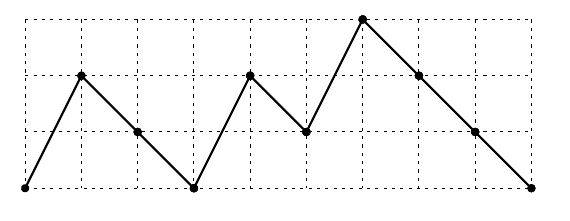
In general, Łukasiewicz paths start and end at height 0, never go below the initial height; the up steps can be arbitrarily large, but the down steps always reduce the height by 1.
The Łukasiewicz paths can encode partitions, permutations, \(n\)-ary trees, and more. We will present the encodings, which let us write the ordinary generating function of the encoded objects as a generalized continued fraction.
4:00–5:00 pm · Goldsmith 317.
Everyperson Seminar
Abstract
Abstract. How many integral solutions can there be to a polynomial equation f(x,y) = 0, if x and y are restricted to lie in a box of side length L? This type of question has many applications and is far from understood. I'll discuss some of the different approaches to this question. No background necessary!
4:00–5:00 pm · Goldsmith 317.
Fellowship of the Ring Seminar
Abstract
Abstract. It is a general question to understand how the behavior of Laplacian eigenfunctions on a manifold reflect the geometry of the geodesic flow. I'll discuss this type of question in the case of locally symmetric spaces, and in particular some cases where one can prove "quantum unique ergodicity." This was established first by Lindenstrauss in rank 1, and then in some higher rank cases by Silberman and the speaker.
2:00 pm
Everyperson Seminar
Abstract
Abstract. Hybrid systems research tries to rigorously model systems which have analog components described by ODEs (Ordinary Differential Equations), and very small digital components, often described as programs. Hybrid systems techniques are usually used in areas such as aircraft safety where errors are extremely expensive. Because hybrid systems are often used to prove safety properties, it is critical to have a rigorous analysis.
This talk describes some of the problems in using a computer to simulate a hybrid system. One of the major issues is that FP (Floating Point numbers) have none of the nice properties that the Reals (or even the Rationals) have. I will start by discussing the properties of FP, and then describe "Interval Arithmetic", a technique by which we can do calculations over FP and prove useful properties about those calculations. I will then briefly define hybrid systems, and describe the particular one I've been modeling.
Finally, I will talk about the system we've built, and how it rigorously models a hybrid system, even when the ODEs describing that system are discontinuous.
This talk is self-contained, and assumes very little background in either mathematics or computer science.
4:00–5:00 pm · Goldsmith 317.
Everyperson Seminar
Abstract
Abstract. A knot is called slice if it bounds a disk in the four dimensional ball. I will give an overview of the history of slice knots. Furthermore I will show how one can see certain objects in the four dimensional space.
4:00–5:00 pm · Goldsmith 317.
Fellowship of the Ring Seminar
Abstract
Abstract. We introduce the moduli space of pointed real curves of genus 0 and the moduli space of admissible curves as its orientation double cover. Their strata correspond to real curves of different types and may be encoded by trees with certain decorations. By using the stratification of moduli of admissible curves, we identify its homology with graph homology of trees with corresponding decoration. We determine some relations in homology analogous to the relations in the homology of the moduli of stable pointed complex curves.
2:00 pm
Everyperson Seminar
Abstract
Abstract. I will introduce lattice models of loops and related combinatorial problems, such as dimer coverings and edge-colorings of planar graphs. The bulk of the talk will be devoted to height representations, which are maps of random loop configurations to configurations of a fluctuating interface. I will use this height technology to derive some interesting physics results pertaining to classical frustrated magnets, and polymers in two dimensions.
3:45 pm · Goldsmith 317.
Everyperson Seminar
Abstract
Abstract. Evolutionary processes may be dramatically amplified or completely suppressed by the effects of spatiotemporal structure.
Given an arbitrary coloring on a weighted digraph G, define an iterative process in which the color of one vertex replaces the color of a neighboring vertex with probability proportional to some characteristic chromatic fitness. Assuming monochromatic absorbing states, the system is absorbed into a given state with probability rho(G) after characteristic time tau(G). This talk will discuss how these functions vary with G.
The applications of evolutionary graph theory to the study of theoretical anatomy will be explored. As a concrete example, the structure of epidermal tissue, and in particular the role of stem cells, will be treated.
Further topics - including cascade hypergraphs, chromatic diffusivity, spatial games, and scalefree amplifiers - will be introduced as time allows.
4:00–5:00 pm · Goldsmith 317.
Fellowship of the Ring Seminar
Abstract
Abstract. The Stark Conjectures, first formulated in a series of papers in the 1970s, postulate some deep connections between the leading terms at s=0 of the L-series of number fields and the arithmetic of corresponding extensions. These conjectures are much more precise in the case of abelian extensions, and over the years a number of generalizations and/or refinements have been made. This talk will try to explain what the abelian Stark Conjecture is (particularly in the so-called rank one case), mention how the Conjecture can be used computationally, describe the "local" conjecture of Gross, and indicate the recent unifying version of Burns.
2:00 pm
Everyperson Seminar
Abstract
Abstract. In 1979, Hofstadter introduced and briefly discussed a chaotic, recursively-defined function which he called Q:
Q(n) = Q(n-Q(n-1)) + Q(n-Q(n-2))
Over the past 25 years, a number of mathematicians have studied this function and a handful of variants of it, and though some statistical details about Q's type of chaos have been observed, no one has managed to prove a single fact about Q - not even that it -is- a function! In my talk, I'll describe a new avenue of (mostly empirical) which looks at a family of variants of Q, and which borrows some ideas from other disciplines. It turns out that this family of functions, on the collective level, exhibits an amazing degree of regularity, and yet within the framework of that family-level regularity, there are very weird irregular patterns unlike any seen before. I'll discuss what is currently known and unknown about this new family of functions, presenting the ideas mainly through a series of computer-generated graphs which display the tantalizing eccentricities that have been recently uncovered.
4:00–5:00 pm · Goldsmith 317.
Fellowship of the Ring Seminar
Abstract
Abstract. What are the possible sequences H of vector space dimensions for the first, second ...., j-th higher order partial derivatives of a degree-j homogeneous form f in a polynomial ring in r variables? Consider the family PGOR(H) of such forms f up to k*-multiple having a given sequence H=(1,r,...,r,1). Is this family an irreducible algebraic subset of the projective space paremetrizing all forms of degree j? What is its closure?
Equivalently, what are the possible Hilbert functions H for graded Artinian Gorenstein algebra in codimension r? Is the family of such algebras irreducible?
We first describe briefly the idyllic situation in three variables, consequence of the Buchsbaum-Eisenbud Pfaffian structure theorem, and work of R. Stanley, S.J. Diesel, J.O. Kleppe and many others. We then explore the case of r=4, reporting on joint work with Hema Srinivasan. The issue of characterizing H when r=4 remains open: we give an opinion.
2:00 pm
Fall 2003
20 talks
Everyperson Seminar
Abstract
Abstract. Spheres are the most symmetric compact Riemannian manifolds. A way to formulate the above statement is to consider conformal transformations. The group of conformal transformations of the sphere is non-compact, while the conformal group of any other compact Riemannian manifold is compact (Ferrand, Obata ~70). A Lorentzian manifold is a manifold modelled over the space-time (in the same manner that a Riemannian manifold is a manifold modelled over the space). We will introduce a certain Lorentzian manifold, sometimes called "the boundary of the anti-de-Sitter space", which resembles the symmetric properties of the sphere. We will discuss this resemblance from the point of view of rigidity phenomena occurring for conformal actions of Lie groups on Riemannian and Lorentzian manifolds.
4:00–5:00 pm · Goldsmith 317.
Fellowship of the Ring Seminar
Abstract
Abstract. We will discuss the following analogue of the celebrated normal subgroup theorem of Margulis: Theorem: Let \(G=G_1\times G_2\) be a locally compact group. Assume any proper quotient group of each \(G_i\) is compact. Let H < G be an irreducible lattice. Then any proper quotient of H is finite. The proof goes (like Margulis' proof) by showing that any quotient of H has both property (T) and amenability. These two parts of the proof are independent, yet there is a considerable formal similarity between them. It is this similarity that we will try to emphasize.
2:00 pm; joint with Y. Shalom
Everyperson Seminar
Abstract
Abstract. Recently, I developed a new algorithm on PFD - partial fraction decomposition of rational functions. This new algorithm is not only fast but also has theoretical applications.
Given a rational function R(x), the generalized Dedekind sum is the sum of R(a) over all nth roots of unity a (often with a = 1 excluded). Such problems arise in several areas of mathematics, such as number theory and topology.
4:00–5:00 pm · Goldsmith 317.
Fellowship of the Ring Seminar
Abstract
Abstract. Let G be a finite group. An admissible G-cover is essentially a principal G-bundle over a stable curve except that the G action need no longer be free over the marked points and nodes. A suitably pointed version of such data forms a moduli space which is responsible for G-equivariant (1+1)-dimensional topological field theories. We prove that by taking "G invariants," one obtains a (1+1)-dimensional TFT. This procedure can be promoted to a G equivariant version of a cohomological field theory, in the sense of Kontsevich-Manin. Such theories arise when considering the Chen-Ruan orbifold cohomology of a global quotient by G.
2:00 pm
Fellowship of the Ring Seminar
Abstract
Abstract. The topological symmetry group of a finite, connected graph embedded in \(S^3\) is the subgroup of the automorphism group of the graph consisting of those automorphisms which can be induced by a homeomorphism of the ambient sphere. We obtain strong restrictions on the finite groups which can arise as topological symmetry groups for some embedded graph. This is joint work with Erica Flapan, Ramin Naimi, and James Pommersheim.
2:00 pm
Everyperson Seminar
Abstract
Abstract. An Aztec diamond of order n is a planar region defined as the union of all unit squares with integer vertices whose interiors lie inside the region |x+y| <= n+1. In earlier work, Jockusch, Propp, and Shor proved a theorem describing the limiting shape of a random domino tiling of an Aztec diamond. They showed the boundary between the uniformly tiled "frozen" corners and the more unpredictable "temperate zone" in the interior of the region approximated a circle. The so-called arctic circle theorem made precise the phenomenon observed in random tilings of large Aztec diamonds.
This talk will survey results for Aztec diamonds as well as examine a related combinatorial model called groves. Groves were created by Gabriel Carrol and David Speyer as a combinatorial interpretation for Laurent polynomials given by the cube recurrence. Groves have observable frozen regions which can be described precisely via asymptotic analysis of a generating function using methods due to Pemantle. These methods should also give a new proof of the arctic circle theorem for Aztec diamonds.
4:00–5:00 pm · Goldsmith 317.
Fellowship of the Ring Seminar
Abstract
Abstract. Let p be a prime. The modular curve \(X_0(p)\) (almost) parametrizes isomorphism classes of pairs (E,C), where E is an elliptic curve and C is a subgroup of order p. In his paper, "Modular Curves and The Eisenstein Ideal", Mazur proved many results about the arithmetic of the Jacobian \(J_0(p)\) of \(X_0(p)\). For example, he proved that the torsion subgroup is generated by cusps and has order the numerator of (p-1)/12. He showed that the component group of the special fiber of \(J_0(p)\) at p is also cyclic of order (p-1)/12. Let \(X_1(p)\) be the modular curve that (almost) parametrizes isomorphism classes of pairs (E,P), where E is an elliptic curve and P is a point on E of order p. In this talk, I will talk about analogous questions about the arithmetic of the Jacobian \(J_1(p)\) of \(X_1(p)\). In particular, in this talk, I will discuss a paper, due to Edixhoven, Conrad, and myself, in which we prove that \(J_1(p)\) has trivial componenent group at p. I will also discuss explicit computations with \(J_1(p)\) and its factors, which suggest questions and conjectures about, e.g., the structure of the rational torsion subgroup of \(J_1(p)\).
2:00 pm
Everyperson Seminar
Abstract
Abstract. For those familiar with chess, a rook is the piece that moves, and attacks, along rows and columns. The number of ways to arrange \(k\) rooks on the board in such a way that they don't attack each other is called the \(k\)th Rook Number. In the case where our board is a subset of an \(n\) by \(n\) square board, the rook numbers have to do with counting permutations of \(n\) elements with some restrictions. The case where our board is a Ferrers board, a.k.a. Young diagram, the rook numbers have some really nice properties.
And now, for something completely different. Let \(\Omega\) be an algebra generated by two elements \(D\), \(U\), with a commutator relation \(DU-UD=1\). For \(\omega\in\Omega\), the Normal Ordering Problem is to find the decomposition \[\omega=\sum c_{i,j}U^iD^j,\] where in each term, all the \(U\)'s appear to the right of all the \(D\)'s. This problem comes up in quantum mechanics, with \(U\) denoting the creation operator, and \(D\) the annihilation operator. It's easier to work with an operator where the \(D\)'s act before \(U\)'s, because, I suspect, it's easier to destroy than to create.
So how does a placement of non-attacking rooks relate to normal-ordering an operator? I'll show that, if the operator can be represented as a word, then the coefficients of its normal-ordered form are exactly rook numbers on a particular Ferrers board.
4:00–5:00 pm · Goldsmith 317.
Fellowship of the Ring Seminar
Abstract
Abstract. Recent conjecture of Kontsevich-Soibelman and Gross-Wilson asserts that the Gromov-Hausdorff limit of a maximally degenerate Calabi-Yau family is a sphere with Monge-Ampere Kahler affine structure with singularities in codimension 2. I will describe some examples of such structures and state an analog of the Calabi conjecture in the affine setting.
2:00 pm
Everyperson Seminar
Abstract
Abstract. A very active area of current research is dynamics on locally homogeneous spaces. The simplest, and arguably the most important example is SLn(R) / SLn(Z), which can be identified with the space of lattices in Rn which have a fundamental domain of volume 1. I will discuss how this is related to many number theoretic questions, including Littlewood's conjecture on simultaneous Diophantine approximations.
4:00–5:00 pm · Goldsmith 317.
Fellowship of the Ring Seminar
Abstract
Abstract. To begin, we will briefly trace the development of Mahler measure over the past century and provide some unexpected identities which help to explain the current interest in this area of mathematics. We will then develop the tools needed to evaluate the Mahler measure of certain two-variable polynomials, including an introduction to the Bloch-Wigner dilogarithm function. Finally, we provide an appealing formula which gives a value for Mahler measure in terms of the shape, side lengths, and angles of an associated cyclic quadrilateral. If time permits, we will also explore the connection between Mahler measure, special values of L-functions, and the Bloch group.
2:00 pm
Everyperson Seminar
Abstract
Abstract. Let \(f=x^n+a_1x^{n-1}+\cdots+a_n\) be a monic polynomial with real coefficients. One can ask the following questions:
(1) When are all the roots of \(f\) real?
(2) How many positive (negative) real roots does \(f\) have?
We discuss methods to attack these questions. The results are all classical. The solutions to these problems are related to more general questions such as
(1) Let \(p\colon\mathbb{R}^n\to\mathbb{R}^m\) be a polynomial mapping. Describe the image of \(p\).
(2) Let \(G\) be a compact (e.g. finite) group acting linearly on a vector space. Describe the space of orbits of \(G\).
4:00–5:00 pm · Goldsmith 317.
Fellowship of the Ring Seminar
Abstract
Abstract. The talk will be on our recent work jointly with M. Brion, on a geometric construction of a "standard monomial basis" for the homogeneous co-ordinate ring associated with any ample line bundle on the generalized flag variety. This basis is compatible with Schubert varieties and opposite Schubert varieties. The construction is done using a degeneration of the diagonal.
2:00 pm
Everyperson Seminar
Abstract
Abstract. Let \(G\) be a Lie group and let \(\Gamma\) be a discrete subgroup of \(G\) such that \(X=G/\Gamma\) is compact (or more generally, has finite volume). Let \(g_t\) be a one-parameter subgroup of \(G\). The study of the action of \(g_t\) on \(X\) has a long and illustrious history. In certain cases, the action is nice and the orbits have rich geometric structure. The tools used to study orbit structures include ergodic theory, topological dynamics and the geometry of homogeneous spaces. I will start with the abelian case to motivate theory and build up towards representative low-dimensional examples. This talk will be self contained and will assume very little. In particular, it could be treated as an introduction (in retrospect) to those by Margulis, Tomanov, Weiss and Lindenstrauss.
4:00–5:00 pm · Goldsmith 317.
Fellowship of the Ring Seminar
Abstract
Abstract. If char(k)=p and g is in k[[x,y,z]], let \(e_n\) be the degree of the ideal \((x^q,y^q,z^q,g)\) where \(q=p^n\). The function \(n\mapsto e_n\) is difficult to compute. I'll discuss what happens when \(g=z^D-H(x,y)\) where H is a smooth form of degree 4. There is an elegant complete description of all these \(e_n\) that involves iteration of various rational functions (modulo a conjecture that must be true, but that still defies a complete proof). We make heavy use of ideal classes in k[[x,y]]/H and "magnification operators" acting on these ideal classes, as in Teixeira's thesis.
2:00 pm
Everyperson Seminar
Abstract
Abstract. Computing the volume of a geometric body is an ancient, basic and surprisingly difficult mathematical task. Even for a convex body in n-dimensional space (given by a membership oracle), no deterministic algorithm can approximate the volume to within a factor that is exponential in n. On the other hand, as shown by Dyer, Frieze and Kannan, using randomness, the problem can be solved in polynomial time, leading to many developments in the fields of Markov chains and geometric inequalities. The complexity of the latest algorithm for the problem grows as the 4-th power of n. The key ingredients of the algorithm are (1) a method for "morphing" one convex body into another and (2) a geometric random walk that "mixes" rapidly from any starting point. Time permitting, we will also discuss applications to optimization.
This is joint work with L. Lovasz (Microsoft Research).
4:00–5:00 pm · Goldsmith 317.
Fellowship of the Ring Seminar
Abstract
Abstract. The character group of the maximal subtorus of the Jacobian of a modular curve at a prime of semistable reduction has been a useful tool for the study of classical modular forms. We present an interpretation of this character group in terms of vanishing cycles that generalizes to the higher-dimensional Hilbert modular varieties. Moreover, we show how the Jacquet-Langlands correspondence can be understood as a relationship between the character groups for a Hilbert modular variety and a corresponding Shimura curve.
2:00 pm
Fellowship of the Ring Seminar
Abstract
Abstract. A few years ago Breuil conjectured a complete classification of mod-p reduction types of 2-dimensional p-adic crystalline representations of \(\operatorname{Gal}(\overline{Q}_p/Q_p)\) with Hodge-Tate weights 0 and k where k < 2p+1. This naturally requires a satisfactory theory about the "integral models" (over \(Z_p\)) of such Galois representations, which exists previously only for k < p by the Fontaine-Laffaille theory. A general theory (without restriction on weight) is important in the study of Galois deformation. In this talk, I will introduce our objects of study, describe our approach of Galois deformation via explicitly constructing families of etale (phi,Gamma)-modules, then I will discuss applications of our results in partially solving Breuil's conjecture and some further questions. This is a joint work with Berger and Li.
2:00 pm
Everyperson Seminar
Abstract
Abstract. In the early 1980s, Feynman suggested that quantum systems might be able to do certain computations more efficiently than classical computers. This led to the development by Deutsch and others of a new model of computing - quantum computing. Shor's discovery in 1994 of a polynomial time quantum algorithm for factoring ignited the subject that subsequently expanded in many directions.
In this talk I will first give a brief introduction to quantum computing from a geometric perspective. I will then show how a solution method for geometric optimization problems can be used to construct quantum algorithms that solve new problems more efficiently than is possible classically.
The work presented during the second half of the talk is joint work with David Meyer, Jihun Park, Jamie Pommersheim and Mitch Rothstein.
4:00–5:00 pm · Goldsmith 317.
Fellowship of the Ring Seminar
Abstract
Abstract. The Hilbert series of the graded ring associated to a projective variety contains a lot of information about the variety, e.g., dimension, degree, arithmetic genus etc. If the variety is nice then the Hilbert series can be uniquely written in the form \(h(t)=f(t)/(1-t)^n\), where f(t) is a polynomial with non-negative integer coefficients and f(1) is not equal to zero. In this talk I will consider the Hilbert series of determinantal varieties (including symmetric and skew-symmetric determinantal varieties). These varieties arise naturally in many branches of mathematics, e.g., in classical invariant theory. I will give a formula for the coefficients of the numerator f(t) of the Hilbert series as dimensions of representations of certain compact Lie groups. The work presented is joint work with Thomas Enright.
2:00 pm
Spring 2003
23 talks
Everyperson Seminar
Abstract
Abstract. Feynman diagrams is a combinatorial formalism which plays a vital role in quantum field theory. It stems from the attempt to write explicitly the stationary phase asymptotic expansion of rapidly oscillating integrals. While the existence of this expansion is well known to many mathematicians, the explicit formula for it, while being basic to every quantum physicist, is much less widely known in the mathematical community and can rarely be found in mathematical texts. Nevertheless it is completely elementary and also very useful. I will explain what this formula is, what it has to do with physics, and how it can be used in mathematics.
Prerequisites: Calculus 3, linear algebra with tensors.
4:00–5:00 pm · Goldsmith 317.
Fellowship of the Ring Seminar
Abstract
Abstract. The Cherednik algebra was introduced by Cherednik 10 years ago to prove the famous Macdonald conjectures about multivariable orthogonal polynomials. Since then it was realized that it is itself a very important algebraic object, which is intimately related to many parts of representation theory. I will define the (rational) Cherednik algebra, and describe its finite dimensional representations.
2:00 pm
Everyperson Seminar
Abstract
Abstract. Many physical systems which evolve in time often preserve a natural volume on the state space. After Birkhoff's proof of the ergodic theorem it became important not only to give examples of ergodic transformations, but also to show that (paraphrasing Birkhoff) they were "typical". While they were Junior Fellows at Harvard in the 1930's, J.C. Oxtoby and S.M. Ulam worked on this conjecture of G.D. Birkhoff that ergodicity is the "general case" for volume preserving homeomorphisms of the cube (or a compact manifold).
In this talk I will survey their work and later developments extending the result of Oxtoby and Ulam in different directions. I hope to describe a simple self contained proof of their result from basic principles. No knowledge of ergodic theory will be presumed.
4:00–5:00 pm · Goldsmith 317.
Fellowship of the Ring Seminar
Abstract
Abstract. Recent work on representation dimension has given new impetus to an old unsolved problem known as the Finitistic Dimension Conjecture. We know that the Finitistic Dimension Conjecture is true for all algebras of representation dimension at most three (Igusa-Todorov). Representation dimension, introduced by M. Auslander, is always finite (Iyama) and for many classes of algebras is now known to be at most three. No algebra is known to have representation dimension larger than three.
2:00 pm
Everyperson Seminar
Abstract
Abstract. Context semantics is a computer-science analogue of Girard's geometry of interaction, which was designed to give a denotational meaning to proofs in linear logic. Its interest to computer scientists, among its other virtues, is that it gives a sequential meaning to functional programming languages with higher-order types.
I'll explain how this denotational semantics models lambda calculus and PCF, which are both simple, mathematically idealized versions of Lisp. In particular, I'll discuss readback, where the normal form (fully evaluated structure) of a program can be recovered from its semantics. This analysis can be used to prove the correctness of optimal evaluation algorithms which maximize the sharing of computations.
If you have seen Lisp or a functional programming language, you'll know what I'm talking about. My presentation doesn't have a lot of theorems, but it does have a lot of nice looking pictures.
4:00–5:00 pm · Goldsmith 317.
Fellowship of the Ring Seminar
Abstract
Abstract. I will discuss some results due to Joe Harris, Mike Roth and myself about the birational geometry of spaces of rational curves on Fano hypersurfaces: reducibility/irreducibility, dimensions, types of singularities and Kodaira dimensions. I will explain the relation of these results to the open question of which Fano hypersurfaces are unirational, and, time permitting, to a conjecture of de Jong and myself generalizing Lang's theorem that a function field of transcendence degree 2 is a "\(C_2\) field".
2:00 pm
Everyperson Seminar
Abstract
Abstract. We will consider several high-school and freshmen problems in noncommutative mathematics based on a notion of quasideterminant introduced by I. Gelfand and V. Retakh twelve years ago.
4:00–5:00 pm · Goldsmith 317.
Fellowship of the Ring Seminar
Abstract
Abstract. The quadratic algebra \(Q_n\) of pseudo-roots of noncommutative polynomials introduced by I. Gelfand, R. Wilson and the speaker has a rich and interesting combinatorial structure. In particular, it gives a new characterization of the algebra of noncommutative symmetric functions. In the talk I am going to discuss some solved and unsolved problems of the algebra \(Q_n\).
2:00 pm
Everyperson Seminar
Abstract
Abstract. Throughout the history of physics and mathematics, there are many occasions when progress in one subject is motivated by the developments in the other. Starting with a brief review of the history of this phenomenon, I will focus on some recent developments, which include the study of special holonomy manifolds (such as Calabi-Yau and G2 manifolds) and their geometric structures, motivated by the ideas in string theory. As an example, I will discuss coassociative fibrations and mirror symmetry for G2 manifolds, studied in a joint work with S.T.Yau and E.Zaslow.
4:00–5:00 pm · Goldsmith 317.
Fellowship of the Ring Seminar
Abstract
Abstract. Hypergeometric systems are a very interesting class of systems of PDEs that can be studied using combinatorial (commutative) algebra. There are many open problems in this area, and the one I will discuss concerns the dimension of the solution space (the "holonomic rank") of such a system. All the available evidence points at a very strong connection between rank fluctuations and the local cohomology of the underlying toric ring. The precise relationship is a joint conjecture with Ezra Miller. The talk will be self contained: I will assume no hypergeometric or toric background, and among other things, I will show how to combinatorially compute the local cohomology of a toric (or semigroup) ring.
2:00 pm
Everyperson Seminar
Abstract
Abstract. A puzzling discovery of the theory of integrable systems is that the motion of the poles of meromorphic solutions to soliton equations (PDE such as the Korteweg-deVries equation) is often governed by integrable many-body systems (ODE such as the Calogero-Moser system). I will present an explanation of this phenomenon (joint work with T. Nevins) using (noncommutative) algebraic geometry. We study the space of "configurations of points on the quantum plane" and other spaces of noncommutative vector bundles as a natural bridge between solitons and particles. Namely, the soliton equations are realized as flows on these configurations, and a geometric Fourier transform converts the flows into the linear flows along tori (Jacobians of spectral curves) which give the "integration" of the many-body system.
4:00–5:00 pm · Goldsmith 317.
Fellowship of the Ring Seminar
Abstract
Abstract. The purpose of this talk is to give an elementary overview of Barbasch's classification of the spherical unitary dual for split classical groups (over a real or p-adic field). The answer can be organized in terms of a remarkably simple kind of functoriality and, at least formally, suggests nonobvious relationships between the spherical unitary duals of different Lie groups. I'll state at least one such relationship carefully. (It can be interpreted as a generalized representation-theoretic Shimura correspondence.) Virtually all of the results discussed here are due to Barbasch; the new ones are joint with him, as well as with Adams and Vogan.
2:00 pm
Everyperson Seminar
Abstract
Abstract. We model antiphase boundaries with a phenomenological free energy with a cusp singularity. There is still a unique way to define equations of motion of the order parameters using the canonical restriction of the subgradient of the free energy functional. We discuss consequences of this theory for the dynamics of grain boundaries in a polycrystal.
4:00–5:00 pm · Goldsmith 317.
Fellowship of the Ring Seminar
Abstract
Abstract. Cluster algebras were introduced a few years ago in a joint work with Sergey Fomin. They are a new class of commutative rings designed to provide an algebraic framework for the study of canonical bases and total positivity in semisimple Lie groups. Every cluster algebra has a distinguished family of generators called cluster variables. The main structural result of the theory obtained so far is a complete classification of cluster algebras of finite type, i.e., those having finitely many cluster variables. We find it quite striking that this classification turns out to be one more instance of the famous Cartan-Killing classification. I will discuss this classification result and main ideas of its proof.
2:00 pm
Fellowship of the Ring Seminar
Everyperson Seminar
Abstract
Abstract. In a multiplicative group G, we can state the Discrete Logarithm Problem (DLP) as follows: If b is in G, and y is in the subgroup generated by b, find any x in Z such that y = bx. Until 1985, cryptographic uses of the DLP were limited to the multiplicative groups of finite fields. Then V. Miller and N. Koblitz independently suggested that a finite subgroup of the points on an elliptic curve E over a finite field could also be used. From these suggestions, cryptosystems have been constructed using the integer multiplication maps on E. In collaboration with F. Diamond, I investigate the construction of generalized cryptosystems using the entire endomorphism ring when End(E) =Z[f], where f is the p-th power Frobenius map.
4:00–5:00 pm · Goldsmith 317.
Fellowship of the Ring Seminar
Abstract
Abstract. We present a formula for products of Schubert classes in the quantum cohomology ring of the Grassmannian. It is given in terms of a generalization of Schur symmetric polynomials for shapes that are naturally embedded in a torus. The construction implies symmetries of the Gromov-Witten invariants (the structure constants of the quantum cohomology) with respect to the action of \(S_3\), \((Z/nZ)^2\), and \(S_2\). The last symmetry is a certain "strange duality" of the GW-invariants that inverts the quantum parameter q. We solve a problem posed by Fulton and Woodward about characterization of the powers of q that occur with nonzero coefficients in the quantum product of two Schubert classes.
2:00 pm
Everyperson Seminar
Fellowship of the Ring Seminar
Abstract
Abstract. This talk will be dedicated to some computational aspects of Hilbert modular forms. I will present an algorithm which can be used to compute such forms on \(Q(\sqrt{5})\). This algorithm is a nice application of the Jacquet-Langlands correspondence. I will then present some of the geometric objects that correspond to some of the forms we compute.
2:00 pm
Everyperson Seminar
Abstract
Abstract. a lot is known about the way almost all points of Rn (with respect to Lebesgue measure) are approximated by rational points. Recently, a lot has become known about number-theoretic properties of generic points with respect to volume measures on smooth submanifolds of Rn. VERY recently, it was understood that similar properties can be established for measures satisfying certain geometric conditions - friendly measures. Besides smooth measures, examples include fractal measures on objects such as Koch's Snowflake or Sierpinski's Carpet.
I will define the `friendliness' axioms, discuss various examples, including the fractal ones, and explain why it is good to be friendly. The results (PDF) are joint with Elon Lindenstrauss and Barak Weiss.
Everyperson Seminar
Abstract
Abstract. Starting from a semisimple finite dimensional Lie algebra, we will consider its quantum deformation with the special value of the deformation parameter. The finite dimensional representation theory changes significantly in this case and becomes richer. In particular, the fusion category, which has been routinely used in mathematics and math physics, is only the "top of the iceberg" of the bigger non-semisimple category of representations over the quantum group. Using simple examples, we will look at what lies beyond.
4:00–5:00 pm · Goldsmith 317.
Fellowship of the Ring Seminar
Abstract
Abstract. The small quantum group Uf was introduced by Lusztig as a certain finite dimensional Hopf algebra associated to a semisimple complex Lie algebra Lg and a primitive l-th root of unity q in C. According to Lyubashenko and Majid, in many cases Uf admits a bijective action of two operators obeying the modular identities. This action stabilizes the center Z of Uf, and can be used to study its structure. We will start from the obvious subalgebra in Z, which arises from the Grothendieck ring of the category of finite dimensional Uf-modules, and construct the smallest modular-invariant subspace in Z that contains it.
Only part of the original abstract was recovered.
2:00 pm
Everyperson Seminar
Abstract
Abstract. Random matrix models have a wide range of applications in both physics and mathematics. They can be viewed as a simplified version of quantum field theories and as such can be analysed using the tools of quantum field theory. In this talk we discuss some simple aspects of random matrix models from a quantum field theoretic perspective.
4:00–5:00 pm · Goldsmith 317.
Fall 2002
21 talks
Everyperson Seminar
Abstract
Abstract. Recent work arising from ideas in algebraic geometry and symplectic geometry has given rise to new ideas in a classical area of mathematics: the problem of counting lattice points in convex polytopes, and the related problem of finding analogs in higher dimensions to the classical Euler-MacLaurin formula. We review the work of Cappell and Shaneson, Kantor-Khovanskii, Guillemin, and Brion-Vergne, and provide an elementary proof of their results. If time permits, we will discuss the analytical issues arising in the Euler-MacLaurin formula.
4:00–5:00 pm · Goldsmith 317.
Everyperson Seminar
Abstract
Abstract. I will consider a class of integrals involving exponentials of rational functions. I will show that some of these integrals can be computed explicitly in terms of elementary functions. The cases when such explicit calculation is possible follow the pattern implied by the identities satisfied by the Gamma-function.
4:00–5:00 pm · Goldsmith 317.
Fellowship of the Ring Seminar
Everyperson Seminar
Abstract
Abstract. In dimension 4, the physics of bosons and fermions are distinguished by their spins. In mathematical terms, their particle states form very different representations of the rotation group SO(3). In dimension 2, there is no notion of spin. As a result, bosons and fermions are sometimes indistinguishable. I will explain one classic example, discovered by string theorists in the 80s, and show how it is related to an interesting property of the Jacobi theta function. Required background for this talk is linear algebra and one complex variable.
4:00–5:00 pm · Goldsmith 317.
Fellowship of the Ring Seminar
Abstract
Abstract. This is an attempt to parametrize representations of a reductive p-adic group in terms of geometric and arithmetic data attached to conjugacy classes in a dual group. I will discuss a very simple case, where the representations are easy to construct, and only the parametrization is interesting. Even here, we find it essential to consider representations of several related groups (inner forms) at once, but the representations are tied together by certain numerical invariants (formal degrees).
2:00 pm
Everyperson Seminar
Abstract
Abstract. We begin by recalling the classical theory of elliptic integrals for the periods of an elliptic curve. Within this classical setting we describe how algebraic variation of elliptic curves in a family defines the period mapping, the corresponding Picard-Fuchs differential equation, and the "mirror map". By applying the theory of monodromy-preserving (isomonodromic) variation of Fuchsian ordinary differential equations to these Picard-Fuchs equations, we obtain from certain families of elliptic surfaces algebraic solutions to Painleve VI equations, Garnier systems, and their generalizations, which in turn describe the algebraic variation of the mirror map.
4:00–5:00 pm · Goldsmith 317.
Fellowship of the Ring Seminar
Abstract
Abstract. Moriwaki's line bundle is a line bundle on the Deligne-Mumford moduli space of stable genus g curves, which has non-negative degree on almost all complete curves. In this talk, I will explain how Moriwaki's result follows naturally when one studies the metrized line bundle over this moduli space one constructs to compute the (archimedean) height of the algebraic cycle \(C-C^{-}\) in the jacobian of the curve C. I will also explain the analogue of this inequality for the moduli space of pointed stable curves, which arises when one studies the height of the degree 0 cycle \((2g-2)x-K_C\) in the curve C. The coefficients that appear in both inequalities are, in some sense, "structure constants" of mapping class groups.
2:00 pm
Fellowship of the Ring Seminar
Abstract
Abstract. We will discuss joint work with R. Lazarsfeld, M. Mustata and T. Yasuda on jet schemes and singularities of pairs. We describe how to compute some of the invariants of singularities using jet schemes. As an application, we are able to give a proof for the inversion of adjunction conjecture, when the ambient space is smooth.
2:00 pm
Everyperson Seminar
Abstract
Abstract. Although there is no concrete evidence of existence of black holes, some elegant mathematical models are available. It is a very famous property of black holes that even light cannot escape from their strong gravitational force. In this talk I will give a general relativistic model for non-rotational, spherically symmetric zero-charged bodies, and then for black holes, and will show, in mathematical terms, that light cannot escape.
Fundamental knowledge of Riemannian and semi-Riemannian geometry is enough for this talk.
4:00–5:00 pm · Goldsmith 317.
Fellowship of the Ring Seminar
Everyperson Seminar
Abstract
Abstract. I will define supersymmetry and its manifestation in certain second-order differential equations that appear in physics, namely the `Schrodinger equation' for certain quantum mechanics problems.
4:00–5:00 pm · Goldsmith 317.
Fellowship of the Ring Seminar
Everyperson Seminar
Abstract
Abstract. Growth is a purely combinatorial invariant that can be defined for any algebraic structure with generators and relations. It appears simple; however, it has emerged as a powerful tool in the study of groups and noncommutative algebras. In this talk, I will define growth, review classification results in group theory and noncommutative algebra that are obtained with the use of growth theory, and describe several applications.
4:00–5:00 pm · Goldsmith 317.
Everyperson Seminar
Abstract
Abstract. Suppose you were going to have a yard sale, and you wished to publish directions. Typically, you would select a major street or landmark and publish directions from all points to the landmark, and then careful directions from the landmark to your location. It turns out that this paradigm is also behind many of the best compact routing schemes, where the "directions" or routing information, are stored locally at each vertex: in the analogy above, this is equivalent to the person having only a short address, and learning directions to his destination from looking at small signs posted at each street corner. We will present our recent compact routing results, and how they relate to the graph-theoretic notion of spanners. If time permits, we will present our newest results in the name-independent model.
4:00–5:00 pm · Goldsmith 317.
Fellowship of the Ring Seminar
Abstract
Abstract. Early this century, Ramanujan observed that coefficients of the Delta function \(\Delta(\tau)=q\prod_{n=1}^{\infty}(1-q^n)^{24}\) satisfy certain congruences. Ramanujan also found congruences satisfied by coefficients of the modular function j. Although Ramanujan's congruences for Delta were "explained" by Serre and Swinnerton-Dyer using Deligne's theory, it took Katz's construction of p-adic modular forms to provide a good theoretical basis for congruences for j. In this talk, I will explain some of the history of p-adic modular forms, how explicit computations can really be carried out, and some recent results and conjectures that have implications for classical modular forms.
2:00 pm
Everyperson Seminar
Abstract
Abstract. The cohomology ring of the Grassmannian X=G(k,n) has been studied for well over 100 years, but the last decade has seen surprising new twists to the story. I will explain the beautiful puzzle rule of Knutson-Tao-Woodward for the triple intersection numbers on X, and an extension of this rule that conjecturally computes all 3-point, genus 0 Gromov-Witten invariants on X. These numbers are the structure constants of the quantum cohomology ring of X. Only linear algebra is required to follow this talk.
4:00–5:00 pm · Goldsmith 317.
Fellowship of the Ring Seminar
Abstract
Abstract. I shall describe the notion of a slightly ramified extension of local rings, and use this to prove a criterion for the smoothness of deformation spaces (or local moduli spaces) in mixed characteristic in terms of lifting the tangent space of the problem. From one point of view, this generalizes Cartier's proof that group schemes are smooth in characteristic zero. In consequence, the deformation spaces of certain Calabi-Yau varieties are smooth in mixed characteristic.
2:00 pm
Everyperson Seminar
Fellowship of the Ring Seminar
Abstract
Abstract. The nth iterate of the map \((x,y)\mapsto (y,(y^2+1)/x)\) is of the form \((x,y)\mapsto(f(x,y),g(x,y))\), where the rational functions f and g turn out to belong to the ring Z[x,1/x,y,1/y] of Laurent polynomials. This is just one example of a very widespread phenomenon that governs iteration of many multivariate rational maps. I'll talk about how combinatorial models can help one understand specific instances of this "Laurent phenomenon"; e.g., for the specific mapping described above, the relevant combinatorial model is the dimer model on a 2-by-n grid. Such models can yield positivity theorems that seem hard to prove by purely algebraic means.
2:00 pm
Everyperson Seminar
Abstract
Abstract. We will give an elementary introduction into the the notion of stability in abelian categories. Examples include the categories of vector bundles and quiver representations. We'll try to explain why stability plays an important role in algebraic geometry, representation theory, and now in string theory.
4:00–5:00 pm · Goldsmith 317.
Fellowship of the Ring Seminar
Abstract
Abstract. We construct Nakajima's quiver varieties of type A in terms of Beilinson-Drinfeld Grassmannians of type A. This gives a compactification of quiver varieties and a decomposition of affine Grassmannians into a disjoint union of quiver varieties. The construction provides a geometric framework for skew (GL(m),GL(n)) duality and identifies the natural basis of weight spaces in Nakajima's construction with the natural basis of multiplicity spaces in tensor products which arises from affine Grassmannians. This is joint work with I. Mirkovic.
2:00 pm
Spring 2002
19 talks
Everyperson Seminar
Fellowship of the Ring Seminar
Abstract
Abstract. We motivate the theory of descent on elliptic curves: descent was originally created to measure the solutions to diophantine equations (specifically those that cut out elliptic curves) but has evolved more recently into a way of measuring the failure of a local-to-global principle for elliptic curves known as the Tate-Shavarevich group. We write down explicit models for genus one curves that are required to perform descent in the special case that the elliptic curve has full level structure.
2:00 pm
Fellowship of the Ring Seminar
Abstract
Abstract. The orbit space of stable weighted configurations of n points in \(CP^1\) forms a non-singular algebraic variety \(C_n(m)\). In a similar way we define \(D_n(m)\), the categorical quotient of the space of semi-stable configurations with respect to the action of \(\mathrm{PSL}_2(C)\).
If \(m=(m_1,\ldots,m_n)\) is an n-tuple of weights (positive real numbers) associated to the n points, it is known that \(D_n(m)\) is birationally equivalent to \(M_n\), the variety of space polygons in Euclidean space \(R^3\). I will talk about a method to calculate the cohomology ring of \(M_n\) (or \(D_n(m)\)) and an ampleness criterion to determine which of these spaces are Fano.
2:00 pm
Everyperson Seminar
Abstract
Abstract. Dan Graboi and John Lisman (Brandeis Biology) describe a computational model of how the human vision system recognizes words. Their experiments found that a greedy algorithm worked best.
I'll discuss their model and show that the greedy algorithm is not optimal, but that the problem as posed is NP-complete, so that an optimal strategy is (almost certainly) not feasible. On the other hand, the problem is approximable by the very algorithm they suggest, and any better approximation can be proved to be NP-hard.
4:00–5:00 pm · Goldsmith 317.
Fellowship of the Ring Seminar
Fellowship of the Ring Seminar
Everyperson Seminar
Abstract
Abstract. If K is a compact subset of the real numbers R, then a theorem of Weierstrass says that every continuous function f : K -> R is a uniform limit of polynomials. But which functions are limits of polynomials with integral coefficients? For example, if 0 is in K, then f(0) must be an integer. We will see that the general answer depends on arithmetical and geometric properties of K.
4:00–5:00 pm · Goldsmith 317.
Fellowship of the Ring Seminar
Abstract
Abstract. Inspired by Deninger's work, David Boyd found many experimental relations between the Mahler measure of certain two variable polynomials and the zeta function of an associated number field at s=2. I will describe how these identities can be proved and the role played by the underlying hyperbolic geometry.
2:00 pm
Everyperson Seminar
Abstract
Abstract. Connectionism is a subfield of artificial intelligence (AI) that seeks to model language, reasoning, and other intelligent behavior using networks of simple processors inspired by the nervous system. This approach, also called neural networks, has met with much success for a limited set of domains, but has been successfully criticized as inadequate to the task of representing structured information like natural language sentences and logical propositions. In this talk I give an overview and history of the problem, and describe a candidate neural net solution. This solution, called Infinite RAAM, treats the neural network as a chaotic dynamical system, giving us new insights into the possible way that minds and brains might work.
The talk is geared toward people completely unfamiliar with the material, so it should be fun for the Everyperson audience, including undergraduates.
4:00–5:00 pm · Goldsmith 317.
Fellowship of the Ring Seminar
Abstract
Abstract. Let C be a curve over a number field with Jacobian J=Jac(C). We recall the definition of the Neron-Tate height of algebraic cycles on J and compute this height for special cycles on J in the case of good reduction. We explain the obstructions in the case of bad reduction and give some partial results.
2:00 pm
Everyperson Seminar
Abstract
Abstract. In this talk I'll introduce some apparently simple questions about polynomials and power series for which no answer is known. However, when the coefficients of the polynomials or power series are in a finite field, the questions lead to mysterious real-valued functions, and there is computer evidence that these functions have self-similarity properties that completely characterize them. In some cases this can actually be proven. Much of this is joint work with Teixeira.
4:00–5:00 pm · Goldsmith 317.
Everyperson Seminar
Abstract
Abstract. Question: How many integer sequences of length n are there which always increase but never more than double?
These numbers grow very quickly -- for n=20 there are 989,901,541,366,810,465,070,950,556,260,422,637,919,176 of them. Counting them in the obvious way would take time exponential in n. I'll share a clever observation (of mine) to calculate the answer in time polynomial in n, and another clever observation (of Donald Knuth's) to estimate the asymptotics.
4:00–5:00 pm · Goldsmith 317.
Everyperson Seminar
Everyperson Seminar
Abstract
Abstract. What is the "best" (i.e., quickest) way to rotate 3D objects on a computer screen? Since rotation (together with translation, which is trivial) is the basis for 3D animation, this problem is crucial for the efficient implementation of many 3D computer graphic rendering algorithms. Yet, despite its apparent simplicity of statement, this turns out to be a surprisingly complex and interesting problem, not only for practical computer science, but also in numerical analysis and pure mathematics.
There are many ways to represent rotations---three by three orthogonal matrices, elements of SU(2) (i.e., 2 by 2 unitary matrices of determinant 1), unit quaternions, spinors, Euler angles, elements of projective three space---and we shall discuss each of them (and introduce a new one!). There has been a lot of debate in recent years about the relative merits of each---but of course our new one is the best :-). In fact what we shall see is that the best representation of a rotation and the best way to rotate an object are closely related questions, and both of them are highly dependent on the way that the data that defines the rotation is presented, and on the nature of the object that is to be rotated.
4:00–5:00 pm · Goldsmith 317.
Fellowship of the Ring Seminar
Abstract
Abstract. I will introduce the notion of Mukai regularity for coherent sheaves on abelian varieties, defined via conditions on the supports of the cohomologies of Fourier-Mukai transform complexes. In a very special form, depending on the choice of a polarization, this resembles and in fact strenghtens the classical notion of Castelnuovo-Mumford regularity. The techniques are in part a generalization of an approach of Mumford-Kempf-Lazarsfeld made possible by the use of Mukai's theory.
I will then explain how this can be applied to a variety of questions related to abelian varieties and more general irregular varieties, ranging from the appearance of new interesting invariants for line bundles, to effective results on linear series and defining equations, and to a study of special classes of vector bundles.
2:00 pm
Everyperson Seminar
Abstract
Abstract. The mathematical discipline of dynamical systems has given science the tools to describe and understand complicated long-term behavior. This talk will give a description and examples of some of these notions in increasing order of complexity. For the novice this will provide an introduction to a hot subject in mathematics and science. For those familiar with the subject this will serve as a suggestion how a course in dynamical systems can be taught, as well as a preview and outline of a text on dynamics by Hasselblatt and Katok that will appear this summer (Dynamics: A first course with a panorama of recent developments, Cambridge University Press).
4:00–5:00 pm · Goldsmith 317.
Fellowship of the Ring Seminar
Everyperson Seminar
Abstract
Abstract. Sets of partially defined elements equipped with Scott topology are widely used in formal semantics of programming languages and in the theory of mathematical computations. I'll overview some advances in analysis on Scott domains (in particular, in the theory of generalized distances and measure theory for these spaces) and in theory of their logical representation. I'll indicate several open problems in this field.
4:00–5:00 pm · Goldsmith 317.
Fellowship of the Ring Seminar
Abstract
Abstract. There are theories, due independently to myself and Stevens on one hand, and Hida on the other, of nontrivial p-adic families of Hecke eigenclasses in the cohomology of a congruence subgroup of GL(n,Z) with twisted coefficients. When n = 2, every ordinary cuspidal eigenclass (equivalently: every ordinary modular newform) can be fitted into such a family. For larger n, this is not necessarily the case. I will discuss especially what happens for n = 3.
2:00 pm
Fall 2001
17 talks
Everyperson Seminar
Fellowship of the Ring Seminar
Abstract
Abstract. We describe the multiplicative structure of the (small) quantum cohomology ring of the Grassmannians parametrizing maximal isotropic subspaces of a vector space equipped with an orthogonal or symplectic form. No prior knowledge of quantum cohomology or Gromov-Witten invariants will be assumed. This is joint work with Andrew Kresch.
2:00 pm
Everyperson Seminar
Fellowship of the Ring Seminar
Abstract
Abstract. I will introduce the main objects that play a part in p-adic Hodge theory, and apply that to an example (Tate's elliptic curve): I will construct the "p-adic periods" of such a curve. Then, I will discuss the so-called "Fontaine monodromy conjecture" (which is now a theorem); this is related to Kiran Kedlaya's talk of Oct. 15th.
2:00 pm
Everyperson Seminar
Fellowship of the Ring Seminar
Fellowship of the Ring Seminar
Abstract
Abstract. Classical and modern representation theory makes use of a host of elegant combinatorial tools. One of the oldest and easiest to appreciate is a construction of the representations of SL(n) based on Young diagrams. In its full generality, "Schur-Weyl duality" is a powerful technique, but this original case is concrete and readily accessible. The same approach applied to the group of symplectic or orthogonal matrices is no harder to describe, but it holds a few surprises even for experts, including one recent and unexplained link to quantum groups.
2:00 pm
Everyperson Seminar
Abstract
Abstract. you are going to witness an everyperson-seminar-type one-hour-long remake of a real 20 minute long talk given at the special session on "Number Theory, Holomorphic Dynamics, and Algebraic Dynamics" at a recent AMS meeting. The audience will be invited to imagine themselves squeezed inside a plane in a three dimensional space, or more generally, inside a proper affine subspace of a Euclidean space, and study approximation properties of generic points thereof. No background will be assumed and the talk should be accessible to everyone.
4:00–5:00 pm · Goldsmith 317.
Fellowship of the Ring Seminar
Everyperson Seminar
Fellowship of the Ring Seminar
Abstract
Abstract. The (small) quantum cohomology ring of a Grassmann variety encodes the enumerative geometry of rational curves in this variety. By using degeneracy loci formulas on quot schemes, Bertram has proved quantum Pieri and Giambelli formulas which give a complete description of the quantum cohomology ring. In this talk I will present elementary new proofs of these results which rely only on the definition of Gromov-Witten invariants and standard facts about cohomology of Grassmannians.
2:00 pm
Fellowship of the Ring Seminar
Abstract
Abstract. There is a canonical representation of the absolute Galois group of the rational numbers in the outer automorphism group of the fundamental group of the projective line minus three points. Ihara has associated to this a certain graded Lie algebra over the p-adic integers. Deligne has conjectured that, when tensored with the p-adic rationals, this Galois Lie algebra becomes free on one generator in each odd degree starting with 3. I will describe what is known or expected regarding the structure of the Galois Lie algebra itself.
2:00 pm
Everyperson Seminar
Abstract
Abstract. Given a finite sequence, such as 1 4 2 5 3 8 6, deleting any of the entries leaves a subsequence, for example, 1 2 5 8. This subsequence is increasing, and it is in fact a longest increasing subsequence of the original sequence (though it is not the only longest increasing subsequence). The problem of finding the longest increasing subsequence of a sequence is interesing algorithmically, and has surprisingly deep mathematical ramifications. The most straightforward approach to the problem is through dynamic programming, but a modification discovered by Craige Schensted (and later rediscovered by Edsger Dijkstra) is slightly more efficient and has many remarkable properties. Algorithmically, it also solves the problem of finding the largest union of k increasing subsequences, and mathematically it has numerous applications, notably in enumerative combinatorics and in representation theory.
This will be a very basic talk, and should be comprehensible to undergraduates in both mathematics and in computer science.
4:00–5:00 pm · Goldsmith 317.
Fellowship of the Ring Seminar
Fellowship of the Ring Seminar
Abstract
Abstract. Using a path description, we can determine a minimal set of generators for the centralizer of the action of a compact Lie group on tensor powers of a minuscule representation. For spinor representations and vector representations of classical type (except \(D_N\)), they already appear in the second tensor power. For the vector representation of \(D_N\) resp minuscule representations of \(E_N\), N=6,7, an additional generator in the N-th (resp (N-1)-st) tensor power is needed.
2:00 pm
Everyperson Seminar
Abstract
Abstract. We present a short and thus somewhat biased survey of the subject. We start with the Cayley graphs and their expansion properties. Then switch to the product replacement graphs, their connectivity properties, and how they give new constructions of expanders.
4:00–5:00 pm · Goldsmith 317.
Fellowship of the Ring Seminar
Spring 2001
1 talk
Fellowship of the Ring Seminar
Spring 1993
1 talk
Fellowship of the Ring Seminar
1993 (semester unknown)
1 talk
Fellowship of the Ring Seminar
Coverage and source notes
There are 220 Everytopic historical listings: 215 have a recovered title, and 218 have a complete calendar date. Month-only and year-only dates retain their original precision. The Fall 2026 schedule contains seven named speakers and five unassigned slots; none is included in the historical total. The January 29 and March 11, 2024 cancellations are also excluded.
No individual historical records were recovered for Fall 2016, Spring 2017, Spring or Fall 2021, Spring 2022, Spring 2023, Fall 2025, or Spring 2026. Several other semesters are only partially recovered. These gaps do not imply that no seminars took place.
The earliest recovered Everytopic semester is Fall 2006. Entries titled “Spring 2006” on one legacy page belong to Spring 2007; a legacy Fall 2011 page also has an incorrect year in its heading. Title wording follows the sources, with corrections from contemporary department announcements where available.
The predecessor archive contains 196 listings, with 169 complete abstracts and 1 partial abstract. No original abstract was recovered for 26 listings. The official semester pages cover Fall 2001 through Spring 2006. Three earlier Fellowship reports are documented in speakers’ CVs: May 2001, February 1993, and 1993 without a recorded semester. These are the earliest individual records recovered here, not the founding dates of the seminars. Dates without a recorded day or semester retain that precision. No-meeting slots and general student events are excluded from the talk count. Damaged source text is not reconstructed by guesswork.
Sources include organizers’ semester pages, individual talk posters, speakers’ public CVs, university event listings, Internet Archive snapshots, and department seminar announcements. Public sources are linked; department announcements are identified by date. Original abstracts are included for 211 Everytopic listings; nine have no recovered abstract. Original wording is retained, with mathematical typography and document formatting restored. A historical listing does not independently confirm that a talk took place. Page structure follows the current Everytopic seminar page.